Munich's Freight-Train Crash Turned a Rail-Yard Failure Into a Street-Level Trust Test
Two wagons plunged from a Munich bridge after a June 20, 2026 freight-train collision during shunting. The immediate tragedy matters, but the harder question is how quickly rail operators can explain why a yard failure spilled into a public street.
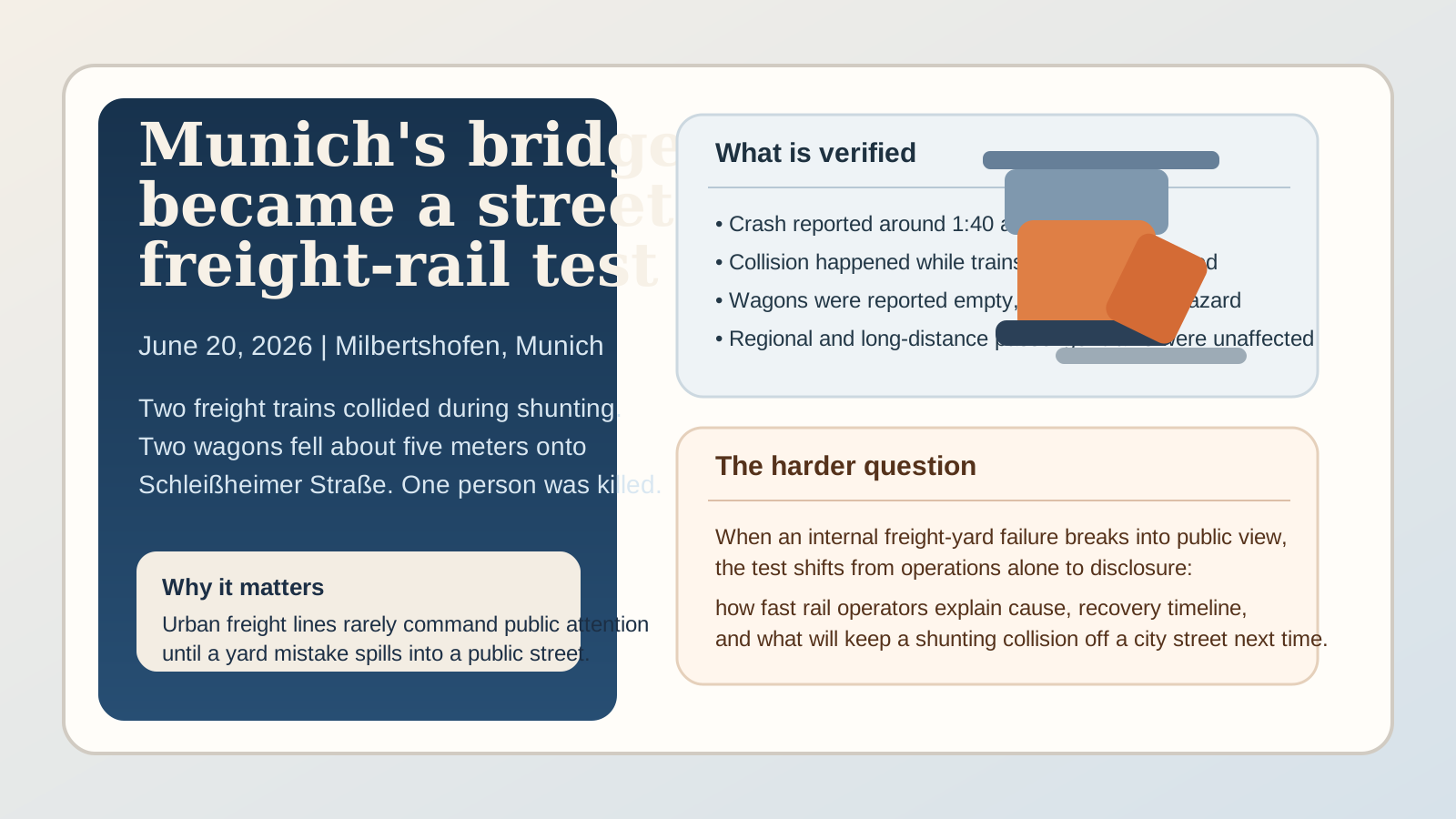
The first fact out of Munich on June 20, 2026 was brutal and narrow: two freight trains collided overnight on a rail bridge, two wagons plunged roughly five meters onto Schlei\u00dfheimer Stra\u00dfe, and one person was killed. The Associated Press reported the fatality and the bridge fall. BR24's local reporting added the operational detail that police said the two trains collided while being shunted in Milbertshofen, and that the wagons were unloaded. Those details do more than fill out the scene. They tell readers what kind of rail story this is. Not a long-distance passenger disaster, and not a weather-driven derailment. It is a freight-yard failure that crossed a line operators usually keep invisible: it broke out of back-of-house rail operations and into an ordinary city street.
BR24 — München: Güterzug stürzt von Brücke | BR24live
BR24's same-day live clip shows the scene and local reporting context. If the player does not load in your browser, use the direct YouTube link in the article.
That distinction matters because public trust in transport systems is built unevenly. Passenger rail is judged every day, in stations, on platforms and in delay notices. Freight rail usually is not. It runs behind fences, over viaducts and through industrial margins, and the public notices it mainly when something loud, blocked or catastrophic happens. Munich's crash forced that hidden part of the system into view all at once. BR24 reported that Deutsche Bahn said the affected track is used only by freight trains, so regional and long-distance passenger service was not disrupted. That should reassure travelers. It should not end the conversation. A city still woke up to rail cars on a roadway below a bridge, a death under investigation, and unanswered questions about how a controlled shunting movement escalated into a fatal urban crash.
What is verified, and what still is not
The verified outline is solid enough. AP and BR24 both place the crash in the early hours of Saturday. BR24 says it happened around 1:40 a.m. local time, when the trains collided during shunting on a bridge in Milbertshofen. Two wagons fell about five meters to the road below. One person died. The wagons were not carrying cargo, and BR24 said the public was not facing an added hazardous-material risk. The same outlet also reported that recovery could take hours or even days, which is a reminder that rail accidents are not finished when emergency lights leave the scene. Cleanup, forensics and operational disclosure are part of the public story too.
What remains unresolved is even more important for the article's angle. BR24 said authorities had not yet clarified why the trains collided or exactly where the victim was at the moment of impact. That means the hardest questions are still ahead of the easiest public conclusion. Readers can already tell this was serious. What they do not yet know is whether it exposed a procedural lapse, a signaling problem, a communication failure in the yard, or some more unusual chain of events. Until that is clear, every institution involved is being measured less by perfect certainty than by how candidly it narrows uncertainty in public.
Why this feels different from an ordinary rail brief
PanoramaDigest already covered the far deadlier Bedford passenger-train collision as a direct test of Britain's rail-safety story. Munich is a smaller event by casualty count, but the institutional lesson is different rather than lesser. Bedford was immediately legible as a front-facing passenger emergency. Munich is more revealing about the hidden layers underneath a modern rail city. Shunting movements are supposed to be controlled, contained and operationally routine. When a maneuver in that zone sends wagons off a bridge and onto a public road, the failure stops being purely technical. It becomes civic. Residents do not need to know the jargon of yard operations to understand the basic question: how did something that should have remained inside the rail system escape into a city block?
| What Munich showed | Why it matters |
|---|---|
| Freight operations can remain out of sight for years | That invisibility raises the pressure to explain quickly when something goes wrong in public. |
| No passenger service was affected | The absence of commuter disruption lowers panic, but it also risks understating the seriousness of the operational failure. |
| The wagons were reported empty | That limited the immediate hazard, yet it also underscores how much worse the street-level consequence could have been under different cargo conditions. |
| The cause is still under investigation | Trust now depends on how transparent investigators and operators are about sequence, safeguards and remedies. |
The harder test starts after the wreckage is lifted
This is where rail institutions often lose the story. The first hours are concrete: cordons, cranes, police lines, broken metal. The next phase is abstract and therefore easier to mishandle. If the explanation arrives slowly, evasively or in fragments, the public fills the gap with a more corrosive belief that the freight side of the rail network is allowed to stay opaque until disaster forces it open. Munich's officials still have time to avoid that pattern. But they will need to do more than promise an investigation. They will need to show what sequence failed, why existing safeguards did not contain it, and whether urban freight routes with similar operating patterns are being checked immediately.
That is also why this story is worth more than a quick foreign-news item. Big cities are under growing pressure to move more goods by rail for climate, congestion and logistics reasons. That makes freight infrastructure more valuable, not less. But value alone does not create legitimacy. Public acceptance depends on visible competence, especially when the system briefly becomes visible for the worst possible reason. Munich's crash is tragic first. It is also a reminder that freight rail earns the right to stay unnoticed only when its hidden routines are consistently safe.
- Around 1:40 a.m. local time: BR24 says two freight trains collided during shunting in Milbertshofen.
- Immediate consequence: two wagons fell about five meters from the bridge onto Schlei\u00dfheimer Stra\u00dfe below.
- Public reassurance: local reporting said the wagons were unloaded and the affected line did not disrupt passenger rail service.
- Next test: investigators and operators must explain cause, recovery timing and what will prevent another yard failure from reaching public space.
Source card: The BR24 live clip below is the clearest current video from a local newsroom at the scene. If the embedded player does not load, use the direct BR24 YouTube video. Readers who want the verified local facts in text form should keep BR24's explainer alongside the AP report.
Reader Sentiment & Impact Pulse
How do you evaluate the primary outcome of this development?
Select an option to cast your perspective. Responses are anonymous and aggregated in real time.
Key Context & Frequently Asked Questions
Two wagons plunged from a Munich bridge after a June 20, 2026 freight-train collision during shunting. The immediate tragedy matters, but the harder question is how quickly rail operators can explain why a yard failure spilled into a public street. This analysis from PanoramaDigest examines primary documentation, operational implications, and broader institutional impacts across world.
Read Next
Related Stories

Russia Extends Parliamentary Elections to Occupied Ukrainian Territories in Defiance of International Law
Moscow's decision to conduct parliamentary voting inside illegally occupied regions of Ukraine has drawn sharp international condemnation, underscoring ongoing sovereignty disputes and challenges to the rule of law.
Philippines School Shooting Leaves Three Dead, Sparking Urgent Security Review
A tragic shooting at a Philippine educational institution has left three people dead, including the gunman, prompting immediate calls for national campus safety reforms.

Scientists Warn of Escalating Glacial Flood Risks Across Eight Himalayan Nations Following Nepal Disaster
Following catastrophic inundations in Nepal, climate scientists warn that over 240 million people across eight South and Central Asian countries face heightened risks from glacial lake outburst floods and extreme weather events.