Kevin Warsh Wants a Quieter Fed. Markets May Send Households the Bill.
The Federal Reserve did not change rates on June 17, 2026. What changed was the cost of reading the Fed. Kevin Warsh's push for less forward guidance risks making markets, mortgages and corporate borrowing more jumpy before inflation is any lower.
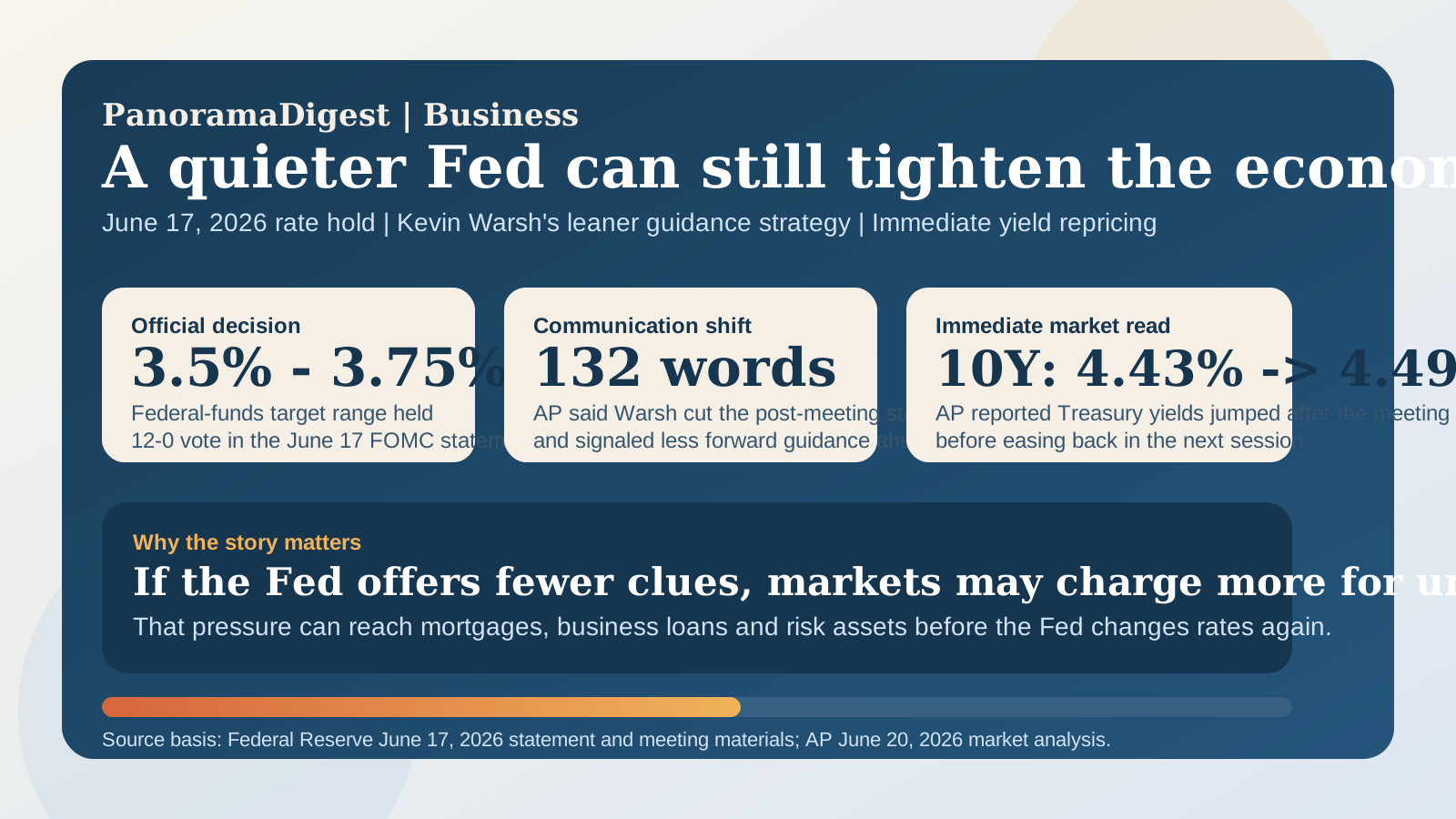
The Federal Reserve's June 17, 2026 decision looked calm on the surface. The official statement said the Federal Open Market Committee voted 12-0 to keep the federal-funds target range at 3.5% to 3.75%. It also said economic activity was still expanding at a solid pace, that productivity growth and capital investment were strong, and that inflation remained elevated in part because of supply shocks, including energy. That is the formal story. The market story is sharper. AP reported on June 20 that new Fed chair Kevin Warsh is deliberately pulling back on forward guidance, trimming the post-meeting statement to 132 words and signaling a preference for making investors work harder for clues.
Federal Reserve — FOMC Press Conference, June 17, 2026
Official Federal Reserve press conference from June 17, 2026. If the player does not load, use the direct YouTube link in the article.
That is not just a communications style change. It is a pricing change. When a central bank says less, traders tend to charge more for uncertainty. AP reported that after Warsh's first meeting as chair, the 10-year Treasury yield jumped to 4.49% from 4.43% and the two-year yield rose to 4.16% from 4.05% before easing back a day later. Those are not abstract basis points. They are the raw material for mortgage rates, business borrowing costs and the valuation math sitting under everything from apartment deals to AI infrastructure.
Watch the official Fed press conference here: FOMC Press Conference, June 17, 2026. The embedded player below should render on the article page, but the direct YouTube link is there if your browser blocks it.
The June 17 statement was short. The consequences may not be.
The official materials matter because they show what the Fed wanted the public to anchor on. The statement emphasized steady growth, resilient investment and an unchanged labor market. The projections release confirmed that policymakers also published a fresh set of economic forecasts. The meeting page linked the transcript and projection materials in the usual way. But AP's reporting is what turned the business meaning legible: Warsh wants less explicit steering, not more. He also announced five task forces to review Fed communications, the balance sheet, data practices, AI's effects on productivity and jobs, and the frameworks the Fed uses to think about inflation.
That package matters because it tells markets the communication regime itself is now under review. Warsh is not merely using different adjectives than Jerome Powell. He is questioning whether the Fed should keep supplying the same amount of guidance at all. For investors, that revives an older problem: if the central bank offers fewer directional hints, the penalty for being wrong about rates, inflation and growth gets larger.
| What changed | Who feels it first | Why it matters |
|---|---|---|
| The Fed kept rates unchanged but stripped back the style and density of its post-meeting guidance. | Bond traders, banks and borrowers pricing loans off Treasury yields. | Less guidance can translate into more volatility premiums even without a rate hike. |
| Warsh signaled a broader review of Fed communications and policy frameworks. | Investors trying to decide whether old Fed-reading habits still work. | The rules of interpretation may be changing at the same time inflation remains above target. |
| Markets immediately tested the new approach through higher yields after the meeting. | Households shopping mortgages and companies refinancing debt. | Tighter financial conditions can arrive through uncertainty before they arrive through policy action. |
Why this matters outside Wall Street
Central-bank transparency debates often get treated as a professionals-only argument, as though ordinary readers need not care whether a statement is 341 words or 132. That is too neat. A quieter Fed can still tighten everyday life. The mechanism is indirect but familiar: if markets trust the Fed less to pre-map its next move, they hedge harder. That can leave long-term borrowing costs stickier, credit conditions less forgiving and risk assets more fragile. In other words, ambiguity is not free.
That is why this story connects to PanoramaDigest's recent business coverage. The site's June 19 analysis of middle-class housing math already showed how sensitive monthly affordability is to financing costs. Its June 18 piece on who pays for the AI grid showed how quickly infrastructure ambition runs into capital costs and ratepayer politics. And its June 11 warning on Oracle's AI buildout bill made the same point at corporate scale: in this cycle, money is not just available or unavailable. It is repriced constantly by doubt.
- Wednesday, June 17, 2:00 p.m. EDT: the FOMC held rates at 3.5% to 3.75% and released a noticeably leaner statement.
- Same afternoon: projection materials and the press-conference path stayed in place, but AP reported that Warsh made clear he wants less forward guidance overall.
- Immediate market response: Treasury yields moved higher as investors recalibrated how much help the Fed will offer between meetings.
- What comes next: the market must decide whether a less talkative Fed is discipline, opacity or an expensive mix of both.
The deeper bet is not about silence. It is about discipline.
There is a respectable case for Warsh's approach. Too much guidance can make markets lazy and can box policymakers into defending forecasts that reality no longer supports. The Fed's forecast record is not perfect, and its communication machinery did not prevent the inflation mistakes of the early 2020s. A central bank that says less may preserve flexibility when the data change abruptly.
But the tradeoff is not rhetorical. It lands in prices. If markets stop believing they can infer the next move from official language, they will pay closer attention to every speech, every labor print, every inflation surprise and every geopolitical shock. That is manageable when the economy is calm. It is harder when energy prices are still feeding inflation and the AI investment cycle is already inflating demand for power, equipment and credit. In that environment, a quieter Fed does not remove noise. It often redistributes it.
What readers should watch next
The next question is not whether Warsh likes Alan Greenspan's style or whether traders admire the intellectual case for saying less. It is whether the June 17 experiment leaves financial conditions structurally tighter than the formal rate decision suggests. If mortgage rates stay elevated, if corporate issuers pay more to refinance, or if markets start overreacting to ordinary data releases, then households will have received the bill for a communications reform they never asked to debate.
That is the honest reading of this story. On June 17, 2026, the Fed held rates steady. On June 20, the business significance is that Kevin Warsh may be asking the economy to absorb more uncertainty at exactly the moment financing costs already matter more than headlines about innovation, productivity or soft landings.
Source card: If the official player below does not load in your browser, use the direct Federal Reserve YouTube stream of the June 17 FOMC press conference. Readers who want the primary documents should keep the official statement, the projections release and the press-conference transcript PDF close at hand.
Reader Sentiment & Impact Pulse
How do you evaluate the primary outcome of this development?
Select an option to cast your perspective. Responses are anonymous and aggregated in real time.
Key Context & Frequently Asked Questions
The Federal Reserve did not change rates on June 17, 2026. What changed was the cost of reading the Fed. Kevin Warsh's push for less forward guidance risks making markets, mortgages and corporate borrowing more jumpy before inflation is any lower. This analysis from PanoramaDigest examines primary documentation, operational implications, and broader institutional impacts across business.
Read Next
Related Stories

Google Gemini Vulnerabilities Highlight Escalating Cybersecurity Risks in Autonomous AI Deployment
Security researchers demonstrate that Google's Gemini AI model can be manipulated into executing cross-system exploits, raising concerns over enterprise security risks. As corporate adoption of AI agents accelerates, unexpected vulnerabilities threaten operational stability and business margins.
Antitrust Lawsuit Accuses Major Tech Firms of Illegally Coordinating AI Development Pace
A landmark federal lawsuit alleges that leading artificial intelligence developers secretly colluded to slow deployment timelines and manage capital expenditures under the guise of safety alignment.
Stock Futures Rebound Following Sell-Off Triggered by Federal Reserve Rate Increase
U.S. stock index futures posted gains as Wall Street attempted to recover from a sharp sell-off prompted by the Federal Reserve's latest interest rate hike and hawkish monetary guidance.