Qinghai's Earthquake Hit a Remote Plateau Fast. The Harder Test Is Reaching the Damage.
The June 16, 2026 earthquake in Qinghai killed at least one person and injured four more, but the deeper story is how quickly a disaster becomes harder to count and contain when the epicenter sits high, cold and far from dense infrastructure.
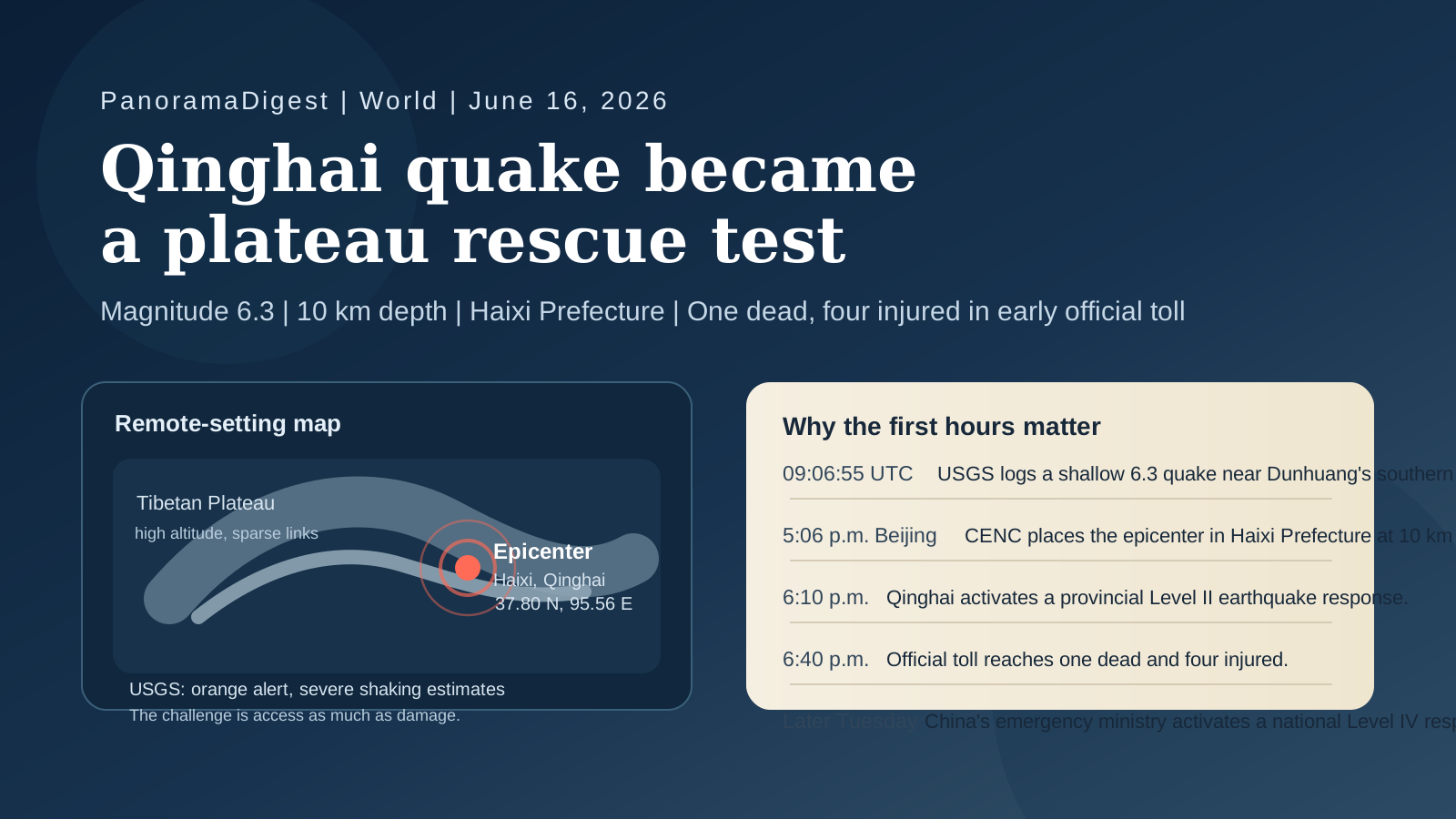
When a magnitude 6.3 earthquake struck Qinghai on Tuesday, June 16, 2026, the first verified facts arrived quickly enough to sound straightforward. The U.S. Geological Survey logged the quake at 09:06:55 UTC, about 260 kilometers south-southeast of Dunhuang, China, at a depth of 10 kilometers, with an orange pager alert and severe-shaking estimates. Xinhua, citing the China Earthquake Networks Center, placed the event at 5:06 p.m. Beijing time in Haixi Mongolian and Tibetan Autonomous Prefecture. By early evening local time, Xinhua reported that at least one person had died and four others were injured.
Those numbers matter, but they do not yet describe the whole difficulty of the event. This was not a quake that hit a dense coastal megacity with cameras on every block and hospitals five minutes apart. The epicenter sits on a high-altitude section of the Tibetan Plateau, and Associated Press reporting noted that the surrounding area averages more than 4,000 meters above sea level. In that setting, the first casualty count is usually the beginning of the story, not the conclusion. Geography becomes part of the emergency itself.
- 09:06:55 UTC: USGS records a magnitude 6.3 quake at 10 kilometers depth in a remote part of northwest China and assigns an orange pager alert.
- 5:06 p.m. Beijing time: Xinhua, citing the China Earthquake Networks Center, reports the quake in Haixi Prefecture with the epicenter near 37.80 N, 95.56 E.
- 6:10 p.m. Beijing time: Qinghai's emergency-management system activates a provincial Level II earthquake response, according to Xinhua.
- 6:40 p.m. Beijing time: Xinhua says one person is confirmed dead and four others are injured as rescue and damage checks continue.
- Later Tuesday evening: China's Ministry of Emergency Management activates a national Level IV emergency response and sends a work team to guide relief efforts.
Why the plateau matters more than the headline magnitude
Readers often treat earthquake coverage as a simple ladder: magnitude first, casualty count second, rebuilding later. In practice, the more revealing question is where the shaking lands. A shallow quake in a remote, mountainous region can leave officials with a harder logistics problem than a stronger quake in a better-connected place. Roads can fail quietly. Communications can stay partial. Weather, altitude and distance can slow both rescue and verification. That is why the Qinghai story should be read not only as a seismic event but as a test of response reach.
Xinhua said the Qinghai provincial seismological bureau dispatched an on-site team to assist local authorities. AP added that rescue teams with search dogs were sent into the mountainous area. Those are sensible first moves, but they also reveal the underlying constraint. The public does not yet know much because responders are still working to physically close the distance between the epicenter and the institutions that turn field conditions into reliable information.
| Verified point | What remains open | Why it matters |
|---|---|---|
| The quake measured magnitude 6.3 and was shallow at 10 km. | The full pattern of structural damage and isolated communities affected. | Shallow quakes can produce sharper surface shaking than readers expect from the number alone. |
| At least one person was killed and four injured as of early evening local time. | Whether the casualty count rises as responders reach more remote locations. | Early disaster counts in high-altitude terrain are often provisional. |
| Provincial and national emergency responses were activated on June 16. | How quickly relief crews can assess roads, utilities and housing safety. | The speed of access often determines whether a disaster stays contained or widens into a longer disruption story. |
| USGS assigned an orange alert and severe-shaking estimates. | How Chinese authorities ultimately classify the damage footprint after field inspection. | Instrument readings explain the hazard; field surveys explain the lived consequences. |
The emergency response tells readers what officials fear most
China's official response levels are useful because they show what authorities think could still be hidden inside the first reports. Xinhua said Qinghai raised a provincial Level II response at 6:10 p.m. local time, and later the Ministry of Emergency Management activated a national Level IV response and sent a work team into the area. Bureaucratic language can sound bloodless, but in disaster coverage it often functions as a public clue. It means officials do not yet trust the initial picture to stay small on its own.
That is also why the most important question in the next several hours is not whether the quake was big enough
to attract world attention. It already did. The better question is whether the response can convert a remote, fast-moving event into a stable, well-mapped recovery effort before aftershocks, darkness or transport limits make the damage harder to see.
What to watch next
The next meaningful updates will be practical, not rhetorical: whether casualty figures change; whether officials report landslides, road breaks or wider infrastructure loss; and whether shelter and medical support can be pushed into the affected zone quickly enough to keep the human toll from climbing after the first night. Those are the signals that tell readers whether Qinghai was struck by a tragic but contained quake or by a more complicated plateau emergency whose scale only becomes legible with time.
PanoramaDigest has already seen how earthquakes can quickly become warning-and-response stories rather than magnitude stories alone, as in its June 8 analysis of the Mindanao quake and the trust test around tsunami alerts. Qinghai is a different geography and a different political system, but the same editorial lesson applies. The first number tells readers what shook. The harder reporting begins when officials try to prove they can still reach the people living where it shook hardest.
Reader Sentiment & Impact Pulse
How do you evaluate the primary outcome of this development?
Select an option to cast your perspective. Responses are anonymous and aggregated in real time.
Key Context & Frequently Asked Questions
The June 16, 2026 earthquake in Qinghai killed at least one person and injured four more, but the deeper story is how quickly a disaster becomes harder to count and contain when the epicenter sits high, cold and far from dense infrastructure. This analysis from PanoramaDigest examines primary documentation, operational implications, and broader institutional impacts across world.
Read Next
Related Stories

Saudi Arabia Alleges Houthi Drone Attack Targeting Mecca, Escalating Regional Tensions
Riyadh has accused the Iran-backed Houthi movement of launching an aerial drone targeting the holy city of Mecca, a charge the militant group has vehemently denied. The incident threatens to derail fragile diplomatic efforts across the Middle East.
U.S. Energy Chief Signals Rapid Restart for Key Saudi Arabian Oil Pipeline
U.S. energy officials indicate that a major Saudi Arabian oil transport pipeline will resume full operations within days, calming global crude markets after brief infrastructure concerns.

Denmark's 11-Month Military Service Starts With 1,600 Volunteers Across 14 Bases
Denmark's first full 11-month military-service cohort includes about 1,600 volunteers at 14 sites. Equal conscription applies if volunteers fall short.