Romania's Failed Cabinet Vote Turned a Budget Crisis Into a Legitimacy Clock
Romania's parliament rejected Adrian Vestea's cabinet, forcing fresh consultations and turning a political stalemate into a more dangerous test of fiscal credibility, EU timing, and public trust.
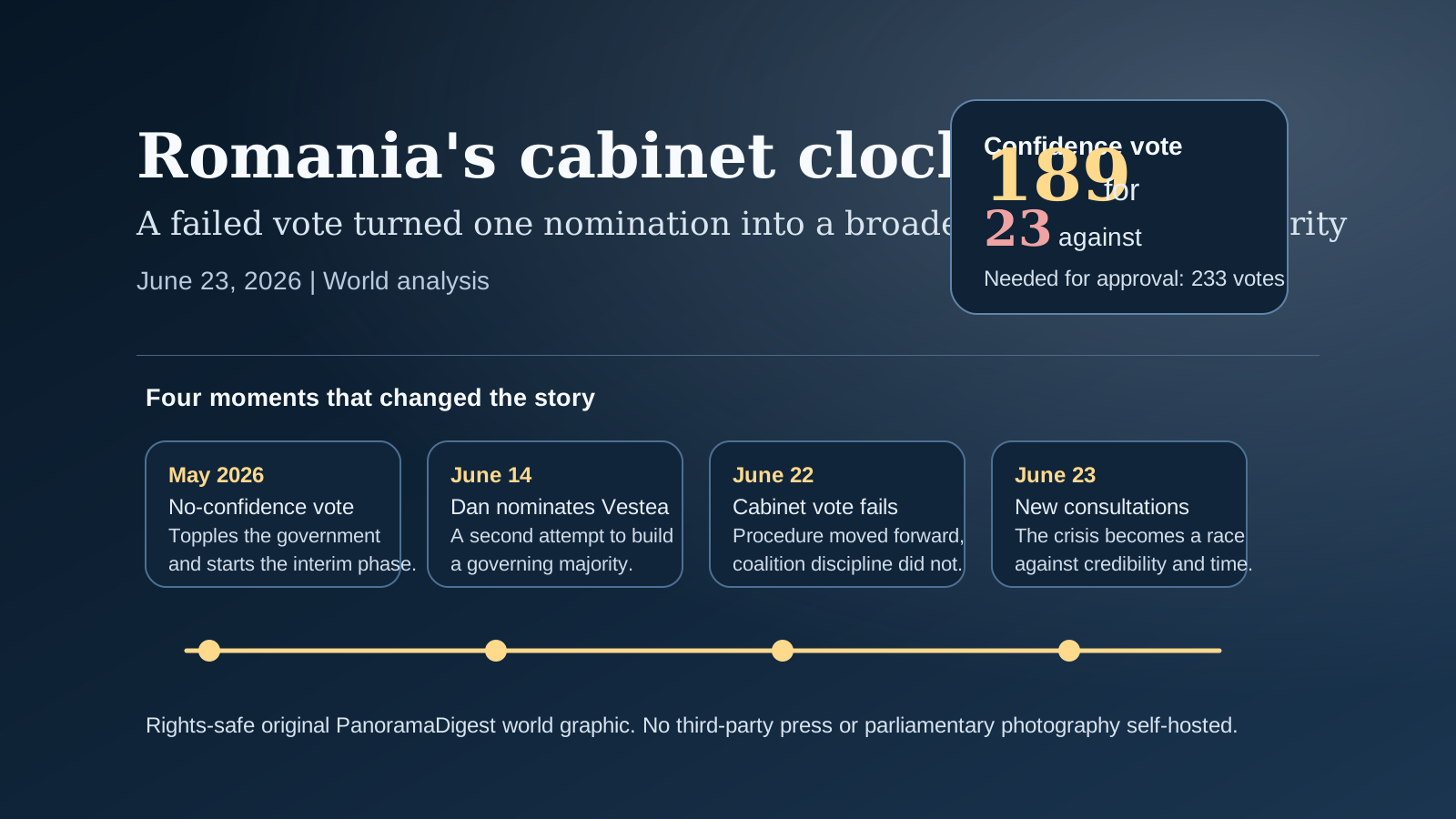
Romania woke up on Tuesday, June 23, 2026 with the same problem it had before Monday night's investiture vote: no fully empowered government and less room to pretend time is neutral. Parliament rejected Adrian Vestea's proposed cabinet 189-23, far short of the 233 votes required for approval, according to Agerpres and The Associated Press. By Tuesday morning, the crisis had already moved to its next phase: Agerpres reported that President Nicusor Dan would call party leaders back to Cotroceni for fresh consultations on naming another prime minister.
Euronews Romania — Parliament decides whether Romania will have a new government
Euronews Romania previewed the investiture showdown; if the player is blocked, use the direct watch link in the story body.
That is why this was never just a one-night parliamentary embarrassment. Romania is an EU and NATO state trying to navigate a large budget deficit, stubborn inflation, and a credibility problem that gets worse every time leaders ask voters, investors, and Brussels for patience while the governing math keeps collapsing. The failed vote mattered because it turned an argument about one nominee into a visible countdown on fiscal authority.
The vote failed, but the real defeat was time
Vestea's camp had framed the investiture as a way to break a damaging stalemate. Instead, the result underlined how little parliamentary consent still exists for a governing formula that can survive first contact with austerity, coalition bargaining, and far-right pressure. Agerpres said Vestea warned before the vote that Romania had only about 70 days left to complete key milestones tied to its recovery plan. After the rejection, he argued that weeks without a fully empowered cabinet were already costing the country funds, trust, and time.
Reuters, in coverage carried by partner publications after the vote, pushed the same point from a market angle: the longer the deadlock lasts, the harder it becomes for Bucharest to reassure ratings agencies and protect access to European money. AP's reporting added the political frame. President Dan's nomination of Vestea never solved the broader coalition problem, because too many parties saw tactical advantage in withholding support or abstaining rather than owning the compromises a workable cabinet would require.
The result is a familiar but increasingly dangerous pattern across European politics: parties that agree the state needs a government still hesitate to be the ones seen paying the price for one. PanoramaDigest recently traced a different version of that succession problem in Britain after Keir Starmer's resignation opened a new stability test. Romania's version is less about party theater and more about whether a country can keep its governing machinery credible while its political center keeps splintering.
A four-date timeline that explains the pressure
| Date | What happened | Why it matters |
|---|---|---|
| May 2026 | A no-confidence vote toppled Romania's previous government. | The country entered an interim phase with less political room to pass painful decisions. |
| June 14, 2026 | President Nicusor Dan nominated Adrian Vestea after an earlier choice fell away. | The presidency tried to reset negotiations without first securing a durable parliamentary majority. |
| June 22, 2026 | Parliament rejected Vestea's cabinet 189-23, with only 212 votes cast. | The failure proved that procedural movement was not the same as coalition discipline. |
| June 23, 2026 | Fresh consultations were set in motion for another nomination. | The crisis shifted from one failed bid to a race against fiscal and institutional credibility. |
Why the next nomination matters more than the last one
Romania does not just need a prime minister on paper. It needs a cabinet that can survive the first arguments over spending cuts, party patronage, and the terms of support from lawmakers who would rather stay flexible than accountable. That is why the next round of consultations matters more than the identity of the next nominee. If the parties return with the same incentive structure, another name will only buy another round of headlines.
The deeper issue is that every faction now wants to look responsible without accepting ownership of the full governing burden. For pro-European parties, that is a dangerous game. They may assume voters fear chaos enough to reward delay, but long gaps between warnings and action often strengthen the forces arguing that the old parties are incapable of governing at all. In Romania's case, that means the center is effectively lending time and anger to rivals who thrive on institutional disgust.
What Brussels, investors, and ordinary Romanians will watch next
The next prime-ministerial nomination will matter less for symbolism than for three practical signals. First, can a candidate arrive with a real vote map instead of a hope-based one? Second, can Romania present a credible path on budget discipline and recovery-plan execution before outside confidence frays further? Third, can the mainstream parties explain to voters why compromise is necessary without sounding as if they are merely protecting themselves?
Those questions have household consequences. Governments in prolonged interim mode tend to postpone the unpleasant decisions until they become sharper: tax changes, funding priorities, local project timing, hiring discipline, and the pace of EU-backed works. The bill for instability rarely arrives as one dramatic collapse. More often it shows up as drift, higher borrowing anxiety, slower disbursement, and a public that stops believing anyone is steering.
Watch: Euronews Romania's pre-vote explainer is available here if the embedded player does not load on your device.
Romania still has room to exit the spiral. But after Monday's failed vote, the country is no longer being judged on whether it can name a government. It is being judged on whether its political class can still recognize when the cost of waiting has become the story.
Reader Sentiment & Impact Pulse
How do you evaluate the primary outcome of this development?
Select an option to cast your perspective. Responses are anonymous and aggregated in real time.
Key Context & Frequently Asked Questions
Romania's parliament rejected Adrian Vestea's cabinet, forcing fresh consultations and turning a political stalemate into a more dangerous test of fiscal credibility, EU timing, and public trust. This analysis from PanoramaDigest examines primary documentation, operational implications, and broader institutional impacts across world.
Read Next
Related Stories

World Leaders Convene at UN Amid Compounding Crises of War, Climate, and AI
Global heads of state gather at United Nations headquarters as intersecting geopolitical conflicts, accelerating climate disasters, and unregulated artificial intelligence challenge multilateral governance.

German Chancellor Merz Slams State Election Outcome as Party 'Disaster' but Defies Calls to Step Down
German Chancellor Friedrich Merz has bluntly labeled a crucial regional election a disaster for his conservative party, yet firmly rejected mounting pressure for his resignation as political instability rattles Berlin.
Russia's Ruling United Russia Party Extends Dominance in Wartime Parliamentary Vote
Early election results in Russia show the ruling United Russia party consolidating its grip on legislative power amid tight state control and ongoing military operations in Ukraine. The wartime vote reinforces Moscow's centralized political trajectory while further insulating its wartime economy from domestic legislative challenge.