The Katy Tesla Crash Is a Hard Test of What Driver-Assist Language Still Lets Drivers Assume
A fatal Tesla crash in Katy, Texas is now under a federal special investigation. The unresolved issue is not only what the car was doing, but what driver-assist language keeps encouraging people to think the car can do.
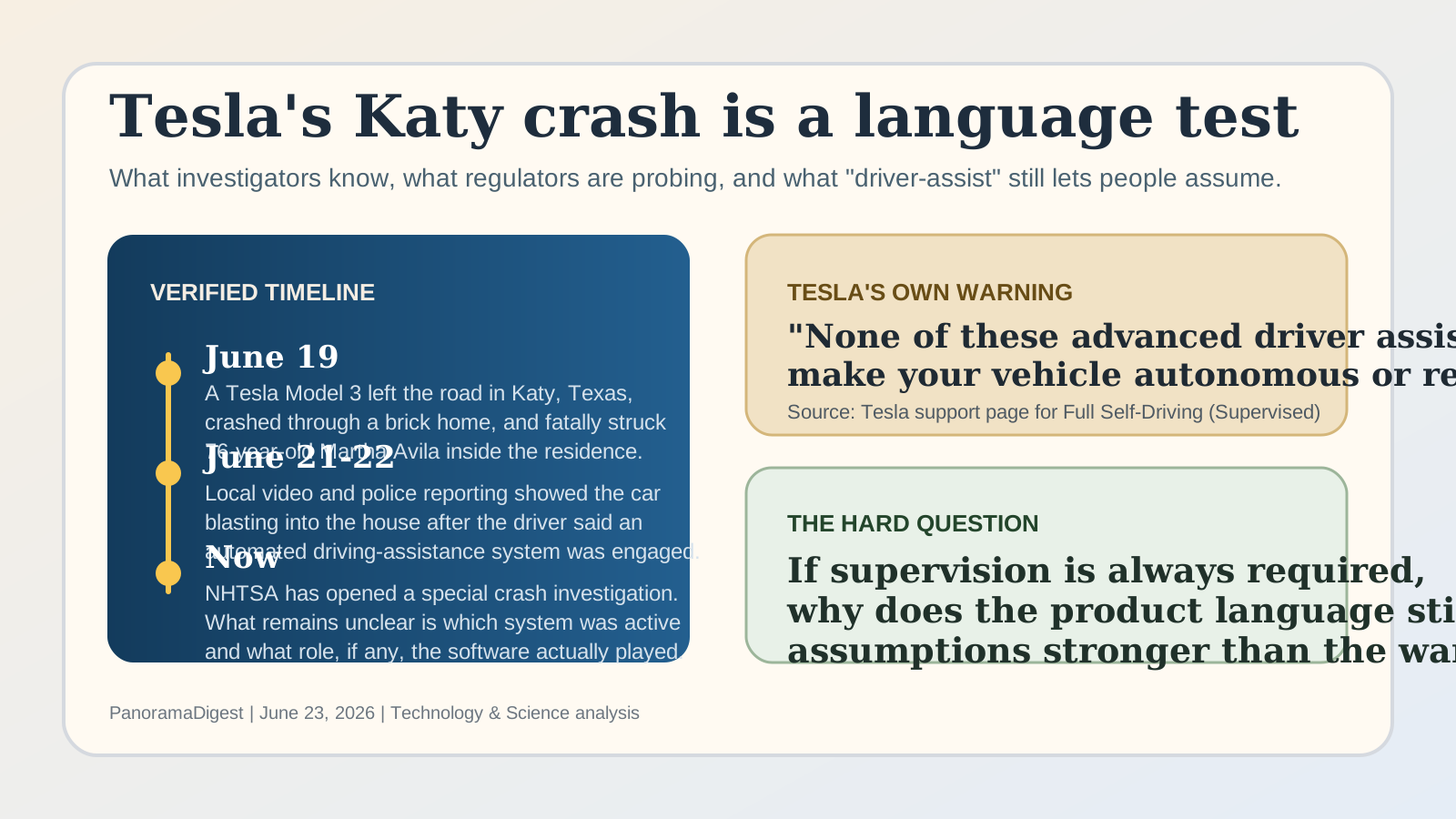
A Tesla crashing through a family home in Katy, Texas, and killing a 76-year-old woman would already be a grim local tragedy even if the car had no software story attached to it. What makes this case heavier is the sentence sitting beside the crash in almost every early account: the driver told investigators an automated driving-assistance system was engaged. That does not prove the system caused the crash. It does make the incident a cleaner test of something regulators, automakers and drivers keep trying to blur together: what these systems actually do, what companies say they do, and what people still seem willing to assume they do anyway.
KPRC 2 Click2Houston — Video Shows Tesla Flying Through Katy Neighborhood Before Slamming Into Home
KPRC's local report is the clearest public video path for the crash sequence. If the player does not load, the article includes a direct watch link.
The verified facts are narrow but serious. ABC News reported that investigators said Michael Butler was driving a Tesla Model 3 in Katy around 8 p.m. local time on Friday, June 19, 2026, when the vehicle left the roadway and struck a brick residence. The Harris County Sheriff's Office said Butler reported operating the vehicle with an automated driving-assistance system engaged. The sheriff's office said the car hit Martha Avila inside the home; she was airlifted to a hospital and later died. KPRC's local reporting added the concrete detail that surveillance video showed the Tesla speeding down Rose Hollow Lane before hitting a curb and blasting through the two-story house on Blooming Park Lane.
That is the crash. The federal layer arrived next. Associated Press reporting carried by Spectrum News said the National Highway Traffic Safety Administration opened a special crash investigation on Monday, June 22. The same report said the exact role of the software remains unclear, but the probe is significant because the car was reportedly using technology Tesla has placed near the center of its future business story.
- Friday, June 19: Harris County investigators say a Tesla Model 3 left the roadway in Katy, Texas, crashed through a brick home, and fatally struck Martha Avila inside the residence.
- After the crash: The driver told investigators an automated driving-assistance system was engaged, according to the sheriff's office and ABC News.
- Saturday to Sunday reporting: Local Houston outlets published surveillance-video reporting that showed the vehicle speeding into the house after jumping a curb.
- Monday, June 22: NHTSA opened a special crash investigation while the exact role of the software remained unresolved.
What makes this story important is not what we already know. It is the gap around what we do not.
The cleanest way to read this case is not as proof that a Tesla system failed, because that has not been established. It is also not as proof that the human driver alone explains everything, because the investigation has not established that either. The real story, at least right now, lives in the gap between those two conclusions. We know the driver said a driver-assistance system was engaged. We know law enforcement said he showed no signs of intoxication and was cooperating. We know federal regulators considered the crash serious enough to escalate into a special investigation. What we do not know is which Tesla feature was active, what the vehicle data show, whether the driver overrode anything, or whether the software meaningfully shaped the sequence before impact.
| Verified point | Unresolved point | Why the distinction matters |
|---|---|---|
| The driver told investigators an automated driving-assistance system was engaged. | Authorities have not publicly identified the exact system or what it was doing second by second. | The public often hears "Autopilot" and "self-driving" as if they mean one thing. Investigators do not have that luxury. |
| NHTSA opened a special crash investigation on June 22. | The agency has not yet said whether software behavior, driver behavior, or both appear central. | A federal probe signals scrutiny, not a verdict. |
| Tesla says its advanced driver-assistance features do not make the vehicle autonomous and do not replace the driver. | The market language around those features still carries stronger cultural implications than the warning itself. | This is the trust problem: a disclaimer can be technically clear and socially ineffective at the same time. |
Tesla's official warning is clearer than the product mythology around it
That last distinction is why this story belongs in Technology & Science, not only in a police blotter. On its own support page for Full Self-Driving (Supervised), Tesla says the feature operates under driver supervision, does not make the vehicle autonomous and does not replace the driver. Its broader Autopilot and Full Self-Driving support language likewise says the currently enabled features require active driver supervision and do not make the vehicle autonomous. On paper, that is not ambiguous. In public life, it clearly still is.
The cultural problem is not that Tesla forgot to add warnings. The problem is that the warning has spent years sharing the stage with more powerful storytelling: product names that sound larger than the fine print, viral clips that celebrate machine competence, and a company strategy that increasingly sells the future before it arrives. AP's June 22 account explicitly tied the federal probe to Tesla's wider push into automated driving and robotaxis. That framing matters. When a company asks investors and consumers to see automation as the core of its next chapter, every fatal edge case stops being just an edge case. It becomes a referendum on whether the surrounding language has been more confident than the lived safety reality.
Why this one crash carries more weight than a routine crash investigation
Ordinary crash reporting asks whether a driver made a mistake. This story asks that too, but it also asks whether the product category itself still trains people to misunderstand the boundary between assistance and autonomy. That is a different question, and it is more consequential. If the driver turns out to have overridden the system, accelerated through warnings, or ignored obvious conditions, that would still not erase the underlying design-and-language issue. It would sharpen it. A supervised system marketed into a public culture that keeps treating supervision as optional is not only a driver problem.
The institutional question here is simple: how many times can a company say "supervised" before regulators decide the public still hears something else? NHTSA's special investigation will not answer that in one filing. But the Katy crash gives the question a far more human cost than another software demo or earnings-call promise ever could.
What to watch next
Three developments matter now. First, investigators will need to establish what specific Tesla feature was engaged, if any, and whether the vehicle log supports the driver's account. Second, regulators will have to decide whether this crash belongs to a pattern that demands more than case-by-case scrutiny. Third, Tesla will face the public burden of explaining not only how the software is supposed to work, but why its cautionary language still seems weaker than the assumptions surrounding it.
Watch the local video evidence: KPRC's YouTube report includes the surveillance footage path and local reporting context. If the embedded player does not load, use the direct link to KPRC's crash video report. Readers who want the broadest verified baseline should keep the ABC News report, the AP/Spectrum News account of the federal probe, and Tesla's official support language for supervised driving in view at the same time.
That combination is enough to see the story clearly for what it is on June 23, 2026: not a settled verdict on one crash, but a hard new test of whether the industry's most aggressive driver-assist narrative has run ahead of what ordinary human beings can safely be trusted to hear.
Reader Sentiment & Impact Pulse
How do you evaluate the primary outcome of this development?
Select an option to cast your perspective. Responses are anonymous and aggregated in real time.
Key Context & Frequently Asked Questions
A fatal Tesla crash in Katy, Texas is now under a federal special investigation. The unresolved issue is not only what the car was doing, but what driver-assist language keeps encouraging people to think the car can do. This analysis from PanoramaDigest examines primary documentation, operational implications, and broader institutional impacts across technology & science.
Read Next
Related Stories

Leaked Apple Silicon Benchmarks Point to Massive Graphics Performance Gains in M5 Ultra and M6 Chips
Leaked benchmark testing reported by MacRumors highlights significant graphics and computational advancements for Apple's upcoming M5 Ultra and M6 silicon, signaling a major leap for on-device AI and workstation performance.
Smart TV Data Tracking Prompts Heightened Privacy Concerns as Consumers Seek Mitigation Strategies
Modern smart televisions routinely monitor viewing habits and collect consumer data through Automatic Content Recognition technology. However, targeted network adjustments and privacy settings offer users practical avenues to limit telemetry and reclaim control over their living room data.

Apple Hardware Executive Details Engineering Strategy for Foldable iPhone Durability and Crease Elimination
In an interview highlighting material science breakthroughs, Apple's hardware leadership discussed the hinge design, display elasticity, and structural longevity engineered for foldable form factors.