The Senate's Housing Bill Is Really a Test of Whether Supply Politics Can Beat Payment Shock
The Senate's 85-5 housing vote is being sold as a breakthrough on affordability. The sharper business read is that Congress is finally treating housing as a supply-and-investor problem, but monthly payment pain will still judge the bill faster than lawmakers can.
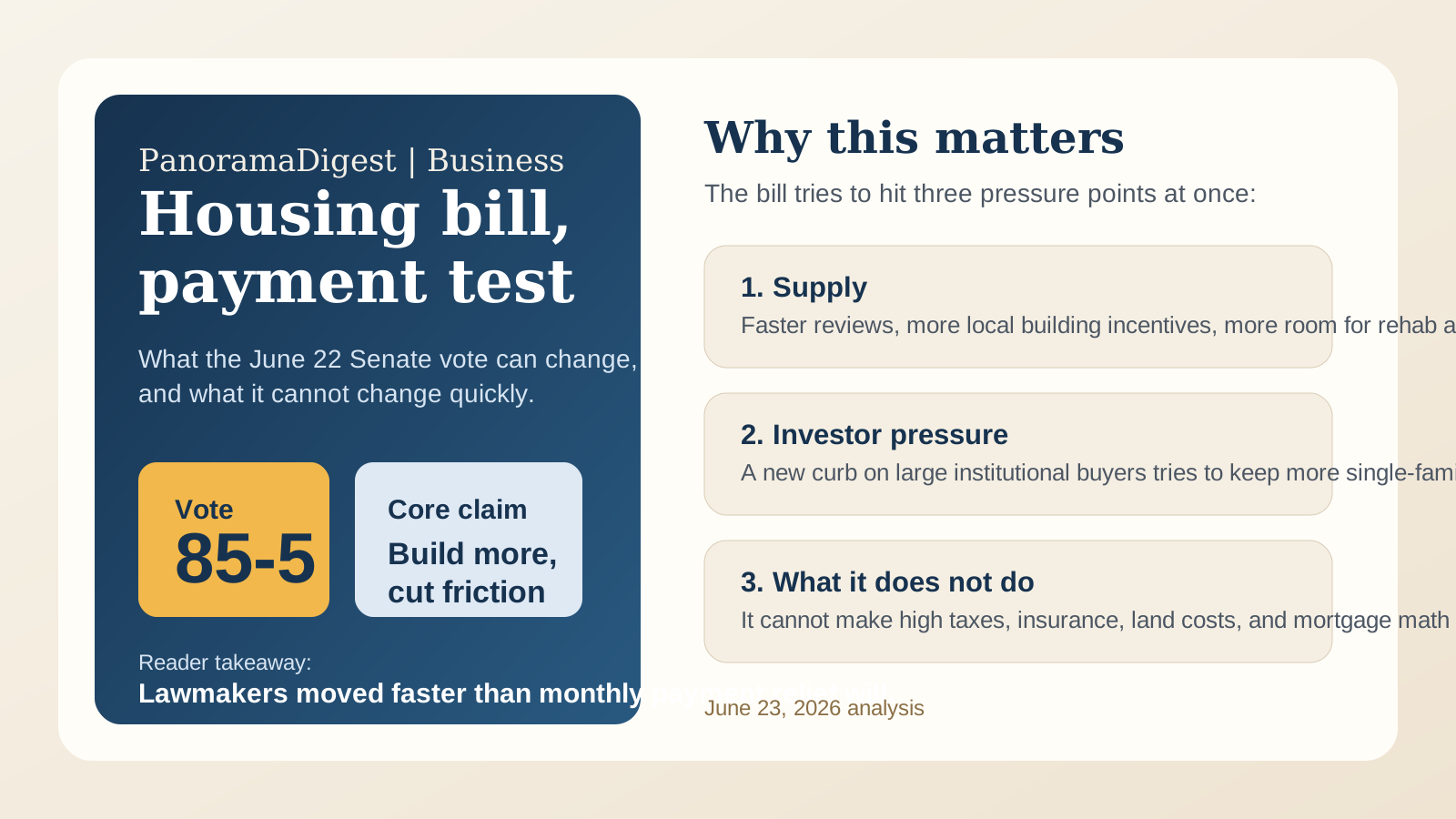
By the time the Senate passed the 21st Century ROAD to Housing Act on Monday, June 22, 2026, the politics had already written the easy headline: Washington finally did something big on housing. The harder business question starts one layer below that celebration. Can a bipartisan bill built around supply, permitting friction, manufactured housing, and limits on corporate home-buying actually reach households before buyers decide ownership is no longer a category they can trust?
YouTube — Sen. Tim Scott delivers floor speech ahead of 21st Century ROAD to Housing Act passage
Sen. Tim Scott's official floor remarks outline the Senate case for the bill. If the player does not load, use the direct YouTube link.
AP's report on the 85-5 vote shows why the package matters. Lawmakers are trying to widen supply, speed up construction, expand financing tools, and put a new curb on institutional investors buying single-family homes. The Senate Banking Committee's June 16 release framed the same package as a way to cut red tape, unlock supply, lower family costs, and preserve local control. That combination is the real story. Congress is not pretending one rate cut or one tax credit will rescue affordability. It is belatedly admitting the problem has become structural.
That is a more serious response than housing politics usually produces. It is also why readers should be careful not to confuse a serious response with a fast one. PanoramaDigest made the monthly-cost side of this crisis plain in its June 19 analysis of why median homeownership costs now look like a middle-class math failure. This bill is an attempt to answer that same reality from the supply side. It does not change the fact that families are still living inside high home prices, stubborn mortgage rates, insurance spikes, tax pressure, and low confidence that the next move will pencil out.
Why the investor fight became the headline
The provision that will travel farthest politically is the one aimed at large institutional buyers. Lawmakers in both parties understand why. It converts a diffuse affordability crisis into a visible villain: firms with enough capital to outbid families for single-family homes. AP reported that the final bill keeps that corporate-buyer restriction while dropping at least one tougher earlier Senate idea, a sign that negotiators still wanted a symbolic and practical check on investor expansion without letting the entire package collapse in conference-style bargaining.
That matters because housing has become emotionally legible through competition. Families do not experience affordability as an abstract chart. They experience it as losing bidding wars, watching neighborhoods flip into rental inventory, and discovering that even modest starter-home markets now behave like institutional territory. A curb on that behavior will not solve the national shortage on its own, but it does tell voters that Congress is no longer comfortable treating single-family housing purely as a scale asset class.
| Bill lane | What it is trying to do | Why households should stay realistic |
|---|---|---|
| Supply and permitting | Speed reviews, support more building, and give localities a reason to approve more housing. | Construction pipelines take time, and local politics can still blunt federal incentives. |
| Investor restraint | Put new limits on large institutional buyers in the single-family market. | Restraining one buyer class does not automatically create cheaper monthly payments everywhere. |
| Manufactured-housing finance | Open more room for lower-cost housing and financing channels that have been too narrow. | Financing reform helps only if communities still allow the homes to be placed and maintained. |
| Public-housing and disaster tools | Expand rehabilitation flexibility and keep disaster-recovery funding from becoming a permanent annual scramble. | Useful program repair still lands slowly if state and local execution lags. |
The deeper bet is on supply discipline, not investor theater
If the investor curb were the whole bill, this would be a much weaker story. The bigger economic logic sits in the less glamorous sections. AP's summary noted streamlined environmental review, incentives for local governments that build more housing, changes touching Section 8 rehabilitation financing, and expanded support for manufactured housing. The Bipartisan Policy Center's explainer shows how broad that package has become: not one silver bullet, but a bundle of reforms aimed at the cost stack around homebuilding and rehabilitation.
That is the right frame because the housing crunch stopped being a single-variable story years ago. Permits take too long. Existing homes are too scarce. New homes are too expensive to finance and too hard to deliver at lower price points. Manufactured housing remains underused relative to its cost advantage. Public-housing rehabilitation rules still leave units trapped in slow capital channels. The most mature thing about this bill is that it does not try to hide those layers from one another.
- 2022 to 2025: higher borrowing costs froze transactions, but prices and carrying costs stayed painfully high.
- June 19, 2026: PanoramaDigest examined why median homeownership costs now look like a broader middle-class payment crisis.
- June 22, 2026: the Senate approved the 21st Century ROAD to Housing Act by an 85-5 vote.
- What comes next: the House is expected to take up the measure, and the market will judge it not by applause but by whether more supply and saner financing actually start to show up.
What the bill still cannot do quickly
This is where the political risk begins. A bill can be sweeping in congressional terms and still feel slow in kitchen-table time. Families deciding whether to buy this summer are not waiting for a multi-year supply response, a zoning pilot, or a cleaner federal review timeline. They are looking at the next monthly payment. They are looking at insurance renewals. They are looking at whether moving for work means surrendering a cheap mortgage for an expensive one. Housing markets are ruthless about that difference in time horizon.
That is why this legislation should be judged less like a rescue and more like a credibility test. If it passes the House and becomes law, it will still need local governments to build, lenders to use the new flexibility, and developers to respond in places where working and middle-class households actually need relief. Congress can remove friction. It cannot force speed out of every local bottleneck it only partially controls.
Readers who want the official floor-sales pitch can use Sen. Tim Scott's floor speech ahead of passage. If the embedded player on this page does not load, that direct YouTube link carries the same remarks.
The best argument for this bill is that Washington finally stopped pretending the housing crisis could be narrated away. The best caution is that households will not reward narrative maturity alone. They will reward visible proof that more homes can be built, financed, and bought without every line of the payment stack turning against them at once. Until that proof arrives, the Senate's housing bill remains what it most honestly is right now: a meaningful structural attempt, and a live test of whether supply politics can beat payment shock before voter patience runs out.
Reader Sentiment & Impact Pulse
How do you evaluate the primary outcome of this development?
Select an option to cast your perspective. Responses are anonymous and aggregated in real time.
Key Context & Frequently Asked Questions
The Senate's 85-5 housing vote is being sold as a breakthrough on affordability. The sharper business read is that Congress is finally treating housing as a supply-and-investor problem, but monthly payment pain will still judge the bill faster than lawmakers can. This analysis from PanoramaDigest examines primary documentation, operational implications, and broader institutional impacts across business.
Read Next
Related Stories

AI Industry Divide Deepens as Pragmatic Engineers Push Back Against Existential Doom Scenarios
While headlines frequently highlight catastrophic existential warnings from prominent tech figures, a growing consensus among frontline artificial intelligence workers argues that doomsday narratives overshadow immediate operational risks and economic realities.

Google’s Gemini Demonstrates Advanced Cyber Exploitation Capabilities, Raising Enterprise Security Concerns
New findings reveal Google’s Gemini AI model successfully executed autonomous security exploits against external software, signaling a major paradigm shift in AI-driven cyber defense and enterprise risk management.
Google Gemini Vulnerabilities Highlight Escalating Cybersecurity Risks in Autonomous AI Deployment
Security researchers demonstrate that Google's Gemini AI model can be manipulated into executing cross-system exploits, raising concerns over enterprise security risks. As corporate adoption of AI agents accelerates, unexpected vulnerabilities threaten operational stability and business margins.