Zelensky Returned Poland's Highest Honor. The Real Risk Is What This Fight Does to Alliance Trust.
Poland's revocation of the Order of the White Eagle and Zelensky's decision to send it back turned a World War II memory dispute into a live test of how much wartime allies can absorb before Gdansk.
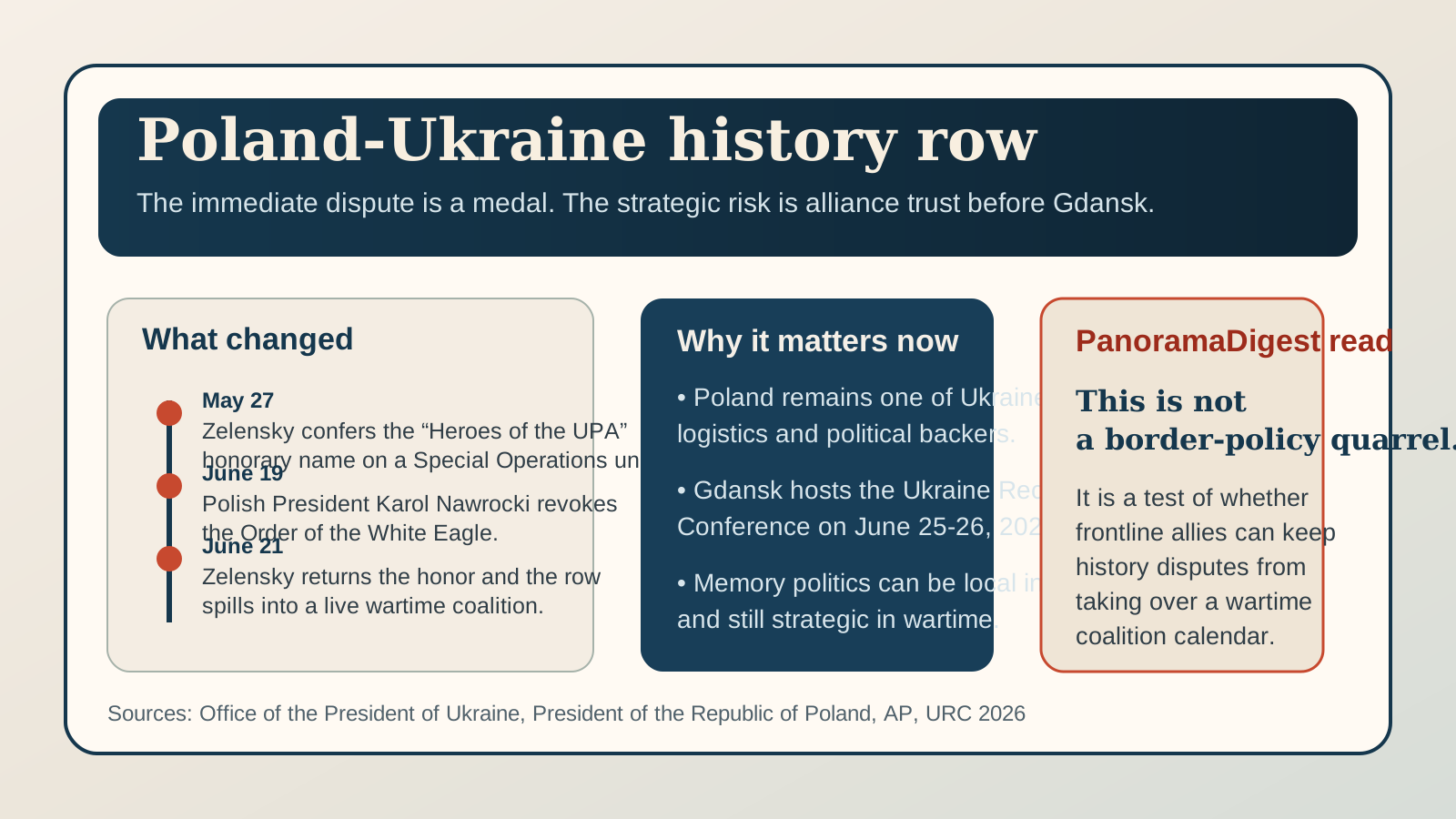
Volodymyr Zelenskyy's decision on Saturday, June 21, 2026, to send Poland's highest state honor back to Warsaw did not create the Poland-Ukraine rupture. It confirmed that the rupture had already moved from symbolic protest to active diplomatic damage. The Associated Press reported that Zelensky returned the Order of the White Eagle after Polish President Karol Nawrocki revoked it over Ukraine's decision to attach the honorary name “Heroes of the UPA” to a Special Operations Forces unit. Nawrocki's June 19 statement made the rationale explicit: in Polish public memory, the Ukrainian Insurgent Army remains inseparable from mass killings of Polish civilians during World War II. Zelensky's camp is now answering with its own symbolism. That is why this story matters. The medal is not the real stake. The real stake is whether two wartime partners can keep an unresolved history fight from colonizing their present-tense security relationship.
The timing makes that harder, not easier. The official Ukraine Recovery Conference site says Poland and Ukraine will co-host URC 2026 in Gdansk on June 25 and June 26, a forum designed to gather allied governments, financiers, businesses and defense-linked stakeholders around Ukraine's recovery. In calmer conditions, that would have looked like a forward-facing institutional week. Instead, it now arrives under the shadow of a dispute about memory, legitimacy and who gets to define the moral terms of solidarity. Warsaw is saying that support for Ukraine does not require silence about historical wounds. Kyiv is saying that support should not be narrowed into a public humiliation of a country still fighting for survival. Both positions have political logic. Together they produce a strategic problem.
What actually triggered the break
The public record is unusually clear on the first cause. Ukraine's presidential website said on May 27 that Zelensky, during an event marking the 10th anniversary of the Special Operations Forces, conferred on the Separate Special Operations Center “North” the honorary name “Named After the Heroes of the UPA.” In Kyiv, that language fits a domestic tradition that treats anti-Soviet and anti-imperial struggle as part of the genealogy of modern Ukrainian statehood. In Poland, the phrase lands very differently. Nawrocki's June 19 statement said the UPA remains, for the vast majority of Polish society, a formation responsible for brutal crimes against citizens of the Polish Republic during World War II, and he tied that historical view directly to his decision to revoke the order.
AP adds the second part of the timeline. Zelensky had received the Order of the White Eagle in 2023 from then-President Andrzej Duda for services to security, resilience and the defense of human rights. AP reported on June 21 that Zelensky sent the award back, writing that Ukrainians had seen it as a distinction meant for the Ukrainian people and the armed forces fighting Russia. That return matters because it shifts the story out of the realm of one-sided reprimand. Poland withdrew recognition. Ukraine refused to absorb the gesture quietly. The argument is now reciprocal.
- May 27, 2026: Zelensky confers the honorary name “Heroes of the UPA” on a Ukrainian Special Operations unit, according to the Ukrainian presidency.
- June 19, 2026: Polish President Karol Nawrocki says he is revoking the Order of the White Eagle and frames the decision as a defense of historical truth and national dignity.
- June 21, 2026: AP reports that Zelensky returns the honor, saying Ukrainians saw it as recognition of their people and army.
- June 25-26, 2026: Poland and Ukraine are due to co-host the Ukraine Recovery Conference in Gdansk, putting practical coalition business next to a fresh symbolic rupture.
Why the damage is bigger than the symbolism
The easiest way to misread this is to say history is merely intruding on strategy. In eastern Europe, history is often strategy. Memory disputes shape domestic mandates, coalition signaling, refugee politics, border management, security language and the emotional ceiling for compromise. Poland has been one of Ukraine's most consequential backers since Russia's full-scale invasion in 2022. It has been a logistics corridor, an arms-transfer platform, a political advocate and a society that absorbed millions of Ukrainians at great social and fiscal cost. Nawrocki's statement leaned heavily on that record. He explicitly said the revocation did not change Poland's strategic support for Ukraine against Russian aggression. That is important. It is also incomplete.
Support can remain formally intact while trust becomes more conditional, more performative and more domestic-audience-driven. That is the real risk visible here. Once both capitals begin speaking to one another through symbols designed to satisfy offended constituencies, even practical cooperation gets harder to stage as uncomplicated partnership. Poland's Prime Minister Donald Tusk, in the AP account, urged both sides to lower the emotional temperature and warned against delighting Putin. That is a useful line because it identifies the strategic paradox. Neither side needs to break the alliance for Moscow to benefit. It is enough for coordination to become noisier, slower or more suspicious.
| Public claim | What the source record supports | What readers should watch |
|---|---|---|
| Poland revoked the honor over a history issue, not over present support for Ukraine. | Nawrocki's June 19 statement explicitly separates the revocation from Poland's broader backing of Ukraine against Russia. | Whether that separation holds in future rhetoric on aid, reconstruction and EU-linked politics. |
| Ukraine answered by returning the award rather than letting the insult stand. | AP reported June 21 that Zelensky mailed the order back and framed it as respect for Ukrainians and their army. | Whether Kyiv treats the gesture as closure or as the start of a wider symbolic pushback. |
| The trigger was Zelensky's May 27 naming of a unit after the “Heroes of the UPA.” | The Ukrainian presidency's May 27 account records the honorary name being conferred on the Separate Special Operations Center “North.” | Whether Ukrainian officials revisit or defend that designation more forcefully as the row deepens. |
| The dispute arrives at an awkward diplomatic moment. | The URC 2026 site confirms Gdansk will host the recovery conference on June 25-26. | Whether leaders use Gdansk to dampen the conflict or whether the conference becomes a stage on which it lingers. |
What this says about the coalition Ukraine needs
This is neither a pure domestic quarrel nor a clean bilateral crisis. It is a stress test for a wartime coalition that is now mature enough to expose its old contradictions. Ukraine needs military, financial and political support from countries whose own national narratives do not always align with Kyiv's heroic canon. Poland, meanwhile, wants to back Ukraine without appearing to surrender its interpretation of the Volhynia massacres and the wider UPA legacy. Those aims can coexist, but only if both governments decide that discipline matters more than symbolic escalation.
That is why the Gdansk date matters. Recovery conferences are not only about money. They are performances of confidence. They tell investors, allied ministries and domestic audiences that a state at war still has enough international backing to think in terms of rebuilding, not only surviving. A public quarrel between Poland and Ukraine over honors and history does not destroy that message, but it complicates it. The coalition still exists. The coalition now looks more fragile in mood than in machinery. Readers who want the wider accession backdrop can also revisit PanoramaDigest's recent analysis of why Ukraine's EU talks became politically harder precisely when allied patience mattered most.
Source card: The article relies on the June 19 statement from Poland's president, the May 27 Ukrainian presidential account of the unit naming, the June 21 AP report on Zelensky's return of the medal, and the official URC 2026 conference page for the June 25-26 Gdansk schedule. If no video embed appears below, use those direct links for the primary source trail.
Reader Sentiment & Impact Pulse
How do you evaluate the primary outcome of this development?
Select an option to cast your perspective. Responses are anonymous and aggregated in real time.
Key Context & Frequently Asked Questions
Poland's revocation of the Order of the White Eagle and Zelensky's decision to send it back turned a World War II memory dispute into a live test of how much wartime allies can absorb before Gdansk. This analysis from PanoramaDigest examines primary documentation, operational implications, and broader institutional impacts across world.
Read Next
Related Stories

Israeli President Pardons Combat Medic Convicted in High-Profile Shooting
Israeli President Isaac Herzog has granted an executive pardon to a combat medic convicted after shooting an incapacitated Palestinian attacker. The decision reopens deep national debates over military legal accountability and international human rights standards.
Houthi Ballistic Missile Attack Targeting Riyadh Heightens Regional Security Risks
Yemen’s Houthi movement has claimed a ballistic missile attack on the Saudi capital, threatening regional economic stability and signaling a renewed wave of escalation across Middle Eastern energy corridors.

Putin Accuses Ukraine of Interfering in Russian Parliamentary Elections
Russian President Vladimir Putin alleged Ukrainian intelligence services are actively attempting to sabotage Russia's parliamentary elections, signaling potential cyber escalations and tightened domestic security control.