Australia's First Mainland H5 Bird Flu Case Is Really a Wildlife-Surveillance Test
Australia confirmed its first mainland detection of the globally circulating H5 bird flu strain on Friday, June 20, 2026, in a brown skua found near Esperance. The immediate public-health risk remains low, but the harder test is whether wildlife surveillance can stay ahead of spread before poultry or broader ecosystems are hit.
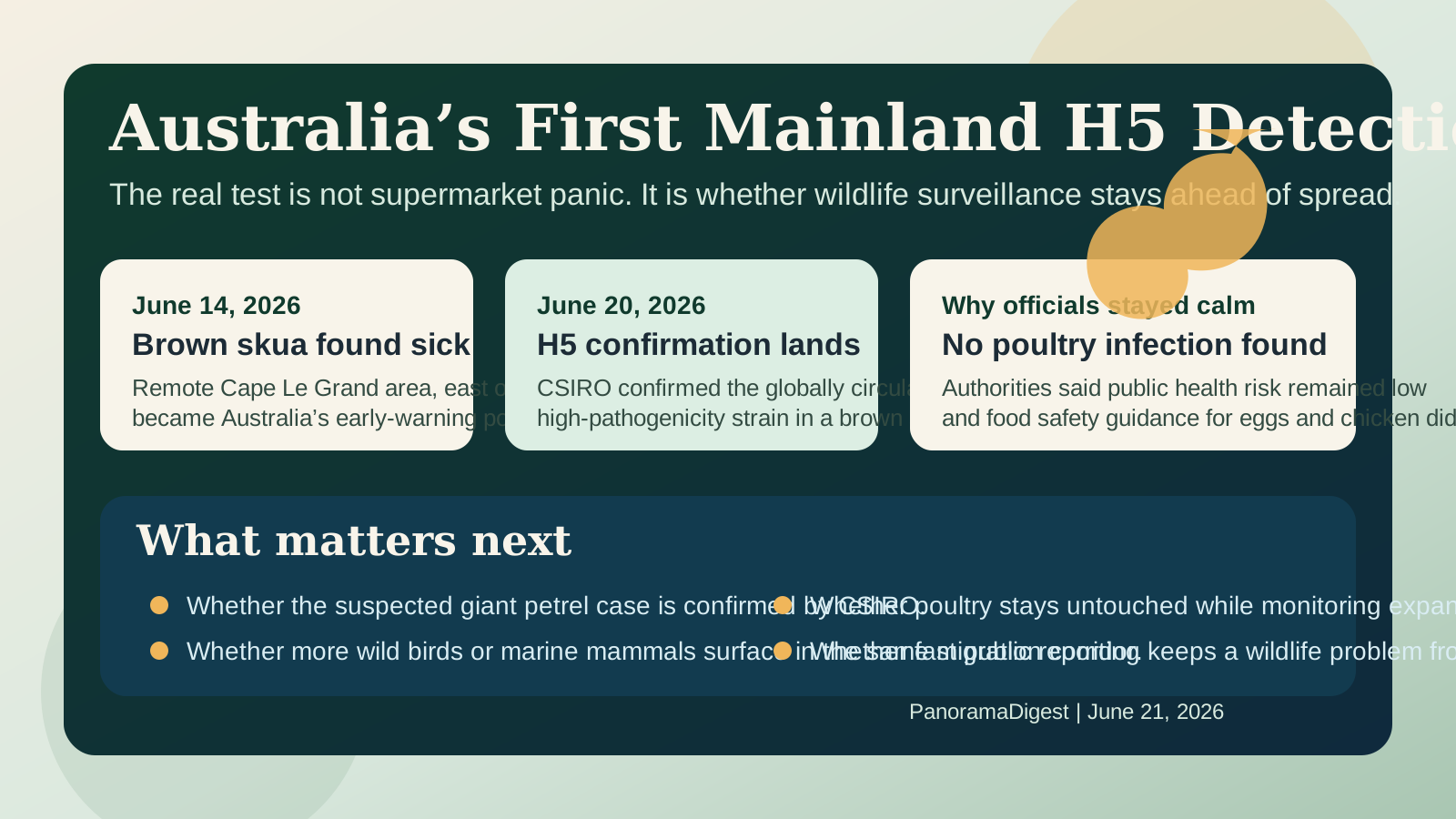
Australia's first mainland confirmation of the globally circulating H5 bird flu strain sounds like the kind of headline that invites instant supermarket panic. The official record points somewhere else. When federal authorities confirmed on Friday, June 20, 2026, that a brown skua found in remote southern Western Australia was infected, they also stressed two stabilizing facts: there was no evidence of infection in poultry, and the public-health risk remained low. That leaves a more important story in view. Australia's real stress test is not whether shoppers get nervous. It is whether wildlife surveillance, public reporting and containment discipline move fast enough while this is still primarily a wild-bird problem.
7NEWS Australia — Bird flu detected in Australia for first time | 7NEWS
7NEWS' June 20 report tracks the confirmation in Western Australia; if the player is blocked, use the direct YouTube link in the article.
The official chronology is unusually clear. In a June 20 ministerial release, the Australian government said CSIRO confirmed H5 high pathogenicity avian influenza in a brown skua in Western Australia. The broader federal bird-flu portal then added the operational details readers actually need: the bird was found sick on June 14, 2026, in an isolated part of southern Western Australia, and a second bird from the same region, a giant petrel, was still undergoing confirmatory testing as of June 20. The agriculture department's update also said the Australian Centre for Disease Control considered the public risk low and that Food Standards Australia New Zealand did not view bird flu as a food-safety risk for chicken meat and eggs when handled and cooked properly.
Why the first mainland detection matters even without a flock outbreak
Australia had managed to avoid this exact mainland moment longer than anywhere else. That did not mean the virus was imaginary. It meant geography and luck had held a line that officials knew would eventually be tested. ABC's June 20 reporting helps explain why authorities were not shocked by the result even as they called it sobering. ABC reported that the brown skua found near Cape Le Grand beach was a sub-Antarctic migratory seabird and that the case was confirmed on June 20 after the bird was located on June 14. Once the globally circulating H5 strain had already devastated wildlife on Heard and McDonald Islands, the real question was never whether mainland Australia could remain untouched forever. It was whether the first mainland detection would be found early, isolated clearly and tracked honestly.
So far, the answer looks better than the headline alone suggests. In a same-day doorstop transcript, Agriculture Minister Julie Collins said there was no evidence of mass mortality and no evidence of infection in poultry, while Chief Veterinary Officer Beth Cookson said the immediate priority was determining the extent of infection in wildlife. That is the right hierarchy. Once a virus like this is confirmed in migratory seabirds, the first task is to understand range and spillover risk before the political conversation gets hijacked by assumptions about supermarket shelves or a false binary between calm and catastrophe.
| Signal | What official sources said | Why it matters |
|---|---|---|
| Confirmed case | CSIRO confirmed H5 high pathogenicity avian influenza in a brown skua found in Western Australia. | This establishes the first mainland detection of the globally circulating strain in Australia. |
| Second bird | A giant petrel from the same region returned a suspected positive result and was awaiting confirmatory testing as of June 20. | The immediate question is whether officials are dealing with one isolated detection or a broader local wildlife signal. |
| Poultry status | Federal and state authorities said there was no evidence of infection in poultry. | That is the line between a serious wildlife surveillance event and a more economically disruptive farm outbreak. |
| Public-health guidance | Authorities said the public risk was low and advised people not to touch sick or dead birds. | Containment now depends less on panic than on disciplined reporting and minimal contact. |
The real vulnerability is in wildlife and response speed
Western Australia's June 20 release makes that tradeoff plain. The state government said the confirmed bird was found in the remote Cape Le Grand area east of Esperance and urged the public to report sick or dead birds and marine mammals to the Emergency Animal Disease Hotline rather than touching them. That language is not decorative. It reflects the uncomfortable truth of this phase: once the virus is in migratory wildlife, governments do not control the birds. What they control is how quickly they learn where else the virus may already be, how quickly they warn people away from risky contact, and how effectively they protect the gap between wildlife exposure and commercial poultry systems.
That is also why the current calm deserves to be read carefully rather than lazily. Low public risk does not mean low institutional pressure. It means the pressure is landing in a narrower place first: wildlife hospitals, field labs, incident-response teams, veterinarians, conservation officials and the reporting systems that tell them where to look next. PanoramaDigest's recent reporting on how outbreak response can look calmer than it really is pointed to the same basic lesson in a different disease setting. Early reassurance is useful only if it is paired with aggressive follow-through. Otherwise the public reads "not alarming yet" as permission to stop paying attention.
Why this is not a food-fear story, at least not on the current evidence
Readers need a sharper line here than social feeds usually provide. The federal agriculture update explicitly says bird flu is not a food-safety risk for chicken meat and eggs when handled and cooked correctly. That matters because a single wildlife detection can easily be misread as proof that the consumer food chain has already been compromised. It has not. Officials have said the opposite. The harder issue is whether the country can preserve that distinction as surveillance expands.
That is where the June 20 detection becomes more than a one-day science headline. If additional infected wild birds surface, governments will be judged on whether they keep the public message clean: report, do not touch, let surveillance teams do the tracing, and avoid treating isolated wildlife detection as evidence of farm spread that officials have not reported. If poultry infections do emerge later, readers will need a different story. On June 21, 2026, that is not the official picture.
What to watch over the next several days
There are four practical questions now. First, whether CSIRO confirms the giant petrel case from the same region. Second, whether additional wild birds or marine mammals are identified along the southern Western Australian corridor. Third, whether the no-poultry-infection line still holds as surveillance widens. And fourth, whether public reporting remains disciplined enough to give authorities usable lead time rather than rumor-churn.
- Do not touch: authorities have asked the public to avoid contact with sick or dead birds or animals and to report them instead.
- Watch the species map: one confirmed brown skua matters, but a pattern across multiple seabirds or marine mammals would matter more.
- Separate wildlife from food panic: officials still say public health risk is low and there is no current evidence of poultry infection.
Watch the latest newsroom explainer: if the player below does not load in your browser, use the direct link to 7NEWS' report on the June 20 H5 bird flu confirmation. Readers who want the most current official posture should keep the federal bird flu update page open beside the article.
The clearest way to read Australia's first mainland H5 detection is not as proof that authorities failed to keep the virus out forever. That was never a realistic long-term standard once the strain was moving through migratory wildlife and sub-Antarctic territory. The real standard is narrower and more demanding: find the virus early, map it honestly, keep the public disciplined, and stop a wildlife warning from becoming a wider system failure. That is the test Australia has now entered.
Reader Sentiment & Impact Pulse
How do you evaluate the primary outcome of this development?
Select an option to cast your perspective. Responses are anonymous and aggregated in real time.
Key Context & Frequently Asked Questions
Australia confirmed its first mainland detection of the globally circulating H5 bird flu strain on Friday, June 20, 2026, in a brown skua found near Esperance. The immediate public-health risk remains low, but the harder test is whether wildlife surveillance can stay ahead of spread before poultry or broader ecosystems are hit. This analysis from PanoramaDigest examines primary documentation, operational implications, and broader institutional impacts across health.
Read Next
Related Stories

Understanding Adult-Onset Allergies: Why the Immune System Can Malfunction Later in Life
New immunological research highlights a growing surge in adult-onset allergies, revealing how environmental shifts and cellular misfires cause mature immune systems to suddenly treat familiar substances as dangerous threats.

Tampa Resident Becomes Florida's First Recorded Dengue Fever Fatality
Health officials have confirmed the first-ever recorded death from locally acquired dengue fever in Florida, prompting renewed concerns over expanding vector-borne diseases in the United States.
Pennsylvania Governor Shapiro Condemns RFK Jr. and Trump Over Measles Response as 'Incompetence'
Pennsylvania Governor Josh Shapiro launched a sharp critique against Donald Trump and Robert F. Kennedy Jr., labeling their public health commentary on measles as dangerous incompetence amid rising vaccine skepticism.