China's May Data Shows Why Export Strength Still Can't Hide a Weak Consumer
China's May numbers did not show a collapse. They showed something trickier for Beijing: factories still moving while households and property keep slipping backward.
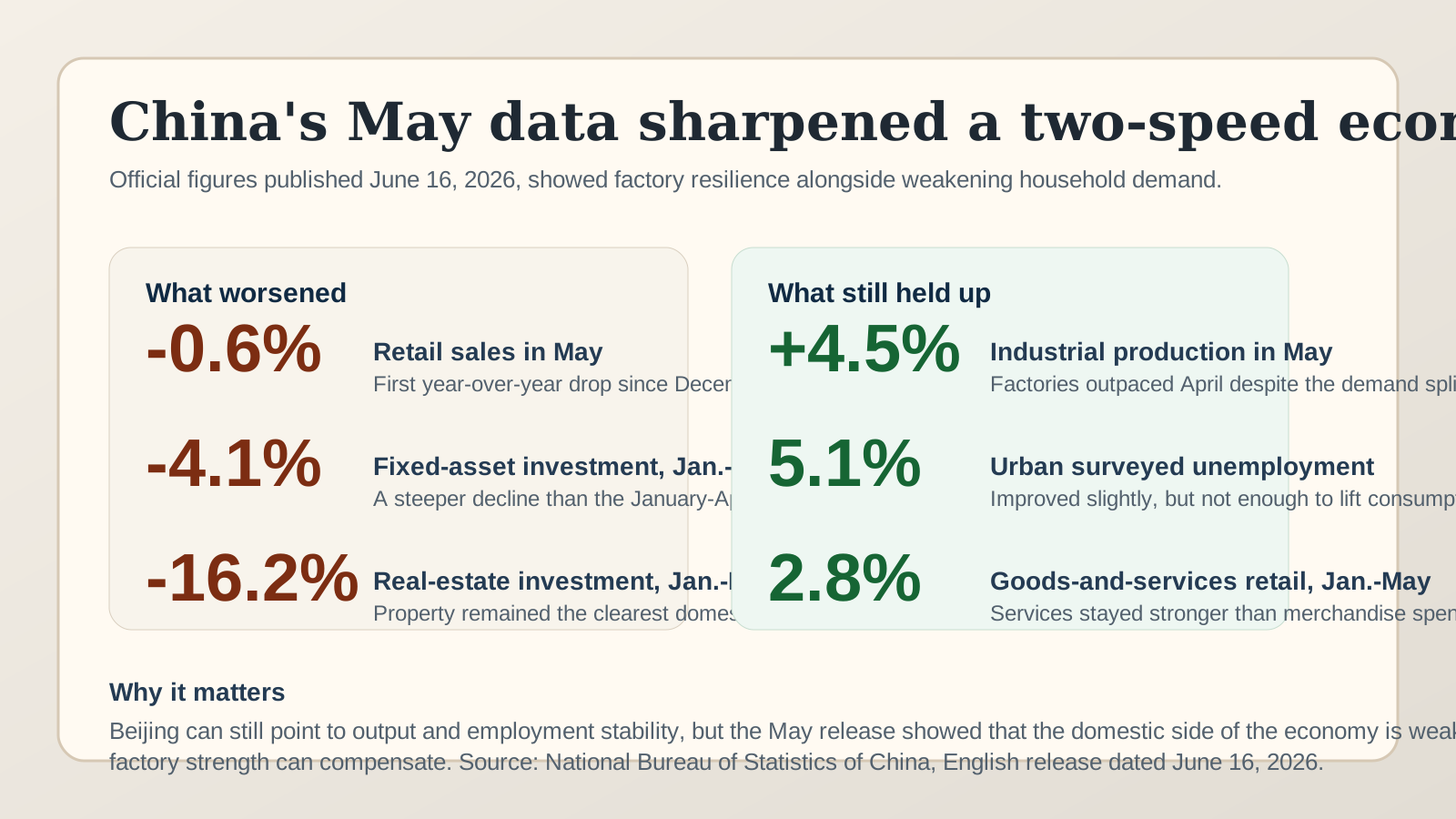
China's official May release did not read like a crisis bulletin. It read like a country still able to produce, ship, and employ just enough to keep the headline intact while the domestic side of the economy keeps losing force. The National Bureau of Statistics said on June 16, 2026, that retail sales of consumer goods fell 0.6% from a year earlier in May, the first year-over-year decline since December 2022, while fixed-asset investment for January through May was down 4.1%. Industrial production, by contrast, still rose 4.5%.
That split is the real story. Beijing can still point to factory resilience, high-tech manufacturing, and a slightly lower urban surveyed unemployment rate of 5.1%. But the same release showed real-estate investment down 16.2% in the first five months of the year and private investment down 7.1%. In other words, the economy is still making things. It is having a harder time persuading households and private capital to act like they believe the recovery is broad enough to trust.
April to May was not a wobble. It was a sharper domestic-demand warning.
The official numbers worsened in the places policymakers most need to stabilize. Retail sales swung from a thin 0.2% gain in April to a 0.6% decline in May. Fixed-asset investment moved from a 1.6% drop in January-April to a 4.1% drop in January-May. Services still looked healthier than goods, but not healthy enough to change the picture: the broader goods-and-services retail measure was up 2.8% for the first five months, while goods alone remained notably weaker.
Reuters' reporting on the release, republished by Business Standard, described the pattern as a two-speed economy. That is the right shorthand, but it still understates the political problem. A government can live with unevenness for a quarter or two. It has a harder time with an economy where official output numbers keep improving while households keep behaving like risk managers.
| Indicator | April reading | May reading | Why it matters |
|---|---|---|---|
| Retail sales, year over year | +0.2% | -0.6% | Consumer demand slipped back into contraction even after a major holiday period. |
| Industrial production, year over year | +4.1% | +4.5% | Factory output kept growing, showing that supply and exports are still carrying more weight than consumption. |
| Fixed-asset investment, year to date | -1.6% | -4.1% | Business and development spending weakened further instead of stabilizing. |
| Urban surveyed unemployment | 5.2% | 5.1% | Labor-market improvement was too mild to produce a visible spending rebound. |
Factories can buy time. They cannot repair confidence on their own.
That is why the May release matters beyond one bad retail number. Industrial activity still has support from manufacturing upgrades, export channels, and sectors tied to the global AI infrastructure build-out. Household consumption does not get the same automatic lift. When the property market remains a drag, consumer-goods stimulus fades, and private investment keeps contracting, the economy starts to look less like a balanced recovery and more like an exercise in running one engine harder because the other one will not restart.
The official release still gave Beijing material for reassurance. Services production rose. Infrastructure investment stayed positive. High-tech investment also remained in growth territory. But those are not substitutes for broad consumer conviction. The point that matters for businesses is simpler: even a modest improvement in unemployment failed to keep spending from falling year over year.
What Beijing should worry about next
The near-term risk is not a dramatic break. It is policy drift. If second-quarter growth remains acceptable on paper because industry and trade hold up, leaders may feel less urgency to do something more forceful for domestic demand. That is precisely how imbalances get more durable. Once businesses conclude that household demand will stay soft, they delay hiring, trim expansion plans, and protect margins. That feedback loop can leave an economy looking stable at the top line while becoming more brittle underneath.
The May numbers therefore deserve to be read as a warning about composition, not just pace. China is still growing in the sectors that help it make and move things. It is struggling in the sectors that tell you whether households and private investors believe tomorrow is worth spending into. That is a much harder problem to paper over with a better factory month.
Primary sources: the National Bureau of Statistics of China's June 16, 2026 release and Reuters' contemporaneous reporting as republished by Business Standard.
Read Next
Related Stories
U.S. and Japan Buy Yen Together as Dollar Falls From 163 to 156
Japan confirmed coordinated yen buying with the U.S. after the dollar traded above 163 yen. The intervention amount will be disclosed later.
OPEC+ Raises September Oil Production Target by 188,000 Barrels a Day
Seven OPEC+ countries raised their combined September production target by 188,000 barrels a day, bringing the published required total to 31.01 million.

Microsoft Azure Revenue Passes $100 Billion as Cloud Sales Rise 27%
Microsoft said Azure passed $100 billion in annual revenue for the first time, while quarterly Microsoft Cloud sales reached $59.3 billion.