Indiana's Hospital Price Cap Is Turning Employer Health Benefits Into a Real Bargaining Test
Indiana's first hospital-price-cap review gave employers a concrete benchmark, but the real test is whether a 260% of Medicare ceiling changes bargaining power before the broader 2029 deadline arrives.
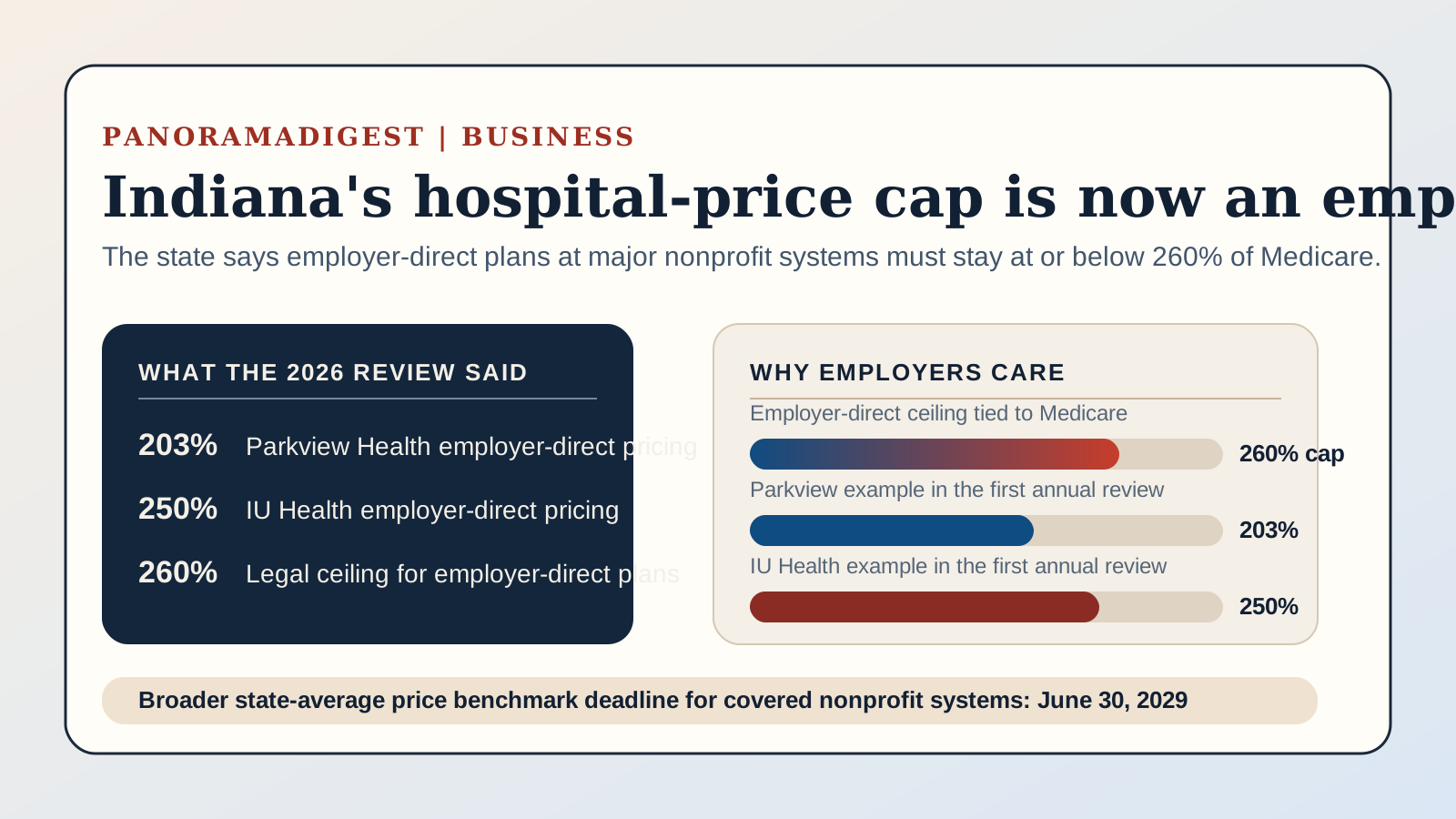
Indiana's healthcare affordability fight has moved past the easy political stage, the one where lawmakers can say hospital prices are too high and everyone nods. The harder stage is here now. A fresh June 15, 2026 round of statehouse reporting in Indiana has put the focus back on a law that tries something unusually direct: telling major nonprofit hospital systems that if they want to deal with employers on health coverage, the price cannot float endlessly above Medicare.
WTHR / YouTube — Clock is ticking for Indiana's biggest hospital networks to lower prices
WTHR's explainer gives the local broadcast version of how Indiana's hospital-price law is supposed to pressure the state's biggest nonprofit systems. If the player does not render, use the direct YouTube link.
That matters because Indiana is not treating employer-sponsored insurance as a side issue. It is treating it as the pressure point. Governor Mike Braun's administration said in May that the first annual review of direct-to-employer arrangements found regulated nonprofit systems in compliance with the law's 260% of Medicare ceiling, with WPTA reporting Parkview Health at 203% and IU Health at 250%. The point was not that Indiana had solved hospital costs overnight. The point was that employers finally had a public benchmark sturdy enough to change negotiations.
That is why this story belongs in business coverage, not just health policy. For most workers, hospital pricing shows up as slower wage growth, slimmer benefits, narrower networks, or another year of explaining to finance why premiums are jumping again. The hospital bill does not disappear because an employer signs the check first. It simply reaches families through payroll deductions and plan design instead of through a receptionist window.
What Indiana actually capped, and what it did not
The cleanest description of the law comes from outside the daily political churn. Georgetown's Center on Health Insurance Reforms wrote that House Enrolled Act 1004 requires hospitals that contract with employer health arrangements to charge at or below a benchmark of 260% of Medicare, while also setting a broader statewide-average pricing test for large nonprofit systems by June 30, 2029. That distinction is crucial.
| Piece of the policy | What it does | Why readers should care |
|---|---|---|
| Employer-direct cap | Requires qualifying nonprofit hospital systems to keep direct-to-employer arrangements at or below 260% of Medicare. | It gives self-insured employers a concrete negotiating reference instead of vague claims about discounts. |
| Annual state review | Tests whether those employer-direct arrangements are complying. | It creates a public scoreboard, even if only a partial one. |
| 2029 statewide benchmark | Pressures covered nonprofit systems to move aggregate prices toward the state average or risk nonprofit consequences. | That is the broader structural deadline, not merely a one-off employer perk. |
| Transparency push | Works alongside state and federal disclosure rules on hospital pricing and contracting. | Without usable price data, a cap is harder to enforce and easier to evade. |
So the June 15 question is not whether Indiana passed a law. It already did. The question is whether the law changes behavior early enough to matter before the larger 2029 reckoning. A compliance finding on employer-direct plans is encouraging, but it is also limited. As WPTA noted, the first review covered employer-direct plans rather than the full universe of third-party insurance arrangements that shape what most workers experience.
Why price transparency suddenly matters more than it used to
This is where Indiana's experiment meets a wider national push. The Centers for Medicare & Medicaid Services says hospitals must post clear pricing information online, including a machine-readable file and a consumer-friendly display of shoppable services, and that enforcement of updated 2026 requirements began April 1, 2026. That sounds bureaucratic until you pair it with what the Associated Press reported this month: the Trump administration has warned more than 500 hospitals nationwide over deficient pricing disclosures, including 34 hospitals in Indiana.
Those two facts belong together. A state can declare that employers deserve better bargaining ground, but a bargaining ground is only real if hospitals and insurers have to show enough price data for purchasers to compare what they are buying. Indiana is effectively trying to connect three ideas that are too often discussed separately: nonprofit status, employer healthcare costs, and transparency. That is a more serious approach than moralizing about expensive hospitals while leaving the price architecture obscure.
It is also why hospitals should resist the temptation to treat the current compliance finding as the end of the argument. If 34 Indiana hospitals also show up in the AP's count of facilities warned about pricing disclosure, then the state still has a credibility problem even while its employer-direct benchmark is functioning. Compliance on one measure does not erase opacity on another.
What employers can actually do with a 260% benchmark
One risk in healthcare policy coverage is that the story stays too abstract. Employers do not buy abstraction. They buy plans, networks, stop-loss protection, and annual renewal pain. A public ceiling tied to Medicare gives them at least three practical tools.
- A negotiation anchor: Employers can ask brokers, administrators, and hospital systems how far current network prices sit from the state's benchmark instead of accepting a generic claim that rates are market competitive.
- A fiduciary test: Indiana's broader reform package, as Georgetown noted, also pushed third-party administrators and pharmacy benefit managers toward clearer fiduciary obligations. That matters because someone has to answer for whether a plan sponsor is getting value, not just access.
- A political backstop: If hospital systems say the benchmark is unrealistic, employers and lawmakers now have a public framework for asking which prices, exactly, are too high and why.
None of that guarantees lower premiums next quarter. But it does change the conversation from helplessness to comparability. In employer healthcare, that is not trivial. It is the difference between guessing and bargaining.
What to watch before Indiana calls this a success
The smartest reading of Indiana's first review is neither triumphalist nor cynical. It is provisional. The state has shown that a benchmark can be published and that major systems can be measured against it. Now readers should watch four things.
First, do more employers actually gain access to cleaner direct-to-employer arrangements at compliant prices, or does the benchmark stay mostly symbolic? Second, does the pricing data get easier to interpret as federal transparency enforcement toughens? Third, do hospital systems respond by lowering real costs, or by shifting margins elsewhere in contracts that ordinary workers cannot see? Fourth, does the state keep enough political will to enforce the broader 2029 benchmark when the headlines are colder and the lobbying is hotter?
Those are the stakes hidden inside what can sound like a niche Indiana fight. It is not niche if you think employer-sponsored health coverage is one of the quietest ways expensive hospital systems reach into household budgets. Indiana is trying to prove that a state can intervene before that cost spiral becomes just another annual inevitability. The law has not won that argument yet. But for employers who have spent years paying high bills through opaque networks, it has finally supplied something more useful than outrage: a number.
Read Next
Related Stories

U.S. and Japan Buy Yen Together as Dollar Falls From 163 to 156
Japan confirmed coordinated yen buying with the U.S. after the dollar traded above 163 yen. The intervention amount will be disclosed later.

OPEC+ Raises September Oil Production Target by 188,000 Barrels a Day
Seven OPEC+ countries raised their combined September production target by 188,000 barrels a day, bringing the published required total to 31.01 million.

Microsoft Azure Revenue Passes $100 Billion as Cloud Sales Rise 27%
Microsoft said Azure passed $100 billion in annual revenue for the first time, while quarterly Microsoft Cloud sales reached $59.3 billion.