Russia's Strike on Kyiv's Lavra Turned Heritage Into Part of the Message
The deadliest detail in Russia's June 15 barrage was the double-tap strike that killed five rescuers in Kharkiv. The most revealing detail was elsewhere: fire damage at Kyiv Pechersk Lavra, where a hit on one of Ukraine's oldest religious sites turned civilian punishment, cultural intimidation and wartime signaling into the same act.
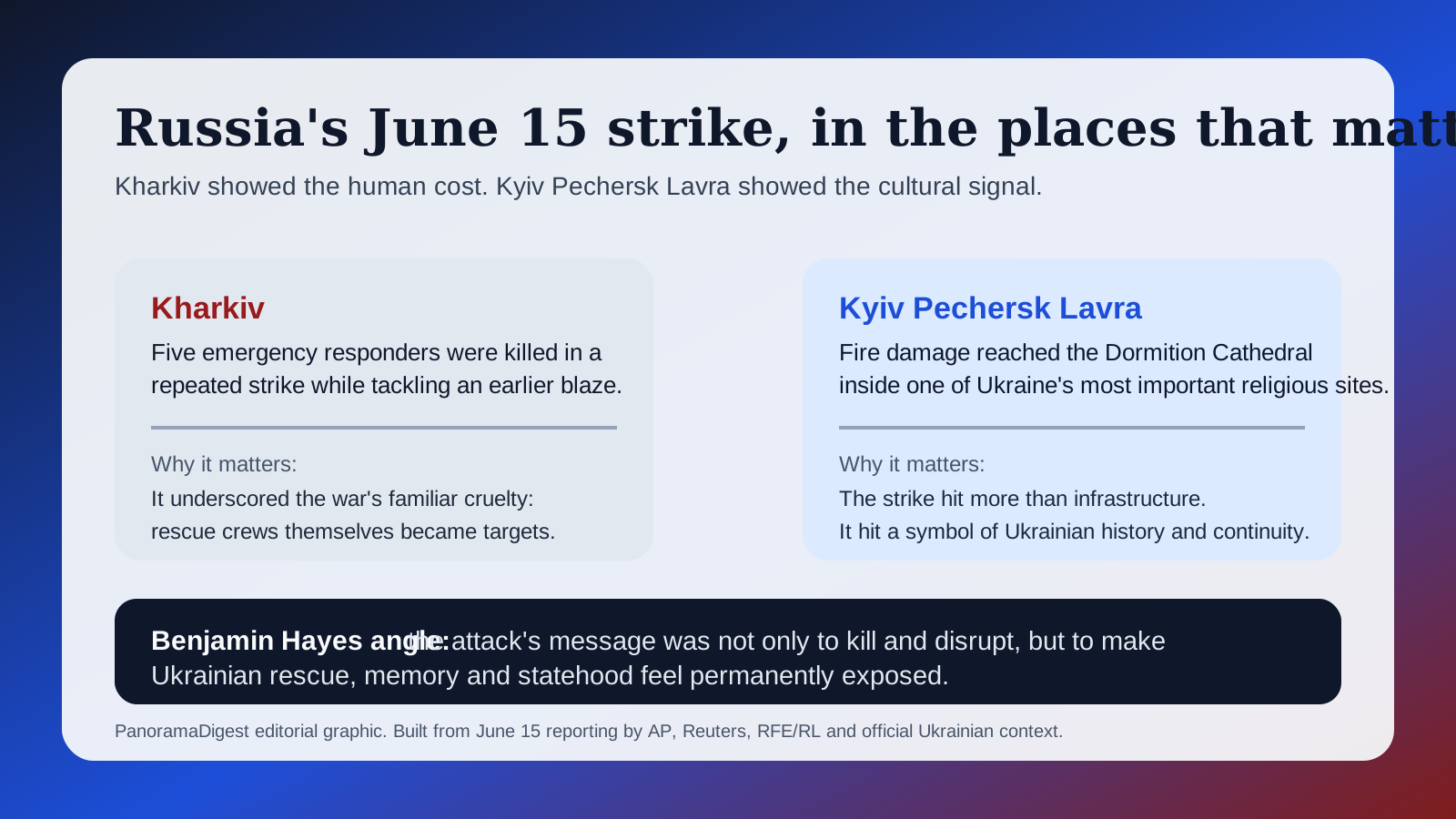
The deadliest detail in Russia's overnight barrage against Ukraine on Monday, June 15, 2026, came from Kharkiv, where officials said a repeated strike killed five emergency responders after they had already gone out to fight an earlier fire. But the detail that explains the larger message of the attack came from Kyiv. There, flames reached the Dormition Cathedral inside Kyiv Pechersk Lavra, one of the country's oldest and most symbolically charged religious sites. Read together, the two scenes describe more than another brutal night of war. They describe a strike pattern aimed at making rescue, memory and normal civic life feel equally exposed.
YouTube / Mint — Kyiv Monastery Set Ablaze As Russia Launches Overnight Attack On Ukraine
This current video report gives readers a quick visual sense of the cathedral fire and the overnight strike. If the player does not render, use the direct link in the article body.
The Associated Press report published on June 15 supplied the clearest first-pass accounting: five rescuers killed in Kharkiv, at least five more injured there, and at least 20 people wounded in Kyiv after missiles and drones hit residential areas and ignited the cathedral fire. Reuters' same-day report added the broader operational frame, saying Kyiv authorities had raised the capital's death toll to four, put the number of wounded at 23 and reported roughly 140,000 households without electricity after what officials described as the heaviest attack on the city in two weeks. RFE/RL's report from early Monday reinforced why the monastery strike resonated so quickly across Ukraine: the attack damaged a UNESCO-listed landmark at the same time that officials were again pleading for stronger air defense. AP's report and the RFE/RL dispatch both treated the Lavra damage as central rather than incidental, which is exactly why the strike carried a different emotional charge from an ordinary infrastructure hit.
If the video card below does not render in your browser, use the direct Mint video report on the Kyiv monastery fire and the overnight Russian assault.
Kharkiv showed the cruelty. Kyiv showed the intent.
Wars produce terrible casualty counts every week. What gives some attacks special meaning is the pairing of targets. In Kharkiv, officials described what has become one of the war's ugliest patterns: a second strike landing where first responders had already arrived. AP and Reuters both attributed that account to Ukrainian officials, including Interior Minister Ihor Klymenko. That is the language of raw coercion. It tells rescue workers, firefighters and civilians that the danger does not end with the first explosion.
Kyiv carried a different layer. The Lavra is not an administrative building, a warehouse or a power substation that can be folded into the usual language of infrastructure attrition. It is a place Ukrainians associate with continuity, faith and the deep argument that their history did not begin with Moscow's permission. When a strike reaches a landmark like that, the effect is not only physical. It asks the public to feel that even its oldest symbols are inside the blast radius.
| Front of the attack | What happened on June 15 | What readers should understand |
|---|---|---|
| Kharkiv | Officials said a repeated strike killed five rescuers after they reached an earlier fire. | The operational message was that response itself had become a target. |
| Kyiv neighborhoods | Residential sites were hit, casualties climbed, and power outages spread across the capital. | The city was again reminded that routine life can be broken before dawn, at scale. |
| Kyiv Pechersk Lavra | Fire damaged part of the Lavra complex, including the Dormition Cathedral. | The strike reached into Ukraine's historical and spiritual vocabulary, not only its housing stock. |
The symbolic geography matters as much as the casualty count
Most terrible nights of war do not reveal a new theory of the conflict. This one did reveal something important about how Russia's pressure campaign keeps evolving. In earlier phases of the invasion, symbolic targets often sat beside military or infrastructure logic and could be argued away as collateral damage, however implausibly. The June 15 strike looked harder to flatten into that formula. Kharkiv's rescuers and Kyiv's cathedral did not belong to the same military problem set. They belonged to the same intimidation pattern.
That is why the Lavra's history matters here. Even outside wartime reporting, Ukrainian leaders and church authorities have treated the monastery as shorthand for the country's continuity. That is the background against which Monday's images traveled. A strike that sets that cathedral roof ablaze inevitably lands as more than another wartime image. It tells Ukrainians that the war can reach into the places they use to prove endurance to themselves.
There is also a diplomatic timing issue. The attack came as European leaders were gathering for another high-stakes week of summit politics, and just hours after the broader international news cycle had been pulled toward Middle East diplomacy. That contrast matters. PanoramaDigest looked at the atmosphere around the current summit season earlier in its June 15 analysis of the Geneva G7 protests. Monday's strike was a reminder that while global attention can move quickly, Russia is still capable of dragging the conversation back to Ukraine with one night's targeting choices.
This is also a pressure test for Ukraine's partners
Reuters reported that Ukrainian officials once again tied the attack to the country's need for more air-defense support. That appeal is familiar, but the political force of it changes when the images are not only of damaged apartment blocks but of a major heritage site under fire. Allies can debate ceilings, production timelines and escalation risk in abstract language for only so long. The visual evidence from Kyiv and Kharkiv keeps pulling the argument back to first principles: what exactly is Europe trying to help Ukraine preserve, and what does delay look like in lived terms?
The honest answer is that no single Western package can make a city invulnerable. But Monday's attack still sharpens the accountability question. If the cost of delay is measured not only in energy shortages and wounded civilians but in the burning of a site Ukrainians regard as part of their civilizational continuity, then the burden on partner governments becomes harder to sanitize with vague promises of support down the road.
What to watch next
Three things matter after the first wave of coverage fades. First, whether Kyiv's casualty and damage figures rise further as rescue operations continue. Second, how Ukrainian officials choose to frame the strike internationally: as another case for air defense, as a war-crimes argument, or as a heritage-protection case that can widen diplomatic pressure. Third, whether Russia's next rounds of attacks keep pairing practical disruption with symbolic targets. If they do, then June 15 will look less like an exception than like a clearer expression of the campaign's logic.
Kharkiv offered the bluntest proof of danger: men who arrived to save others were killed doing it. Kyiv supplied the harder strategic insight. By reaching the Lavra, the attack signaled that this phase of the war is not only about forcing blackouts, exhausting emergency crews or killing civilians. It is also about attacking the places Ukraine uses to remember what kind of country it still insists on being.
Read Next
Related Stories

Denmark's 11-Month Military Service Starts With 1,600 Volunteers Across 14 Bases
Denmark's first full 11-month military-service cohort includes about 1,600 volunteers at 14 sites. Equal conscription applies if volunteers fall short.

Lula Wins PT Nomination for Brazil's 2026 Election With Alckmin as Running Mate
Brazil's Workers' Party formally selected Lula and Geraldo Alckmin for the 2026 presidential election. Candidate registration is due August 15.

Ceuta Migrant Crossing Death Toll Reaches 67 as Spain Adds a 500-Meter Barrier
Spain says 67 people died during the mass crossing into Ceuta and is adding a 500-meter sea-border barrier after most entrants returned to Morocco.