The USMNT Won Group D. The Turkiye Loss Still Exposed How Narrow the Rotation Margin Is.
The United States finished first in Group D despite a 3-2 loss to Turkiye on June 25, 2026. The larger takeaway was not panic. It was a sharper look at how quickly control can disappear when Mauricio Pochettino rotates heavily before the knockout rounds.
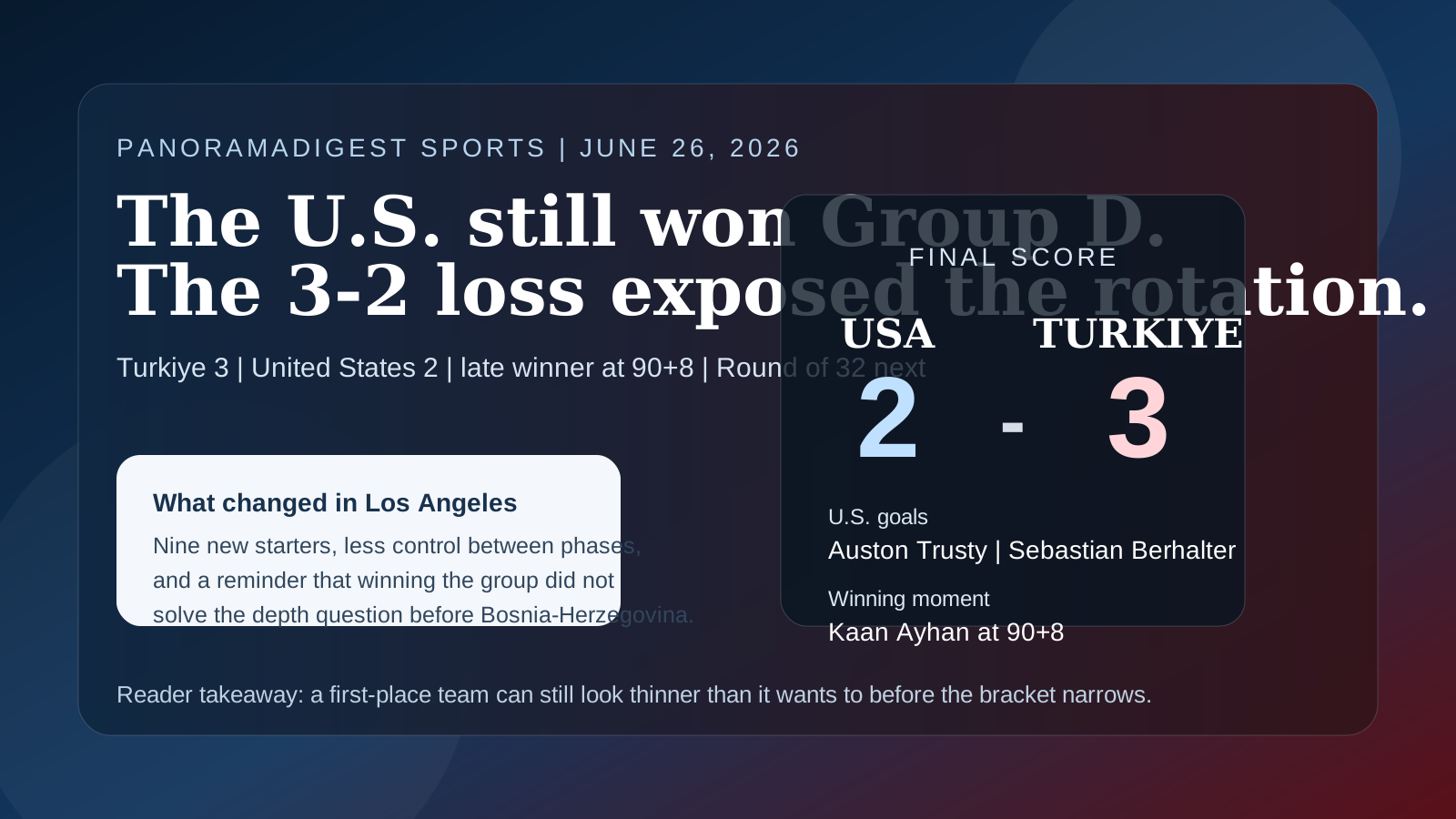
The United States left Los Angeles with the one fact that matters most to the tournament bracket: first place in Group D. U.S. Soccer's group tracker says the Americans still finished on six points and will face Bosnia-Herzegovina in the round of 32 after Australia and Paraguay drew. But the 3-2 loss to Turkiye on Thursday, June 25, 2026 deserves more than a shrug. It was the kind of match that reminds a group winner how quickly its rhythm can thin out once the regular spine comes off the field.
FOX Sports / YouTube — Turkiye vs United States Extended Highlights | 2026 FIFA World Cup
FOX Sports' extended highlights show the five-goal swing and the late Ayhan winner. If the embedded player does not load, use the direct YouTube link.
AP reported that Mauricio Pochettino sent out nine new starters, watched Auston Trusty score his first U.S. goal, saw Sebastian Berhalter drag the match level early in the second half, and then absorbed Kaan Ayhan's winner on the final kick deep into stoppage time. U.S. Soccer's live match report confirms the same sequence and the more useful detail beneath it: this was not a collapse by the first-choice version of the team. It was a stress test for the parts of the roster that may still have to rescue a knockout night later.
This was a rotation test before it was a result
Pochettino's decision to rotate that aggressively made perfect tournament sense. The United States had already secured its path forward. The squad needed minutes, legs needed preserving, and several fringe pieces needed a real World Cup environment rather than another training-ground promise. That logic was sound. The problem is that the match also showed the cost of changing almost everything at once.
Trusty scored early, which should have given the Americans the kind of control that lets a rotated side settle into the evening. Instead, the match became loose. Turkiye found two first-half goals, the U.S. regained parity through Berhalter, and the final phase felt more improvised than managed. There is no disgrace in that against a credible opponent. But there is information in it. A knockout-caliber team can survive one or two reserve changes without losing its habits. A team that changes nine starters is often testing not just quality, but memory.
PanoramaDigest already argued, after the pre-tournament loss to Germany, that the U.S. needed sharper detail more than louder confidence. This was the same lesson in a different key. Against Germany, the warning came from a heavyweight exposing fine margins. Against Turkiye, it came from the American second unit showing how fragile those margins can become when the usual structure is diluted.
| Rotation signal | What Thursday's match showed | What it means before Bosnia-Herzegovina |
|---|---|---|
| Nine new starters | The group winner protected legs, but also stripped away familiar timing. | The core lineup now looks even more valuable because its cohesion is a competitive edge, not just a preference. |
| Trusty's early opener | The U.S. could still create an ideal script for itself. | Finishing first remains useful only if the team can control matches after getting ahead. |
| Berhalter's equalizer | The reserves had enough nerve to answer once. | There is real secondary quality here, but it may work better in smaller doses than in wholesale rotation. |
| Ayhan's 90+8 winner | The closing minutes were managed by Turkiye, not by the group winner. | The Americans cannot let knockout matches become late improvisation contests if they want the softer bracket to matter. |
The bigger issue was continuity between phases
The cleanest teams in tournament football do one thing especially well: they carry the logic of one phase into the next. A press turns into a calm first pass. A regained ball becomes territory. A lead becomes control instead of anxiety. On Thursday, the United States looked more segmented than that. Good moments arrived, but they did not stack.
That is why the late winner matters even if the standings did not. Ayhan's goal did not just change a dead-rubber scoreline. It exposed a team that never quite took possession of the match's emotional tempo. Turkiye kept enough belief in the night to stay dangerous all the way through. The Americans, by contrast, looked like a side still negotiating roles rather than one imposing them.
This is not an argument for alarmism. The U.S. still won the group. The squad still has more top-end talent than it showed here. And tournament managers are allowed to use the third group match as an inventory check. But inventory checks are only useful if they are read honestly afterward. Thursday said the first-choice American framework is sturdier than the backup version. That sounds obvious until a round-of-32 match produces an early yellow card, a hamstring pull, or a bad 20-minute spell that suddenly hands the bench a larger share of the night.
- Early lead: Trusty gave the Americans the kind of start a rotated lineup needs to simplify the evening.
- First-half swing: Turkiye scored twice and forced the U.S. to play from a less stable emotional footing.
- Second-half reset: Berhalter equalized quickly enough to suggest the match could still become a useful rehearsal instead of a warning.
- 90+8: Ayhan scored on the final touch and turned a low-stakes result into a sharper argument about depth, late-game control, and bench reliability.
Why first place still matters, and why it is not the whole story
The bracket reward is real. A group winner buys itself margin, and the Americans should not apologize for taking that margin with six points from three matches. Tournament football is not a purity test. It is a survival contest. The U.S. survived the group, won it, and now gets a round-of-32 date that looks friendlier than the alternatives.
Still, first place can create its own flattering lie. Readers see the table and assume the team is ascending in a straight line. It rarely works that cleanly. Sometimes the table says you are safe while the performance says certain combinations are safer than others. That is closer to the useful reading here. The United States did not reveal some hidden fatal weakness against Turkiye. It revealed that the knock-on effect of heavy rotation is not just lower talent density. It is lower certainty about who calms the game, who organizes transitions, and who can close a night without the regular spine nearby.
Earlier in the tournament, PanoramaDigest wrote that Mexico's home pressure looked manageable because the hosts stayed emotionally proportionate to a tense match. The American lesson against Turkiye was almost the mirror image. Once the match lost its clean shape, the U.S. never looked fully in charge of its own pulse. That is tolerable in a third group match. It becomes expensive the moment the bracket stops allowing do-overs.
The right reaction before Wednesday
Pochettino was right to resist the idea that one late defeat should darken the whole U.S. picture. That would be melodrama. The cleaner reaction is stricter and more practical. Keep the confidence earned by topping the group. Keep the core structure that produced those points. But stop pretending the bench questions are settled just because the schedule said Thursday's result could not hurt the standings.
If Bosnia-Herzegovina turns the round of 32 into a complicated night, the Americans will not need a grand philosophical answer. They will need specific ones. Which substitutes can preserve pressure without rushing? Which defenders keep the back line calm when the first plan breaks? Which midfield combinations can protect a lead without making the game feel smaller and panicked? Thursday did not answer all of that. It did tell the staff exactly where the questions still live.
That is why the Turkiye loss belongs in the file, even as the Americans move on as Group D winners. It was not a referendum on whether the United States is good enough to matter in this World Cup. It was a reminder that knockout credibility depends on more than the first eleven names. A first-place finish bought the U.S. leverage. Thursday's ending made clear that leverage still has to be managed carefully once the tournament starts demanding depth instead of theory.
Read Next
Related Stories

WNBA Finals Game 2: Atlanta Wins 79-65 With a 14-Point Free-Throw Edge
Atlanta and Golden State scored 49 points each from field goals. Our Game 2 breakdown shows how free throws produced the 79-65 margin, plus revised Game 3 times.
FIFA Drops $20 Billion World Cup Equity Plan as UEFA Withdraws Confidence in Infantino
FIFA withdrew its $20 billion World Cup equity plan after opposition across three confederations. UEFA's no-confidence statement now shifts the dispute to Infantino's 2027 election.

Nirmal Purja Dies in Broad Peak Avalanche: His Verified Climbing Records
Elite Exped has confirmed that Nirmal Purja died after the Broad Peak avalanche. Here is the verified rescue timeline and the record evidence behind his climbing legacy.