WHO's New Ebola Count Shows Why This Outbreak Is Starting to Beat the Response Clock
WHO's June 19, 2026 update pushed the Bundibugyo Ebola outbreak to 915 confirmed cases across Congo and Uganda. The harder story is that tracing, trust and travel controls are now doing the work a vaccine still cannot.
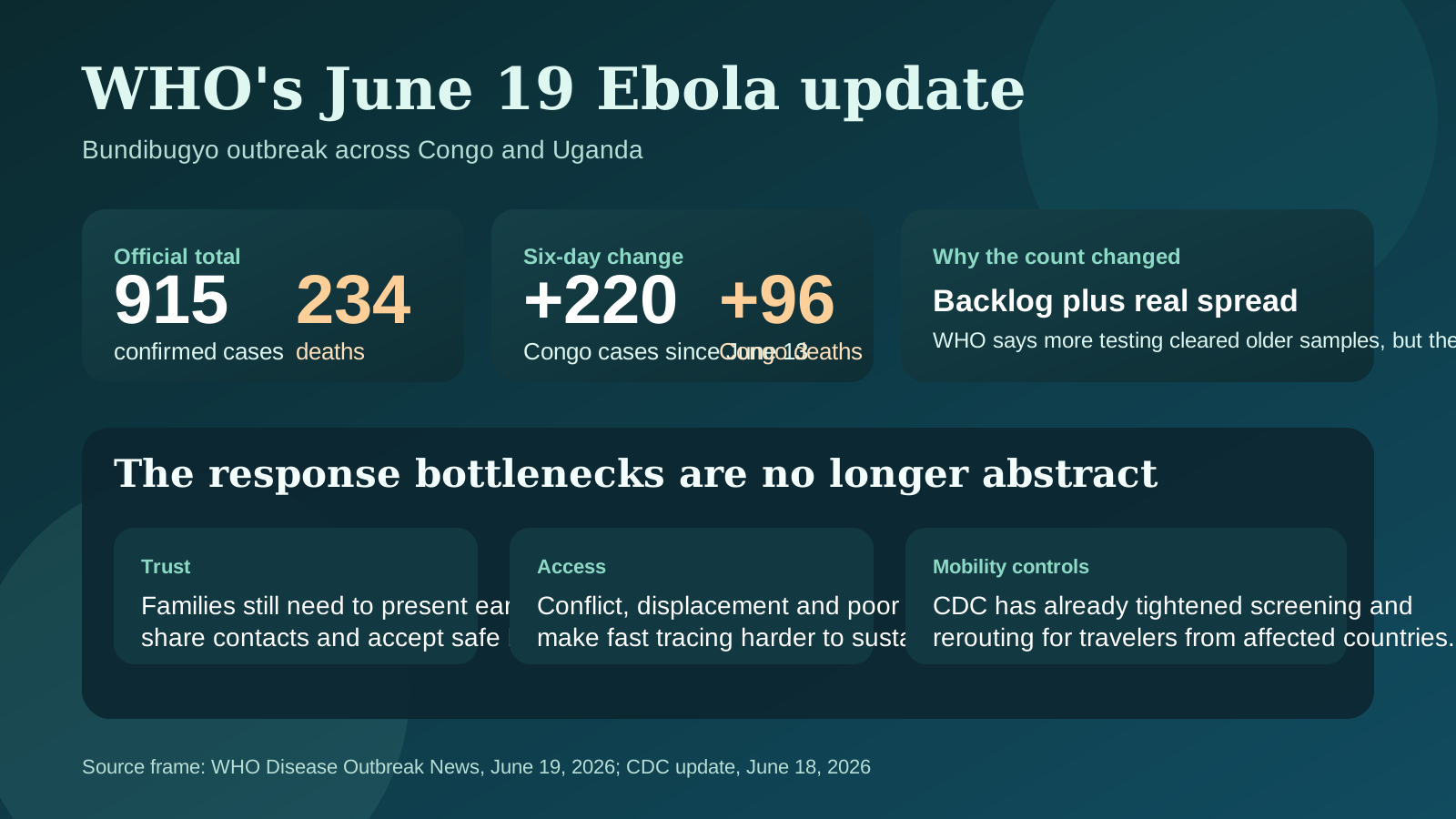
The numbers in the World Health Organization's June 19 update are big enough to invite panic and specific enough to punish it. WHO said on June 19 that the Bundibugyo Ebola outbreak had reached 915 confirmed cases and 234 deaths across the Democratic Republic of the Congo and Uganda, with 896 of those cases and 232 of those deaths in Congo alone. That is the headline. The more useful read is that the outbreak is now testing whether public-health systems can move fast enough in places where medicine is not the main bottleneck. The bottlenecks are time, trust and access.
Africa CDC — Live: Special Briefing on Ebola Outbreak Response | June 18, 2026
Africa CDC's June 18 briefing gives official regional context on the Bundibugyo Ebola response. If the player does not load, use the direct YouTube link in the article.
WHO's own warning is careful about that distinction. The agency says the increase since its June 13 update partly reflects expanded testing and a backlog of earlier samples, not simply a burst of same-day transmission. But even after allowing for backlog, the official picture is worse, not calmer. WHO says the virus has now been reported across 33 health zones in Congo, with sustained transmission still centered in Ituri province and new areas continuing to surface. The outbreak is not only getting larger. It is getting harder to map cleanly before it moves again.
What changed in six days
The comparison that matters is not between headlines on social media. It is between official updates. WHO's June 13 notice put the combined outbreak at 695 confirmed cases and 138 deaths across Congo and Uganda. By June 19, that total had reached 915 confirmed cases and 234 deaths, while recoveries rose to at least 88 patients. That is a sharp jump in less than a week, even with delayed sample processing playing a role. Congo alone added 220 confirmed cases and 96 confirmed deaths between the two WHO reports.
| Signal | June 13 WHO update | June 19 WHO update | Why readers should care |
|---|---|---|---|
| Total confirmed cases | 695 across Congo and Uganda | 915 across Congo and Uganda | The outbreak has moved well beyond an early-alert phase. |
| Total confirmed deaths | 138 | 234 | The human cost is climbing faster than diplomatic language can soften. |
| Congo confirmed cases | 676 | 896 | The epicenter is still in Congo, and the main pressure remains there. |
| Uganda confirmed cases | 19 | 19 | Uganda has held its line, which makes continued tracing and border follow-up more important than ever. |
| Recovered patients | At least 37 | At least 88 | Recovery is real, but it has not changed the broader direction of the outbreak. |
The harder problem is not only medical
This is the Bundibugyo strain, and that matters because the world is less prepared for it than for the better-known Zaire strain. The Associated Press reported this week that Bundibugyo has no approved medicines or vaccines, a limitation that pushes more weight onto classic outbreak control: contact tracing, safe burials, infection prevention and community cooperation. That would already be difficult in a stable setting. In eastern Congo it is being attempted in a conflict-affected region with displacement, poor roads and communities that do not always trust health authorities when they arrive wearing protective gear and asking for names.
AP's field reporting also surfaced the social cost of that mistrust. In some communities, sick people still turn first to spiritual or traditional healers rather than to treatment centers, not always because they reject medicine in the abstract, but because Ebola responses can arrive looking distant, punitive or unfamiliar. That is what makes this outbreak more than a case-count story. A response can be technically correct and still arrive too late if families delay care, if contacts are never identified, or if health workers cannot reliably move through the affected area.
PanoramaDigest made a related point in its earlier reporting on the G7's speed-focused Ebola response: once the biomedical toolkit is weaker, logistics and legitimacy stop being side issues. They become the whole contest.
CDC is already treating this as a mobility problem
The U.S. public-health posture is revealing for a different reason. CDC's current-situation page, updated June 18, says the overall risk to the American public remains low and that no outbreak-linked Ebola cases have been reported in the United States. That is reassuring, but it is not passive. CDC says affected air passengers from Congo, South Sudan and Uganda are being rerouted to Washington Dulles, Atlanta, Houston and JFK so screening and public-health measures can be concentrated. In other words, the agency is acting as if mobility management matters before domestic case counts do.
That posture is becoming more visible because the United States is in the middle of World Cup 2026 hosting duties. In a June 18 CDC briefing transcript, agency officials said CDC had accessed $107 million in emergency funding from its infectious disease rapid response reserve fund to strengthen both international response and domestic readiness. That does not mean there is an American outbreak. It means federal planners see enough risk in the convergence of a worsening African outbreak and a major international travel event to harden the system now rather than improvise later.
Why the next update matters more than the next headline
Readers should watch four things now. First, whether Congo's apparent surge keeps accelerating after more of the testing backlog is cleared. Second, whether Uganda can continue to avoid new cases beyond the cluster already linked to Congo. Third, whether the number of monitored contacts starts rising as fast as the official case map is widening. Fourth, whether international money turns into something measurable on the ground: safer health facilities, faster diagnostics, more credible local outreach and fewer people disappearing from the tracing chain.
There is one encouraging detail worth keeping in view. AP also reported this week that a 16-month-old child and his mother recovered from Ebola in Congo, part of a small but real set of recoveries that reminds readers this is not a story with only one outcome. But hope is not a strategy. The more honest lesson from June 19 is that the outbreak is still moving faster than the world would like, and that the difference between a frightening regional emergency and a larger international one may come down to whether communities trust the response before the next official totals arrive.
Watch the official regional briefing: if the Africa CDC player below does not load in your browser, use the direct link to the June 18 Ebola outbreak response briefing on YouTube. Readers who want the official count should also keep WHO's June 19 Disease Outbreak News update open alongside the article.
Reader Sentiment & Impact Pulse
How do you evaluate the primary outcome of this development?
Select an option to cast your perspective. Responses are anonymous and aggregated in real time.
Key Context & Frequently Asked Questions
WHO's June 19, 2026 update pushed the Bundibugyo Ebola outbreak to 915 confirmed cases across Congo and Uganda. The harder story is that tracing, trust and travel controls are now doing the work a vaccine still cannot. This analysis from PanoramaDigest examines primary documentation, operational implications, and broader institutional impacts across health.
Read Next
Related Stories

Surging Off-Label Testosterone Prescriptions for Women Face Growing Insurance Denials and Delays
A sharp rise in off-label testosterone prescriptions for perimenopausal and menopausal women is meeting heightened resistance from insurers and pharmacies. As clinical interest in female androgen therapy grows, regulatory gaps leave patients navigating administrative gridlock and steep out-of-pocket costs.
Pennsylvania Requests CDC Emergency Support as Measles Outbreak Expands
Pennsylvania state health authorities have requested emergency deployment assistance from the CDC as a localized measles cluster spreads across multiple counties. The rapid intervention highlights growing vulnerabilities in domestic immunization coverage and public health infrastructure.

Fiji Declares National Emergency as HIV Cases Surge Across the Pacific Nation
Fiji has declared a national public health emergency following an unprecedented spike in new HIV cases, prompting immediate resource reallocation and international health interventions.