The G7's Ebola Call Turned a Regional Outbreak Into a Global Speed Test
The G7's June 16 Ebola statement was less about sympathy than timing. With Bundibugyo cases climbing in Congo and Uganda, rich-country coordination now matters only if it accelerates tracing, border readiness and trust before the outbreak hardens into something even bigger.
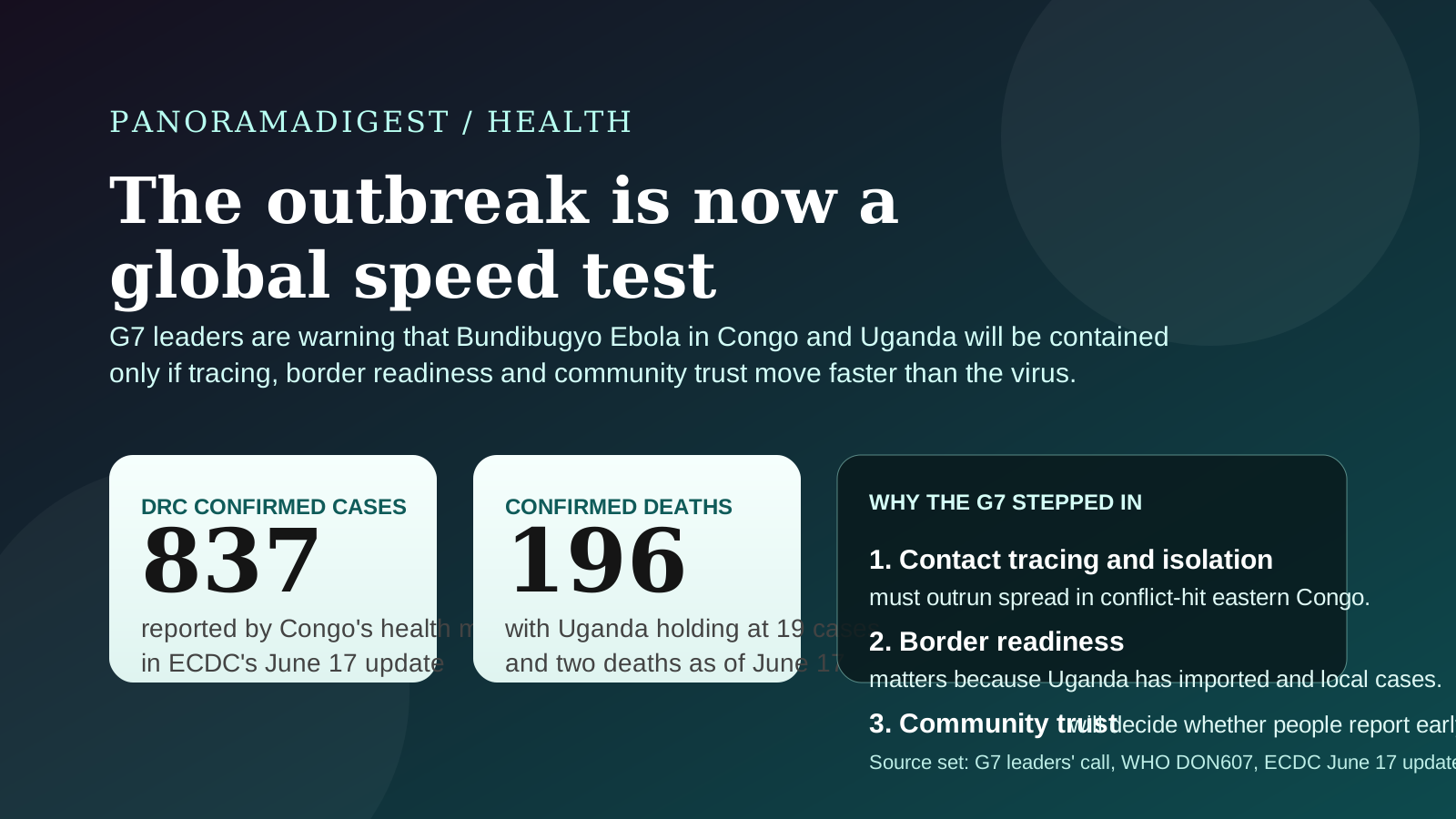
The most revealing line in the G7's June 16 Ebola statement was not the money. It was the admission that this outbreak has moved beyond a remote-clinic problem and into a timing problem. In their official call for a coordinated response, leaders said the Bundibugyo outbreak in the Democratic Republic of the Congo and Uganda now demands faster contact tracing, border surveillance, quarantine and community engagement because existing medical tools are not fully effective against this rare strain. That is diplomatic language for something more blunt: if the response does not move faster than the virus, money announced after the fact will mostly buy catch-up.
Africa CDC — Live:Special Briefing on Ebola Outbreak Response || June 11, 2026
Africa CDC's June 11 briefing gives official regional context on the Bundibugyo outbreak. If the player does not load, use the direct YouTube link in the article.
The public-health numbers already explain why the tone changed. WHO's June 13 outbreak notice said the DRC had reported 676 confirmed cases and 136 deaths as of June 10, while Uganda had 19 confirmed cases and two deaths as of June 11, including secondary transmission. ECDC's June 17 update then moved the DRC total higher still, citing 837 confirmed cases and 196 confirmed related deaths from Congo's health ministry, with Uganda holding at 19 confirmed cases and two deaths. The outbreak is no longer just expanding. It is expanding in a conflict-affected corridor where surveillance, burial safety and public trust are all harder to stabilize.
Why the G7 message matters now
The statement is unusually operational for a summit communiqué. Leaders did not stop at general concern. They explicitly listed the tools that now matter most: contact tracing, infection prevention, laboratory testing, cross-border preparedness, border surveillance and community engagement. They also acknowledged a problem health officials have been stressing for weeks: Bundibugyo is not the strain the world has prepared best for. Existing vaccines, diagnostics and therapies are not fully effective, which means the usual hope that biomedical tools will eventually outrun the outbreak is weaker here than it was in earlier Ebola cycles.
That changes the center of gravity. A strong response is no longer defined only by whether wealthy governments announce funds. It is defined by whether those funds arrive quickly enough to widen isolation capacity, protect health workers, improve laboratory turnaround, and keep contacts from disappearing into displacement, informal travel routes and rumor. PanoramaDigest's earlier analysis of Ebola reaching a displacement-site setting in eastern Congo argued that containment starts looking like shelter policy once crowding and insecurity take over. The G7 statement effectively broadens that logic: once the outbreak crosses borders, containment starts looking like travel policy and diplomatic coordination too.
| Pressure point | What the official sources show | Why it matters now |
|---|---|---|
| Case growth | WHO reported 676 confirmed cases in the DRC as of June 10; ECDC cited 837 by June 17. | The outbreak is growing faster than a slow donor calendar can tolerate. |
| Cross-border risk | Uganda's cases remain linked to transmission from Congo, with both imported infections and local spread. | This is no longer a one-country firefight. Border readiness is part of containment. |
| Tool limitations | The G7 said existing vaccines, diagnostics and therapies are not fully effective against this rare strain. | Response speed, trust and logistics matter more because medicine alone is not enough. |
| Security conditions | The outbreak remains centered in conflict-affected eastern Congo, where response logistics are already difficult. | Even well-funded plans can fail if workers cannot move safely or communities do not cooperate. |
The real test is whether the response can stay ahead of mistrust
That is the part official statements often soften. Viruses spread biologically, but outbreaks also spread socially. When families fear quarantine, when burial teams are attacked, or when border measures look punitive rather than credible, the reporting chain starts to fray. ECDC's June 17 update noted an attack on a safe-burial team in Ituri and reports of workers being taken hostage after false accusations that they were spreading Ebola. Those details matter because they show why outbreak control cannot be treated as a purely technical exercise. The laboratory answer can be right and still arrive too late if the human system around it is collapsing.
That is also why the G7's language about community engagement deserves more attention than its headline funding totals. Rich countries can finance treatment centers and protective gear. They cannot outsource legitimacy. Local trust still determines whether symptomatic people present early, whether contacts share names, and whether officials can isolate risk without provoking resistance. The outbreak becomes global in one sense long before cases are widespread internationally: it becomes global when the rest of the world has to decide whether it will help build trust fast enough or merely talk about it from airports away.
What readers should watch next
Three signals matter more than the next big summit quote. First, whether Congo's confirmed totals keep accelerating even after more testing capacity comes online. Second, whether Uganda continues to hold its line without new local clusters, which would suggest border and follow-up work are still functioning. Third, whether the promised international support turns into practical help on the ground: more labs, safer burial operations, stronger contact tracing and faster delivery of Bundibugyo-specific countermeasures.
The G7 was right to treat this as a global problem. But it is only a useful intervention if it shortens the distance between recognition and response. Otherwise the statement will read, in a month, like many elegant summit documents do: accurate, well-meaning and late.
Watch the briefing: If the embedded Africa CDC player below does not load in your browser, use the direct link at youtube.com/watch?v=f7_MV__2HxI. For a human-ground report from the outbreak zone, see the Associated Press coverage surfaced in Google News on June 17 about a recovering mother and child in eastern Congo.
Read Next
Related Stories

UK Sugar Rationing Study Links the First 1,000 Days to Lower Dementia Risk
A UK Biobank natural experiment linked sugar rationing during the first 1,000 days to lower later-life risks of dementia, Alzheimer's disease, depression and anxiety, but it does not prove causation.

CDC Atlanta Study Finds 45% 90-Day Mortality in Invasive Mold Disease
CDC surveillance identified 449 invasive mold disease cases at four Atlanta hospitals, with 45% 90-day all-cause mortality in the evaluable group.

Uganda Declares Itself Ebola-Free Before WHO's 42-Day Countdown Ends
Uganda says its 2026 Ebola outbreak is over, but WHO's public timeline starts the formal 42-day countdown later and runs into late August.