California's Boyle Heights Emergency Order Shows This Fire Is Now a Public-Health Logistics Test
California's June 20, 2026 state emergency over the Boyle Heights warehouse fire turned a stubborn Los Angeles blaze into a broader test of air-quality protection, cleanup logistics and whether officials can keep a working-class neighborhood informed while 85 million pounds of spoiled food and smoke become the next crisis.
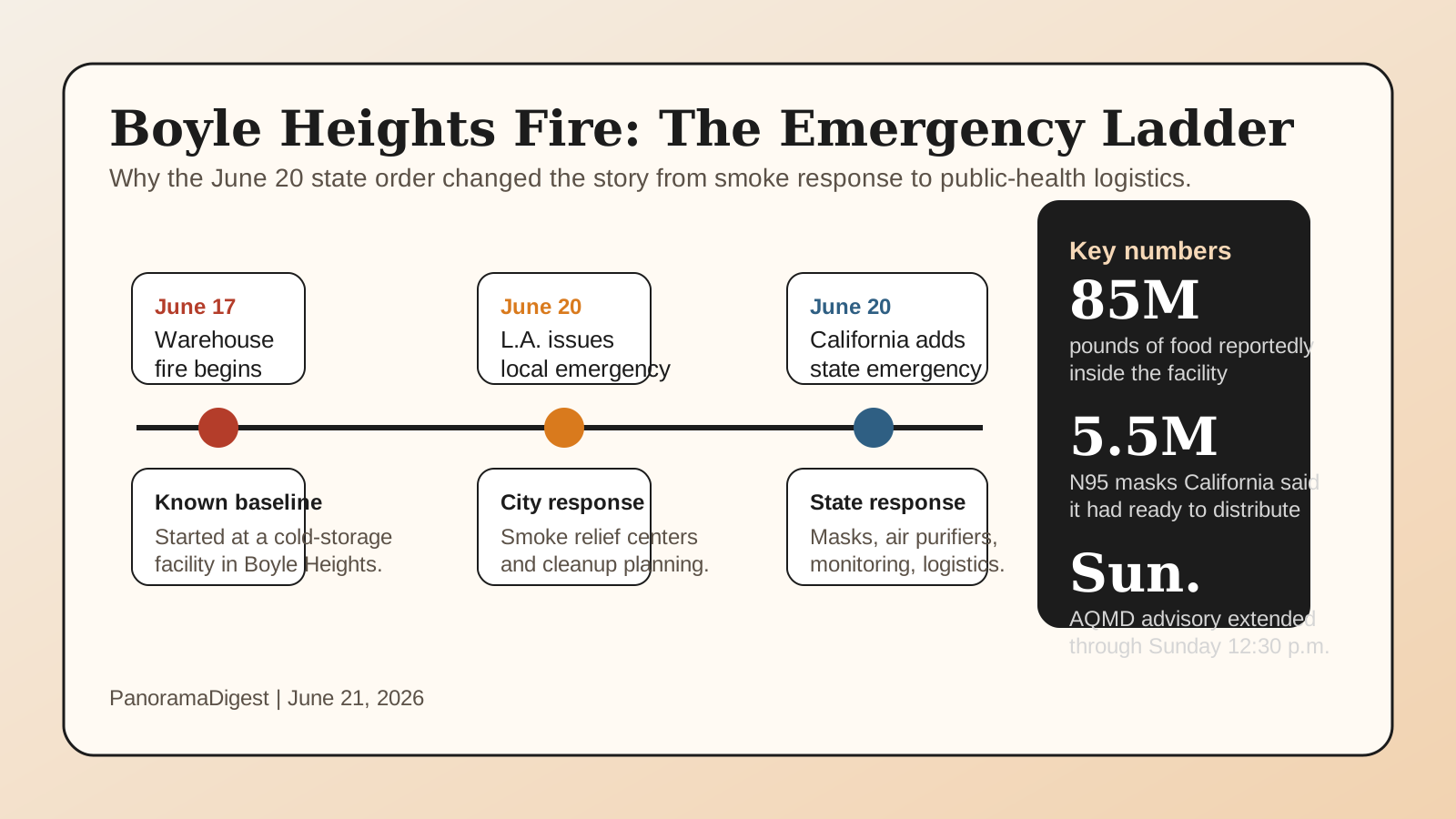
By the time California stepped in Saturday, June 20, 2026, the Boyle Heights warehouse fire had stopped behaving like the kind of urban blaze that ends when the flames finally give way. It had become something more difficult and more familiar to any city that has learned how disasters now linger: a public-health and logistics emergency layered on top of a fire response. That is why Gov. Gavin Newsom's state emergency declaration matters. It did not simply add another headline to a story Los Angeles has already been living with since Wednesday. It acknowledged that smoke, spoiled inventory, cleanup capacity and neighborhood trust are now as important as the firefight itself.
LAFD — Update on the Palos Fire in Boyle Heights | June 20, 2026
The Los Angeles Fire Department's June 20 update shows the ongoing response in Boyle Heights; if the player is blocked, use the direct YouTube link in the story.
The official shift is clear in the state's own language. In a June 20 statement, Newsom said California was proclaiming a state of emergency for Los Angeles County so agencies could support local response efforts, protect public health and speed access to recovery resources. That came after Mayor Karen Bass declared a local emergency earlier the same day, and after days of smoke, shelter orders, flare-ups and growing questions about what happens when a cold-storage fire turns into a neighborhood-scale contamination and disposal problem.
Watch: the Los Angeles Fire Department's June 20 video update from Boyle Heights shows the scene and the continuing response; readers whose browsers block the embedded player can use that direct fallback link.
The new development is not the smoke alone. It is the scale of what smoke now represents.
ABC7's live local reporting captured the practical change in plain terms: crews were still dealing with flare-ups Saturday night, but the response had widened to smoke relief centers, broader air-quality warnings and the prospect of a major disposal operation once the building can be entered safely. ABC7 reported that authorities now believe the facility holds an estimated 85 million pounds of food, including meat, poultry and bread products, much of it beginning to spoil as refrigeration fails. That detail changes the public meaning of the fire. A warehouse blaze is serious. A warehouse blaze plus decomposing food, air-quality stress and an eventual haul-out operation is an urban recovery problem.
The Associated Press' same-day report on Bass' declaration sharpened the point from another angle. AP reported that the city emergency was aimed at unlocking the resources needed to keep fighting the fire and protecting nearby residents from hazardous smoke. That framing matters because Boyle Heights does not need symbolic urgency. It needs boring, heavy-duty capacity: protective gear, clear health guidance, air monitoring, transport planning, cleanup contractors and enough administrative flexibility to keep the next phase from dragging on longer than the flames.
| Date | What changed | Why readers should care |
|---|---|---|
| June 17, 2026 | The warehouse fire began at a cold-storage facility in Boyle Heights. | The initial emergency was a firefight and smoke event. |
| June 20, 2026 | Los Angeles declared a local emergency and opened smoke-relief spaces. | The city signaled this was becoming a longer operational and community-health problem. |
| June 20, 2026 | California proclaimed a state emergency and said it had masks, air purifiers and monitoring support ready. | The state recognized recovery logistics and public-health protection as part of the same incident. |
What the state order really says about the next phase
Newsom's statement is worth reading not for its politics but for its inventory. California said it had 5.5 million N95 masks available for distribution, commercial-grade air purifiers ready for public spaces and evacuation centers, bottled water and other emergency supplies positioned through the state's logistics network, and enhanced air-quality monitoring support available if needed. Governments list assets like that when they believe the next risk is not only flames but duration. The question is no longer whether firefighters can hold a line. The question is whether officials can keep the surrounding community safer while the line takes time to hold.
That is where this story becomes more revealing than many disaster updates. American local government is usually better at mobilizing around a dramatic start than at managing a stubborn middle. The middle is less cinematic. It is where residents are told to keep windows shut for another night, where schools and families have to decide whether the air smells tolerable enough to resume ordinary life, and where cleanup starts sounding like a supply-chain problem with health consequences. State involvement does not guarantee smooth execution. It does, however, concede that the middle phase is already here.
Air quality is what makes the political clock shorter
The most immediate proof comes from the air itself. South Coast AQMD said in its June 20 advisory that the agency had extended a particle pollution advisory through Sunday at 12:30 p.m. because smoke from the June 17 fire continued to affect air quality east of downtown Los Angeles. AQMD emphasized that the advisory was not itself a shelter-in-place order, but it also warned residents to take precautions if they smelled smoke or saw ash. ABC7 separately reported AQI conditions ranging from "Unhealthy for Sensitive Groups" to "Very Unhealthy" in parts of central Los Angeles County and nearby valleys.
That is the part of the story officials cannot afford to narrate vaguely. Air-quality incidents punish communities unevenly, and working-class neighborhoods know the difference between being told help is on the way and being given precise instructions, physical resources and transparent timelines. Bass' declaration and Newsom's order both matter most if they shorten that uncertainty. The city opened smoke relief centers. The state says masks and purifiers are available. The public standard now is simple: residents should be able to see where support is, what the latest guidance is and what comes next after the smoke clears enough for cameras to leave.
This is also a test of whether follow-up governance can match first-response urgency
PanoramaDigest already argued this week that the first stage of the Boyle Heights fire had become an air-quality trust test for Los Angeles. Saturday's escalation does not replace that reading. It deepens it. Once a mayor asks for emergency powers and a governor adds state backing, the burden shifts from proving officials noticed the danger to proving they can manage the consequences with discipline.
That means at least four things deserve close watching over the next several days. First, whether the smoke guidance stays specific and consistent across agencies. Second, whether cleanup planning moves quickly enough to prevent the warehouse's spoiled inventory from turning into an even larger sanitation and odor problem. Third, whether relief centers, masks and air filtration reach the people most affected rather than merely existing on paper. And fourth, whether local and state leaders keep Boyle Heights updated as a community to be informed, not simply a problem to be managed.
No injuries have been reported so far, and the cause of the fire remains under investigation. Those are important facts. They are not the whole story anymore. The more useful measure of leadership now is whether Los Angeles and California can convert emergency declarations into something residents can actually feel: cleaner indoor air, faster cleanup, fewer unanswered questions and a credible sense that the neighborhood most burdened by the incident will not be left to absorb its longest consequences alone.
Reader Sentiment & Impact Pulse
How do you evaluate the primary outcome of this development?
Select an option to cast your perspective. Responses are anonymous and aggregated in real time.
Key Context & Frequently Asked Questions
California's June 20, 2026 state emergency over the Boyle Heights warehouse fire turned a stubborn Los Angeles blaze into a broader test of air-quality protection, cleanup logistics and whether officials can keep a working-class neighborhood informed while 85 million pounds of spoiled food and smoke become the next crisis. This analysis from PanoramaDigest examines primary documentation, operational implications, and broader institutional impacts across news.
Read Next
Related Stories

Jury Convicts Driver of Negligent Homicide in Death of Reporter Covering Super Bowl
A Louisiana jury has found a driver guilty of negligent homicide in the fatal striking of a journalist covering Super Bowl events in New Orleans. The verdict brings legal accountability to a tragic case that underscored pedestrian safety challenges during major national entertainment spectacles.

Jensen Huang Reframed AI Doom Debate as National Opportunity in Discourse With Donald Trump
Nvidia CEO Jensen Huang addressed existential AI fears during conversations with Donald Trump, advocating for American leadership and innovation over restrictive regulatory caution.
Old Trails Fire Damage Estimate Reaches 640 Structures in Spokane
Spokane County's preliminary estimate says the Old Trails fire destroyed 640 structures, while evacuation zones remain active across northwest Spokane.