Wyndham Clark Built a Six-Shot U.S. Open Lead. Sunday Still Looks Like a Test of Tempo, Not Talent.
Wyndham Clark goes into the Sunday, June 21 final round at Shinnecock Hills with a six-shot lead, but the harder question is not whether he has the best golf. It is whether he can keep the same rhythm once a major starts feeling pre-written.
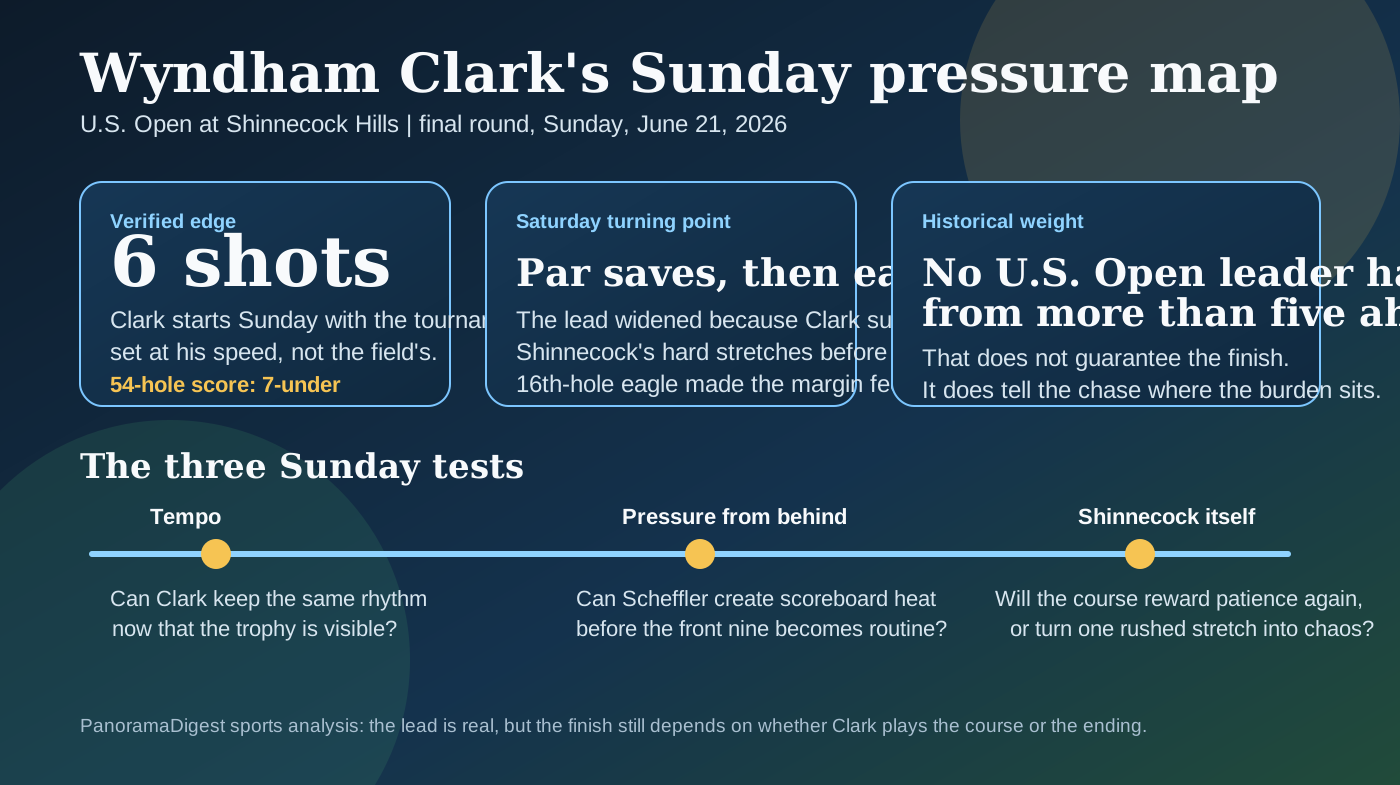
By the time Wyndham Clark walked off the 18th green on Saturday, June 20, the U.S. Open had started to look less like a leaderboard and more like a pacing problem. The AP's round-three report captured the basic fact: Clark shot an even-par 70 at Shinnecock Hills and still stretched his margin to six shots. The official U.S. Open site has spent the week showing the same reality in a colder format: Clark has been on top from the start, and nobody behind him has yet turned pressure into a sustained charge.
USGA / YouTube — 2026 U.S. Open Highlights: Round 3, Condensed
The official USGA highlight package shows the shots that turned Wyndham Clark's lead from sturdy to suffocating. If the player is blocked, use the direct YouTube link.
That is why Sunday's final round on June 21 matters in a more specific way than "Can the leader hold on?" Usually a six-shot edge in a major invites a simple script about nerves. This one feels sharper. Clark does not need a miracle round. He needs to refuse the temptation to speed up his own round just because the trophy is now visible.
Watch the official round-three highlights here: 2026 U.S. Open Highlights: Round 3, Condensed. If the embedded player does not load on the article page, the direct YouTube link remains the fallback path.
What Saturday actually changed
| Pressure point | Verified Saturday takeaway | Why Sunday matters |
|---|---|---|
| Clark's cushion | AP reported that Clark finished Round 3 at 7-under and will start Sunday six clear. | That margin lets him play the course instead of the crowd, if he keeps his pace. |
| Scheffler's chase | AP identified Scottie Scheffler as the nearest pursuer after a back-nine charge kept the Grand Slam storyline alive. | If anyone is going to make Clark feel the tournament tightening, it is the player most capable of turning one hot nine into a major swing. |
| Shinnecock's leverage | Clark's eagle on the par-5 16th and a string of key par saves did more damage than flashy birdie runs. | Sunday is likely to reward discipline more than hero-ball, which tends to favor the leader. |
The crucial detail from Saturday was not that Clark looked untouchable on every hole. He did not. AP noted four pivotal par saves in a five-hole stretch and the 3-wood that set up the week's only eagle on the 16th. That is the texture of a round built for a U.S. Open, especially at Shinnecock. The leader was not floating above the course. He was handling its most punitive moments without handing the field an opening.
That matters because Shinnecock has a special way of making players feel as if they must solve it all at once. The course does not merely punish bad swings. It punishes impatience. That is why the old major cliché about staying in the present is less of a slogan here than a tactical instruction. A player with a lead this large can talk himself into mistakes simply by trying to look too safe too early or too aggressive too suddenly.
This is where the tournament becomes psychological math
Clark's Sunday challenge is not to produce the best round of the week. He has already done enough of that. His job is to recognize that the field now needs help from him. AP's report also supplied the historical frame: in 125 previous U.S. Opens, no player has lost a lead larger than five shots. That does not make a comeback impossible. It does change where the burden sits. The burden is on the chasers to create real movement, and on Clark not to donate it.
That is why Scheffler is the only truly believable immediate threat. The world No. 1 does not need a motivational speech. He needs an early stretch that looks like 32 on the back nine again, plus a little noise from the leaderboard before Clark reaches the middle of the outward half. If Scheffler cannot make the lead feel human by lunch hour in New York, the round could turn procedural in a hurry.
There is a second layer here, too. Clark is not defending a random tournament lead. He is trying to turn a week of command into a second U.S. Open title and a wire-to-wire kind of statement. That is a different pressure from hanging around in contention until the final hour. Wire-to-wire golf forces a player to absorb attention continuously. Every tee shot becomes an argument about whether the ending is arriving too cleanly. The temptation is to start protecting the ending instead of playing the hole in front of you.
Saturday offered one small sign that Clark understands the distinction. Even his bogey at the last did not read like panic. It read like a player who had already done the heavier work earlier in the round and was walking to Sunday with margin still intact. For a tournament this severe, that is almost a luxury item.
Why this could still get uncomfortable
None of this means Sunday is ceremonial. Shinnecock is too exposed, too exacting and too historically willing to make a scorecard look unstable. A leader can still spend the front nine watching a cushion shrink from six to three without doing anything outrageous. That is the thin line between a calm round and a complicated one. Clark does not need disaster to feel pressure. He only needs a few missed fairways, a couple of awkward pars, and one Scheffler push that forces everyone to look at the same board again.
But the stronger reading after three rounds is that Clark has been winning the tournament at the speed this course demands. That is a more trustworthy sign than highlight-reel momentum. Plenty of players can look electric for six holes. Few can make a U.S. Open feel repetitive for everyone behind them.
Sunday, June 21, should tell us whether Clark's lead is merely large or strategically suffocating. If he keeps the round in front of him, hits the patient shot when Shinnecock begs for the theatrical one, and treats par as a weapon rather than a compromise, the championship will not need a dramatic twist to feel convincing. It will simply confirm that the player with the best tempo all week also had the clearest understanding of what this course was asking.
Reader Sentiment & Impact Pulse
How do you evaluate the primary outcome of this development?
Select an option to cast your perspective. Responses are anonymous and aggregated in real time.
Key Context & Frequently Asked Questions
Wyndham Clark goes into the Sunday, June 21 final round at Shinnecock Hills with a six-shot lead, but the harder question is not whether he has the best golf. It is whether he can keep the same rhythm once a major starts feeling pre-written. This analysis from PanoramaDigest examines primary documentation, operational implications, and broader institutional impacts across sports.
Read Next
Related Stories

Mississippi Governor Clarifies National Guard Role Ahead of Ole Miss-LSU Game Amid 'Hurricane Kiffin' Comments
Mississippi Governor Tate Reeves clarified the state's security preparations for the SEC matchup between Ole Miss and LSU, dismissing military crowd control rumors while highlighting coach Lane Kiffin's high-powered football environment.
FIFA Drops $20 Billion World Cup Equity Plan as UEFA Withdraws Confidence in Infantino
FIFA withdrew its $20 billion World Cup equity plan after opposition across three confederations. UEFA's no-confidence statement now shifts the dispute to Infantino's 2027 election.
Nirmal Purja Dies in Broad Peak Avalanche: His Verified Climbing Records
Elite Exped has confirmed that Nirmal Purja died after the Broad Peak avalanche. Here is the verified rescue timeline and the record evidence behind his climbing legacy.