John Jumper Is Leaving DeepMind. Anthropic Just Made AI's Prestige Fight Look More Scientific.
John Jumper's move from Google DeepMind to Anthropic is bigger than a hiring headline. It suggests the next frontier-AI credibility battle may be won through scientific weight, not just faster assistants.
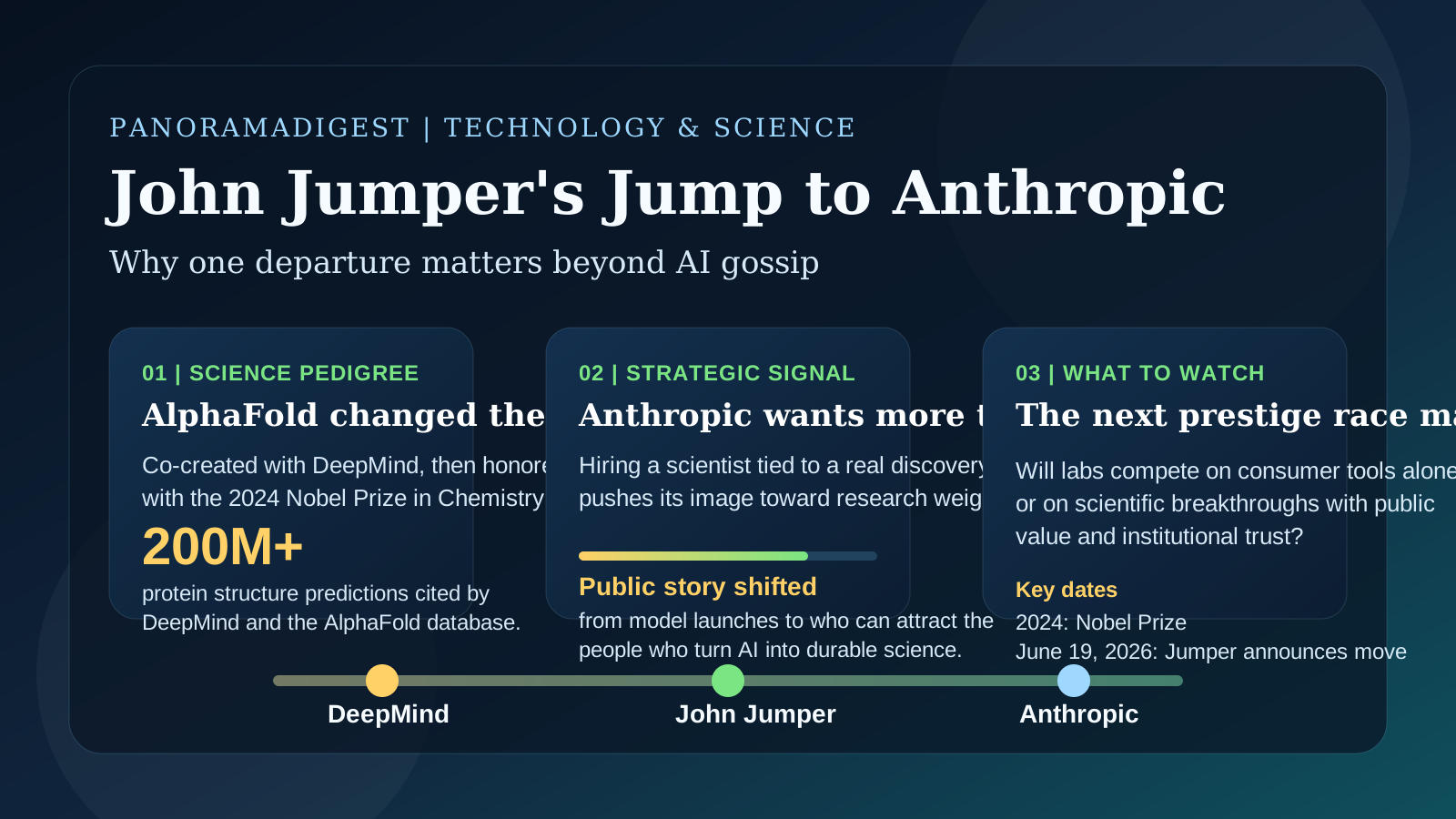
John Jumper's announcement on June 19 that he is leaving Google DeepMind for Anthropic is easy to file under Silicon Valley talent drama. That would miss the real signal. Jumper is not just another senior researcher changing jobs. He is one of the people most visibly associated with AlphaFold, the protein-structure breakthrough that helped win the 2024 Nobel Prize in Chemistry and gave AI one of its strongest public-interest success stories. When a figure like that leaves DeepMind for Anthropic, the story is not only about who hired well. It is about which lab now looks best placed to claim that advanced AI can produce serious scientific value, not merely addictive software.
The basic facts are clear. In a June 19 post on X, Jumper said he had decided to leave Google DeepMind after nearly nine years and would join Anthropic after taking time to recharge. Reuters later reported the move, and TechCrunch's June 20 follow-up underscored why it landed so hard across the industry: Jumper is tied to one of the rare AI projects that changed how scientists actually work, not just how consumers generate text or images.
That distinction matters more in June 2026 than it did a year ago. The consumer AI race is now crowded with comparable chat interfaces, similar coding promises, and relentless model-launch theater. Scientific credibility is scarcer. Anthropic has spent the past several months being judged on model safety, compute scale, and policy friction, including the broader regulatory pressure we examined in our June 19 analysis of Anthropic's White House talks. Hiring Jumper sends a different message. It says Anthropic wants to be seen not only as a company that ships powerful models, but as one that can attract researchers whose names already stand for durable scientific impact.
- October 9, 2024: the Nobel Prize in Chemistry recognizes Demis Hassabis and John Jumper for work on protein-structure prediction.
- By 2026: DeepMind and the AlphaFold database say the system's predictions cover more than 200 million protein structures, turning a breakthrough into working infrastructure for scientists.
- June 19, 2026: Jumper announces on X that he is leaving Google DeepMind after nearly nine years to join Anthropic.
- June 20, 2026: Reuters and TechCrunch push the move into the center of the AI-industry conversation, reframing it as a signal about talent and strategy.
This is not a routine executive move
Jumper's significance comes from what AlphaFold represented. According to Nobel Prize organizers, the 2024 chemistry prize honored Demis Hassabis and Jumper for protein-structure prediction, a problem that had frustrated biologists for decades. Google DeepMind says AlphaFold has predicted more than 200 million protein structures, while the AlphaFold Protein Structure Database describes that catalog as open scientific infrastructure. In other words, Jumper's public reputation is tied to an AI result that became useful outside the AI industry. That is exactly why the move matters.
AI companies have spent two years trying to prove they are not just building better autocomplete systems with richer venture valuations. The labs that stand out in public memory are the ones that can show a bridge from model capability to something bigger: science, medicine, national infrastructure, or institutional trust. Anthropic has often been strongest in the language of safety and alignment. Jumper gives it a stronger symbolic claim in the language of discovery.
| Verified fact | What it signals | Why readers should care |
|---|---|---|
| Jumper publicly said he is leaving DeepMind for Anthropic after nearly nine years. | This was not rumor or anonymous-leak theater. The move began as a direct statement from the scientist involved. | That makes it harder to dismiss as recruitment gossip or stock-market noise. |
| Jumper shared the 2024 Nobel Prize in Chemistry for work tied to AlphaFold. | The hire carries scientific legitimacy, not only product or management prestige. | Public trust in AI increasingly depends on visible real-world usefulness, not benchmark bragging. |
| DeepMind and AlphaFold sources say the system's predictions now cover more than 200 million protein structures. | The scientific contribution attached to Jumper is large-scale and practical. | It reminds readers that the most persuasive AI success stories are still the ones that change work on the ground. |
Why Anthropic would want this kind of stature now
There is still a great deal we do not know. Anthropic has not publicly laid out Jumper's role in detail, and one high-profile hire does not by itself prove a strategic pivot. But the inference here is still hard to ignore. In a market where many companies can promise faster models or better agents, a scientist linked to one of the decade's clearest research breakthroughs offers something rarer: credibility that extends beyond the AI sector's own echo chamber.
That matters because the prestige economy around frontier AI is changing. The first phase rewarded whoever could shock the market with a new chatbot, a new benchmark, or a new consumer interface. The next phase looks more demanding. Regulators want evidence. Enterprise buyers want durability. Researchers want systems that do something more ambitious than rearrange public text. In that environment, the question becomes less which lab sounds smartest this week? and more which lab can make a serious case that its work deserves trust outside the tech bubble?
What DeepMind loses, and what it does not
It would be lazy to overstate the damage to Google DeepMind. One departure does not erase its research bench, its compute access, or its deep record in scientific AI. DeepMind remains the home of AlphaFold, and its own science pages still present the project as a live part of its identity. But prestige is not only about patents, papers, or cloud budgets. It is also about which people the outside world instinctively associates with meaningful progress. When one of those people leaves, competitors gain more than a resume line. They gain an argument.
TechCrunch, citing Bloomberg, reported that Jumper had also been part of Google's work on coding tools for business users. If that detail continues to hold up, the move becomes even more interesting. It would mean Anthropic is not only hiring a Nobel-linked scientific name; it may also be pulling in someone who has worked at the intersection of hard research and commercially relevant product development. That is a more valuable combination than pure symbolism.
What to watch next
Three questions matter now. First, does Anthropic place Jumper in a public-facing science effort, a core-model research role, or something that blends both? Second, does DeepMind answer with new scientific launches that remind the market its bench is deeper than any one person? Third, will other frontier labs start competing more openly for researchers whose prestige comes from real scientific or industrial breakthroughs rather than solely from model-leaderboard status?
Those questions cut through the noise better than the usual talent-war framing. Jumper's move is important not because one elite lab poached from another. Elite labs do that all the time. It is important because it hints at what AI companies now believe will matter most in the next round of competition. If the first era of the AI boom was about who could capture attention, the next may be about who can persuade the wider world that attention turned into substance.
Primary and supporting sources reviewed: John Jumper's June 19 X announcement, Reuters' June 20 report on the move, TechCrunch's June 20 follow-up, the 2024 Nobel Prize in Chemistry summary, Google DeepMind's AlphaFold overview, and the AlphaFold Protein Structure Database.
Reader Sentiment & Impact Pulse
How do you evaluate the primary outcome of this development?
Select an option to cast your perspective. Responses are anonymous and aggregated in real time.
Key Context & Frequently Asked Questions
John Jumper's move from Google DeepMind to Anthropic is bigger than a hiring headline. It suggests the next frontier-AI credibility battle may be won through scientific weight, not just faster assistants. This analysis from PanoramaDigest examines primary documentation, operational implications, and broader institutional impacts across technology & science.
Read Next
Related Stories

Leaked Apple Silicon Benchmarks Point to Massive Graphics Performance Gains in M5 Ultra and M6 Chips
Leaked benchmark testing reported by MacRumors highlights significant graphics and computational advancements for Apple's upcoming M5 Ultra and M6 silicon, signaling a major leap for on-device AI and workstation performance.
Smart TV Data Tracking Prompts Heightened Privacy Concerns as Consumers Seek Mitigation Strategies
Modern smart televisions routinely monitor viewing habits and collect consumer data through Automatic Content Recognition technology. However, targeted network adjustments and privacy settings offer users practical avenues to limit telemetry and reclaim control over their living room data.

Apple Hardware Executive Details Engineering Strategy for Foldable iPhone Durability and Crease Elimination
In an interview highlighting material science breakthroughs, Apple's hardware leadership discussed the hinge design, display elasticity, and structural longevity engineered for foldable form factors.