Trump's Georgia Endorsement Is Really a Runoff Test of Whether Loyalty Still Beats Electability
President Donald Trump's endorsement of Mike Collins on Sunday, June 14, lands just two days before Georgia's Republican Senate runoff. The move does more than boost a favorite. It turns the race into a blunt test of whether GOP voters still trust general-election math when Trump's late blessing points the other way.
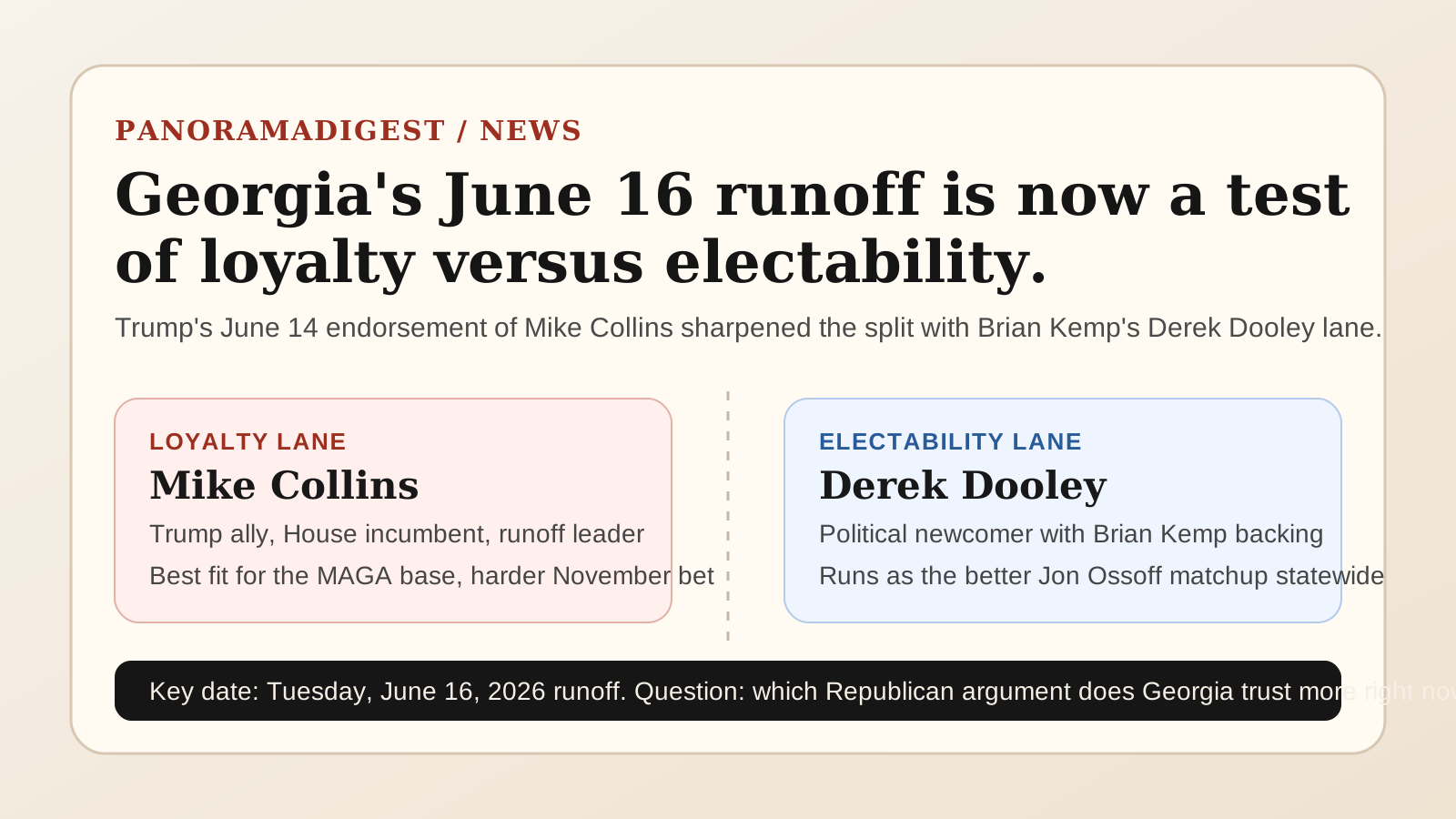
President Donald Trump's endorsement of Mike Collins on Sunday, June 14, did not merely add another famous name to a Georgia campaign mailer. It collapsed the argument of the Republican runoff into one harder question: when a party has to choose between the candidate who best matches Trump's movement and the candidate pitched as the safer November option, which instinct still wins in Georgia?
YouTube / Atlanta Press Club — Georgia U.S. Senate Republican runoff debate
The Atlanta Press Club runoff debate shows the Collins-Dooley contrast before Trump's late endorsement. If the player does not render, use the direct YouTube link in the story.
The Associated Press reported that Trump backed Collins two days before the Tuesday, June 16, runoff to face Democratic Sen. Jon Ossoff, praising the congressman as a longtime ally while ridiculing Derek Dooley's thin voting record. The Washington Post's account made the timing unmistakable: this was a late intervention in one of the party's most consequential Senate nominating fights, not a symbolic courtesy. WABE's earlier runoff reporting helps explain why the endorsement matters so much. Collins has spent the race running as the proven Trump loyalist with an existing political machine. Dooley has run as the outsider with Gov. Brian Kemp's backing and a more explicit electability pitch for suburban and swing voters.
If the video card below does not render in your browser, use the direct Atlanta Press Club runoff debate video.
Why the endorsement matters more than the endorsement itself
Late endorsements are often overrated because many voters have already chosen their side. This one is more important because the race was already being sold inside the Georgia GOP as a proxy fight between two theories of power. Collins offers cultural and ideological alignment with Trump, plus a record that lets him say he has already delivered for the movement in Washington. Dooley offers a different promise: that Georgia Republicans do not need a louder version of what the base already likes, but a nominee who can carry the same coalition into a competitive November race against Ossoff.
That contrast was visible before Trump weighed in. WABE's May 19 coverage described Collins as the committed Trump supporter who authored the Laken Riley Act and campaigned as an "America First" loyalist, while Dooley leaned into outsider language and Kemp's endorsement. The point of Trump's intervention is that it makes avoidance harder. Republicans can no longer pretend this runoff is simply about biography or campaign style. It is about which elite signal they trust more when the signals diverge.
- Tuesday, May 19: Collins leads the Republican Senate primary, but neither he nor Dooley clears the majority threshold needed to avoid a runoff.
- Late May: Dooley and his allies sharpen the electability argument, saying Republicans have not won a Georgia Senate race since 2016.
- Sunday, June 14: Trump endorses Collins, directly undercutting the idea that the party's safest November option should take priority over movement loyalty.
- Tuesday, June 16: Georgia holds the runoff, which Georgia's official election calendar lists as the final day to vote in the race.
The real split is Trump versus Kemp, but not in the old dramatic way
The obvious reading is that Trump and Kemp are fighting again. That is true, but it is not the whole story. The sharper reality is that the two men are offering different risk calculations to the same party. AP noted that Dooley is backed by Kemp, who has clashed with Trump in the past. That line matters less as gossip than as a strategic fact. Kemp's case for Dooley has always been that Georgia is no longer a state where pure base intensity is automatically enough in a Senate race. Trump's case for Collins is that there is still no substitute for a candidate who can own the party's base without apology.
In other words, this is not simply a feud between personalities. It is a disagreement about what recent Georgia history means. If you think Republican Senate losses since 2016 prove the party has to broaden its tone, Dooley makes sense. If you think Republican underperformance came from insufficiently convincing the base, Collins makes sense. Trump's endorsement does not settle that debate. It forces voters to settle it sooner.
| Candidate lane | What supporters say it offers | What the risk looks like |
|---|---|---|
| Mike Collins | Reliable MAGA loyalty, a House record, and clear alignment with Trump's political instincts. | Opponents argue his strongest appeal is to voters Republicans already have, not the ones they still need in November. |
| Derek Dooley | An outsider image, Kemp's support, and a less Washington-shaped profile for the general election. | Opponents argue he lacks a political record and may not energize Trump's core voters enough in a runoff. |
| Trump's intervention | A last-minute signal that movement loyalty should outweigh elite concerns about broad-audience appeal. | If Collins loses anyway, it exposes the limits of that signal in a state Republicans desperately want to flip. |
What Collins gains, and what Dooley can still argue
AP's reporting says Collins led the May 19 primary but did not clear 40%, which matters because it left a lot of Republican votes unclaimed. Trump has now given Collins the cleanest available argument for consolidating them: if the party wants the candidate most visibly aligned with the president, the ambiguity is gone. That can matter a great deal in a low-turnout runoff, where intensity often does more work than persuasion.
Dooley still has a viable reply. He does not need to prove he is more Republican than Collins. He needs to persuade enough runoff voters that beating Ossoff requires a different shape of nominee than pleasing Trump does. AP noted that Dooley answered Trump's move by presenting himself as the outsider alternative to a typical Washington politician. That is a hard argument to make against a presidential endorsement, but not an impossible one in a state where Republican strategists have spent years worrying about suburban leakage and crossover ceilings.
An earlier PanoramaDigest analysis of Georgia's QR-code ballot deadline fight dealt with election administration, not candidate choice, but the overlap is still useful: Georgia politics keeps forcing Republicans to confront whether institutional competence and movement intensity can be treated as the same thing. In this runoff, they cannot.
What to watch on Tuesday night
First, watch whether Collins simply runs up the score in the parts of the state where Trump remains the strongest organizing force. If he does, the endorsement will look less like a nudge and more like a closing argument. Second, watch the margin, not just the winner. A narrow Collins win would still leave open Kemp's case that November is a different electorate. Third, if Dooley somehow survives the endorsement, the result will read as a warning that even in a Trump-led party, some state-level voters still separate movement loyalty from general-election calculation.
The runoff is small on the calendar and large in what it signals. Republicans already know Georgia is one of the Senate seats that could help decide control of the chamber. What they do not know yet is which lesson they think the state has been teaching them. Trump's endorsement has stripped away the polite version of that conversation. By Tuesday night, Georgia Republicans will have to answer it.
Read Next
Related Stories

Old Trails Fire Damage Estimate Reaches 640 Structures in Spokane
Spokane County's preliminary estimate says the Old Trails fire destroyed 640 structures, while evacuation zones remain active across northwest Spokane.

USCIS Can Now Refer Asylum Cases to Immigration Court Without an Interview
A DHS rule effective July 28 lets USCIS send some affirmative asylum applications directly to immigration court. Referral is not a denial, but the interview is no longer guaranteed.

Seattle Center Shooting Kills Three and Injures Four at Bite of Seattle Festival
Seattle police say a shooting at the Bite of Seattle festival killed three people and injured four others, including a 2-year-old boy. One suspect was arrested and police continued searching for another.