FIFA Can Pay Omar Artan. It Cannot Pay Away the World Cup's Host-Credibility Problem.
FIFA's decision to pay Somali referee Omar Artan his full 2026 World Cup fee after U.S. officials denied him entry did not resolve the harder sports story: a host nation that screened in a World Cup match official only to turn him away.
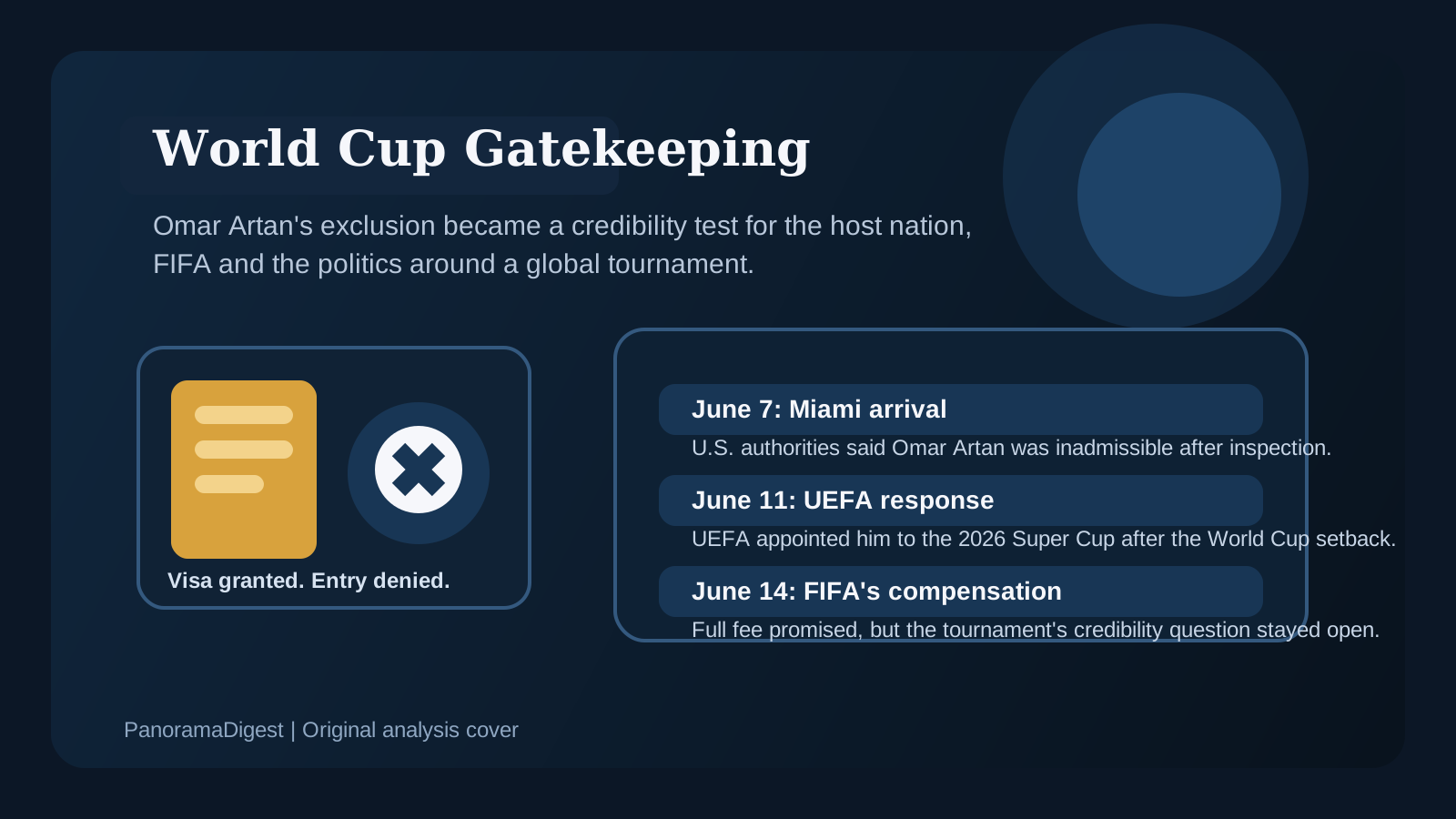
FIFA's promise to pay Omar Artan his full World Cup fee is financially tidy and politically insufficient. Money can compensate a referee for work he never got to do. It cannot repair the image of a tournament host that cleared a match official far enough to let him board a flight, then stopped him at the border and told the football world to treat the episode as normal administration.
BBC News — First World Cup Somali referee Omar Artan barred from entering US | BBC News
BBC News summarizes how Omar Artan's denied U.S. entry knocked a FIFA-selected referee out of the 2026 World Cup. If the player does not load, use the direct YouTube link in the article.
That is why the freshest turn in this story, reported by AP on Sunday, June 14, 2026, matters beyond one referee's bank account. Artan, the Somali official who was supposed to work at the 2026 FIFA World Cup, will still receive his full tournament compensation after U.S. authorities denied him entry. FIFA can do that much. What it cannot do is prevent readers, players and federations from asking what exactly the host-country vetting system is meant to signal if a FIFA-appointed referee can arrive with a visa and still be removed from the event.
The underlying facts remain narrower than the rhetoric around them. AP's earlier June 9 report said U.S. Customs and Border Protection determined Artan was inadmissible because of "vetting concerns." FIFA said at the time that it was not involved in host-country immigration decisions and had been told Artan's status would not change. Publicly, that is still the core of the record: a denial, a vague official rationale and no full explanation that would let the sport distinguish between an unavoidable security judgment and a preventable credibility own goal.
That is where the real story sits. Referees are supposed to be the invisible infrastructure of a major tournament. When one suddenly becomes the headline, it usually means the institutions around the competition have failed in a visible way. Artan was not some marginal administrative visitor. CAF's April 15 announcement of African World Cup officials listed him among the referees selected for the tournament. He had already become one of the continent's most respected officials, and UEFA's June 11 statement reinforced that view by assigning him the 2026 Super Cup after his World Cup exclusion.
The uncomfortable sequence is simple: FIFA selected Artan, U.S. authorities refused him entry after arrival, UEFA quickly moved to honor his standing, and FIFA then decided on June 14 to pay him anyway. Each step reduced the personal damage to Artan while increasing the institutional embarrassment around the host process.
- April 15: CAF includes Artan among the African match officials chosen for the 2026 World Cup.
- June 7: Artan arrives in Miami and is later ruled inadmissible by U.S. authorities over unspecified vetting concerns.
- June 9: AP reports the denial publicly, turning a behind-the-scenes border decision into an international football controversy.
- June 11: UEFA appoints Artan to the 2026 Super Cup, effectively telling the sport that his professional standing remains intact.
- June 14: FIFA says he will still receive his full World Cup fee, acknowledging the harm without resolving the deeper question of how the system failed.
Why the compensation helps Artan but not the host nation
Paying Artan is the minimum fair response because the practical loss was real. He missed training camp, match assignments, tournament visibility and a career milestone that would have made him the first Somali referee to work a men's World Cup. But the payment also carries an implicit concession. It says the loss was not ordinary enough to ignore. If FIFA believed this were just routine travel friction with no institutional cost, it could have hidden behind procedure and moved on. Instead, it effectively admitted that the governing body owed him something more than sympathy.
That still leaves the host-country problem untouched. A World Cup is not only a competition. It is a promise to federations, officials, broadcasters, sponsors and supporters that the event's basic operating conditions are stable. When a referee can satisfy the tournament's football requirements and still fail the host's entry process at the airport, the sport ends up with two incompatible truths at once. One institution is saying this person belongs on the world stage. Another is saying he cannot cross the threshold.
| Institution | What it has done | What question it still cannot answer |
|---|---|---|
| FIFA | Selected Artan and later agreed to pay his full fee. | Why tournament accreditation and host entry screening failed to align before travel. |
| U.S. authorities | Denied entry after inspection and cited vetting concerns. | Whether the issue was specific, avoidable or likely to affect future officials and delegations. |
| UEFA | Appointed Artan to referee the 2026 Super Cup. | None on his sporting merit; its move effectively endorsed his standing. |
| CAF | Had already backed him as one of Africa's elite officials. | How much confidence federations should have in future host-country clearance. |
UEFA's move was the sport's sharpest verdict
The cleanest judgment in the whole affair may have come from UEFA, not FIFA. By giving Artan the Super Cup on August 12 in Salzburg, the European body transformed an abstract show of solidarity into an operational one. It did not merely say he remained respected. It assigned him a major match. That matters because top-level refereeing appointments are not charity. They are trust decisions. UEFA was effectively telling the wider game that whatever happened in Miami did not alter its view of his quality.
That is the sports meaning of June 14. FIFA's payment decision was humane, but it was also revealing. The organization has now found a way to compensate Omar Artan as an individual. It has not yet found a persuasive way to reassure the football world that the same contradiction will not hit someone else before this tournament is over.
Readers who want the clearest video recap of the episode can use the BBC News embed below or watch it directly on YouTube if the player does not render in their browser. For related PanoramaDigest World Cup coverage, see our analysis of the USMNT's June 13 opener against Paraguay.
Read Next
Related Stories
FIFA Drops $20 Billion World Cup Equity Plan as UEFA Withdraws Confidence in Infantino
FIFA withdrew its $20 billion World Cup equity plan after opposition across three confederations. UEFA's no-confidence statement now shifts the dispute to Infantino's 2027 election.
Nirmal Purja Dies in Broad Peak Avalanche: His Verified Climbing Records
Elite Exped has confirmed that Nirmal Purja died after the Broad Peak avalanche. Here is the verified rescue timeline and the record evidence behind his climbing legacy.

FIFA Proposes $20 Billion Commercial Company to Raise $4.2 Billion for Member Funding
FIFA wants to place commercial rights and tournament operations in a new company valued initially at $20 billion, then sell minority stakes to finance expanded member-association funding.