Virginia Church Tent Collapse: Casualties, Storm Conditions and Safety
The fatal tent collapse at EastLake Community Church in Moneta, Virginia, was not only a weather tragedy. It was a test of how fast a large outdoor gathering could move from warning to safe exit.
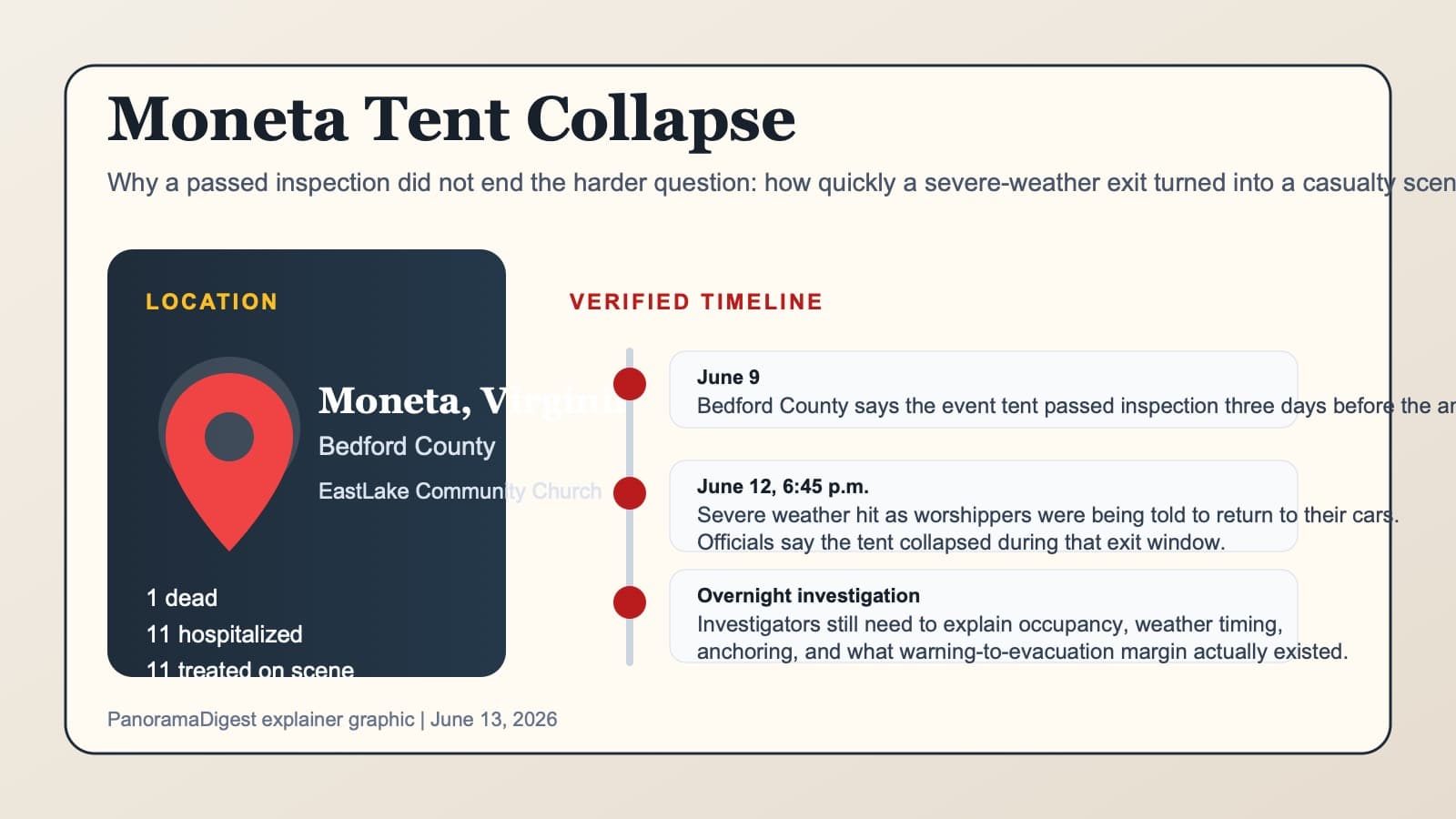
By the time EastLake Community Church's 20th anniversary service ended in chaos on June 12, 2026, the story in Moneta, Virginia, had already moved beyond the phrase freak accident. Bedford County said a large tent collapsed during the outdoor gathering at about 6:45 p.m., leaving one person dead, 11 people taken to hospitals by ambulance and 11 more treated at the scene for minor injuries. Associated Press reported that heavy rain, lightning and strong winds were moving through the area as attendees were already being told to head back to their cars. That combination matters. It means the crucial public-safety question is not only what the storm did. It is how much usable time existed between recognizing the threat and getting a large crowd out from under a vulnerable structure.
WFXR News — Moneta church tent collapses in storm, caused multiple injuries and a death
WFXR's June 12 report captures the immediate local summary from Moneta. Use the direct YouTube link if the embedded player is blocked.
WDBJ7's local reporting and the county's statement line up on the basic facts: emergency crews were dispatched just after the collapse, the incident was initially treated as a mass-casualty response, and investigators were still sorting through the scene overnight. ABC News reported that Pastor Troy Keaton described a burst of wind lifting the tent as he was directing worshippers toward their vehicles. That makes this a harsher story than a simple structural failure. The tent may have been standing minutes earlier. The real vulnerability was the thin band of time in which weather risk, crowd movement and outdoor worship all collided.
What the official timeline already tells us
The county's release adds one detail that will shape every later investigation: the tent had passed inspection by Bedford County's building division on June 9, just three days before the collapse. That fact matters because it narrows the first round of speculation. It suggests the event was not, at least on paper, operating under an obviously unapproved setup. But an inspection is a snapshot, not a live weather plan. It does not answer how many people were under the canopy when the warning became urgent, how the exits were being managed, whether the anchoring remained adequate once winds shifted, or how much notice organizers and attendees had before the structure failed.
- June 9: Bedford County says the event tent passed inspection.
- June 12, before 6:45 p.m.: EastLake Community Church was holding an outdoor service for its 20th anniversary.
- About 6:45 p.m. on June 12: County officials say the tent collapsed during severe weather as people were moving to leave.
- Late June 12 into June 13: Investigators, church leaders and state officials shifted from rescue to evidence gathering and accountability questions.
That sequence is why this will likely be examined as an event-management problem as much as a storm story. The deadliest moments in severe weather often happen not at the start of a warning, but at the point where a crowd has to change behavior all at once. Outdoor concerts, revivals, graduations and sports gatherings all face the same operational truth: once the order to clear a tent or field is given, the margin for delay gets brutally small. PanoramaDigest has seen the same public-space pressure point in a different setting before, when a June 7 festival shooting in Toledo turned crowd movement into the central safety question.
Why the inspection detail does not close the case
| Known already | Still unresolved | Why it matters |
|---|---|---|
| The tent passed inspection on June 9. | What wind conditions existed at collapse time and how quickly they intensified. | An inspected structure can still fail when live weather changes faster than a crowd can move. |
| Officials say one person died and 22 people were injured. | How many people were under the tent when the exit order was given. | Crowd density affects how long a safe evacuation actually takes. |
| The church was marking its 20th anniversary outdoors. | What contingency plan existed for lightning, wind and sheltering vehicles. | Preparedness is not only about the tent itself; it is about where people can go next. |
| Emergency crews treated the scene as a mass-casualty event. | Whether warning communication reached everyone at the same moment. | In large gatherings, uneven communication can turn seconds into injuries. |
That is the line PanoramaDigest readers should watch. If later reporting shows the tent was properly installed and the gust was unusually violent, the story will still remain about preparedness because a passed inspection did not spare the crowd from a fatal outcome. If the investigation finds anchoring, weather monitoring or crowd-control gaps, then the event will become a warning to every organizer who thinks a permit or inspection is the finish line.
What this says about summer gatherings in storm season
The wider lesson is uncomfortable because it is ordinary. This was not a festival built around risk. It was a church anniversary service in a part of Virginia where people regularly gather outdoors in June. That normality is exactly why the collapse deserves careful attention. Summer events often rely on the assumption that weather is manageable until it suddenly is not. Once heavy rain, lightning and wind arrive together, the safest plan is usually the one made before anyone needs to improvise it. Moneta's tragedy now sits inside that national pattern: more outdoor gatherings, more volatile storm windows, and almost no tolerance for confusion once the decision to clear a space is made.
Readers who want the clearest local video record can use WFXR's report, Moneta church tent collapses in storm, caused multiple injuries and a death. If the embedded player is blocked in your browser or region, that direct YouTube link carries the same footage and on-air summary.
What to watch next
The next facts worth waiting for are practical ones: whether investigators specify the wind conditions at the site, whether they identify the exact occupancy under the tent at collapse time, whether local hospitals release more detail about the condition of the injured, and whether the county or church clarifies the evacuation sequence minute by minute. Those details will decide whether Moneta is remembered mainly as a severe-weather tragedy or as a case study in how quickly a warning can outrun a crowd.
On June 12, 2026, a Virginia congregation suffered a devastating loss during what should have been a celebration. The fairest way to read the event is neither to minimize the weather nor to stop at the weather. A crowd was in motion, a storm was closing in, and a structure failed during the narrowest part of that handoff. That is where the hardest public questions now belong.
Read Next
Related Stories

Toledo Festival Shooting: Reported Facts and Public-Safety Response
The Old West End Festival shooting left at least 12 people wounded and forced Toledo to confront how quickly a familiar civic event can become an emergency scene.
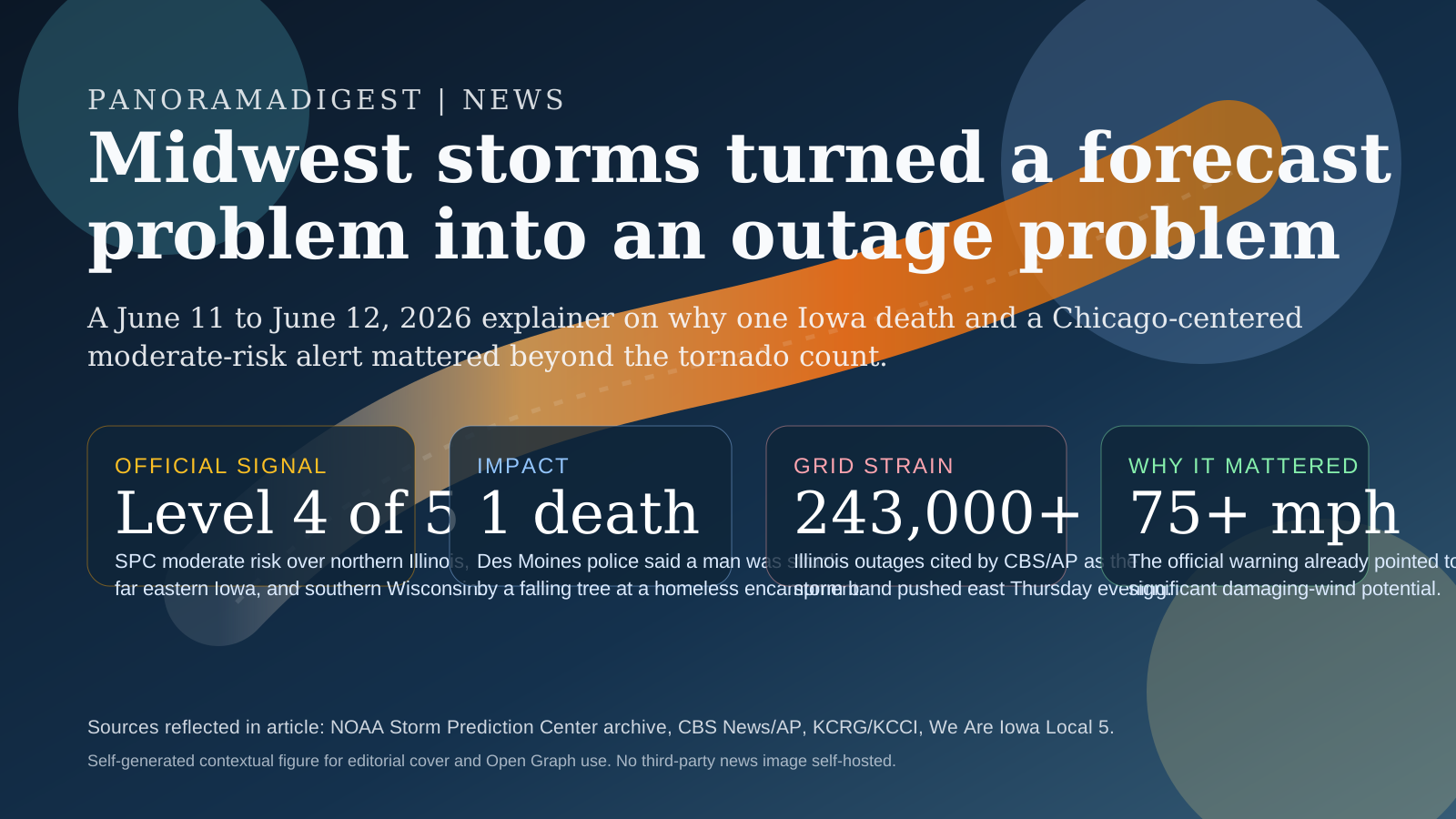
The Midwest Storms Killed One Man in Iowa. The Harder Story Is How Quickly Risk Became Outage.
A deadly tree strike in Des Moines and a Chicago-centered moderate-risk alert exposed the same weakness: summer severe-weather planning still breaks down first where people and power are most exposed.

Typhoon Noul Weakens After Southern China Landfall as Hong Kong Reports 21 Injuries
Typhoon Noul weakened after moving inland over southern China, while Hong Kong reported 21 typhoon-related injuries, 331 fallen-tree reports and eight flooding reports after its No. 8 storm signal.