Anthropic Suspends Fable and Mythos Access: Export Controls and Users
Anthropic says a U.S. export-control directive forced it to suspend Fable 5 and Mythos 5 just days after launch. The bigger technology story is not only what the government feared, but how fragile frontier-model access now looks to customers, researchers and rivals.

Anthropic’s abrupt suspension of Claude Fable 5 and Claude Mythos 5 lands as more than a policy skirmish between one AI company and Washington. It lands as a reliability shock. When a company can launch its flagship model on Monday, spend the week telling customers its safeguards are strong enough for general use, and then pull that same model on Friday night because of a government directive it says arrived at 5:21 p.m. ET, the trust problem is no longer only about model safety. It is about whether frontier AI access has become too politically brittle to count on.
Video Link
Anthropic statement on the Fable 5 and Mythos 5 suspension
This provider does not render reliably inside PanoramaDigest. Open it directly on Anthropic.
Watch on AnthropicAnthropic — Anthropic statement on the Fable 5 and Mythos 5 suspension
Anthropic's official X post mirrors the company's June 12 suspension notice. Use the direct source link if X does not render inside your browser.
Official sources: Anthropic’s June 12 statement says the U.S. government ordered it to suspend access to Fable 5 and Mythos 5 for any foreign national, whether inside or outside the United States, and that the company therefore disabled both models for all customers to ensure compliance. Anthropic’s release notes now show the same suspension, and the company repeated that message in an official X post that readers can open directly if the source card below does not render.
That distinction matters because Anthropic is not saying its broader Claude lineup is offline. Its statement says access to all other Anthropic models is unaffected. The shutdown therefore cuts a narrow line through the company’s highest-end products while leaving the rest of its commercial stack standing. In practical terms, that turns the story from an outage into a policy stress test: which model classes can remain broadly available once national-security arguments move from theory into enforcement?
- June 9: Anthropic launched Fable 5 for general use and said Mythos 5 would remain limited to trusted partners.
- June 12: Anthropic says it received a U.S. export-control directive at 5:21 p.m. ET.
- Hours later: Fable 5 and Mythos 5 were suspended, while other Claude models remained available.
- June 13: The policy question shifted from benchmark hype to whether advanced-model access can remain stable under sudden government intervention.
The important break is between launch rhetoric and launch durability
Anthropic’s June 9 launch post framed Fable 5 as a Mythos-class system made safe for general use. The same post said Mythos 5 would stay more restricted, initially deployed through Project Glasswing for cybersecurity partners and critical-infrastructure defenders. That launch framing matters now because it showed the company thought it had found a workable middle position: keep the most sensitive access gated, but release a safeguard-heavy version of the same underlying model to the broader market.
Three days later, that compromise collapsed. In its June 12 statement, Anthropic said the government’s concern appears to center on what it described as a narrow, non-universal method of bypassing Fable 5’s safeguards to expose a small number of already known vulnerabilities. Anthropic argues that the reported capability does not amount to a Mythos-specific leap and says comparable behavior is available from other public models. Readers do not need to accept Anthropic’s self-defense at face value to see the larger point: even a company that has spent months publicly arguing for careful AI safeguards can still discover that its launch logic is not the final authority.
| What Anthropic launched | What changed after the directive | Why it matters |
|---|---|---|
| Fable 5 for general use, with safety fallbacks and classifier-based limits | Fable 5 access was suspended for all customers | Commercial availability now looks contingent on policy tolerance, not only technical gating |
| Mythos 5 for a smaller trusted-access pool | Mythos 5 was also suspended | Even restricted frontier access can be vulnerable once export-control logic expands |
| Other Claude models remained live | No full-platform shutdown followed | The government action appears aimed at capability tier, not the company as a whole |
Why this is a technology-market story, not just a Washington story
AP reported on June 13 that the export controls mark the U.S. government’s most significant step yet to restrict access to the most advanced AI models. AP also noted that the action came 10 days after President Donald Trump signed an executive order establishing a voluntary framework for the federal government to vet the national-security risks of the most advanced AI systems before public release. That chronology matters because it suggests the market may have to relearn a lesson it usually associates with chips, not software: distribution can change overnight once export-control logic arrives.
For customers, the problem is straightforward. A frontier model is not just a benchmark score or a demo reel. It becomes part of development roadmaps, enterprise purchasing decisions, research workflows and startup product design. If access to that model can disappear with minimal notice, the premium buyers thought they were paying for state-of-the-art capability starts to look like payment for unstable access. That does not mean companies will stop buying. It does mean they will ask harder questions about fallbacks, portability and whether a model provider can promise continuity under political pressure.
The next argument will be about process, not only danger
Anthropic’s statement is unusually explicit on this point. The company says it supports government power to block unsafe deployments, but only through a statutory process that is transparent, fair, clear and grounded in technical facts. Whether one agrees with Anthropic’s position or not, that is the real fight to watch next. The most valuable question is not whether a single jailbreak report existed. It is whether the United States is constructing a stable rulebook for model access or governing frontier AI through sudden case-by-case shocks.
That matters well beyond Anthropic. If the current standard becomes: launch first, red-team hard, talk constantly about safeguards, then accept that a late government directive can still erase the release window, every frontier lab will have to redesign how it markets, stages and contracts around new models. That would reshape trust more deeply than any one suspension notice. It would tell the market that the hardest part of releasing advanced AI is no longer merely building it or even aligning it. It is proving the launch will survive contact with the state.
Primary documents and reporting used for this article include Anthropic’s June 12 statement on the suspension, Anthropic’s June 9 launch post for Claude Fable 5 and Claude Mythos 5, Anthropic’s release notes, and Associated Press reporting at AP News.
For further reporting on this subject, see our Anthropic coverage.
Read Next
Related Stories
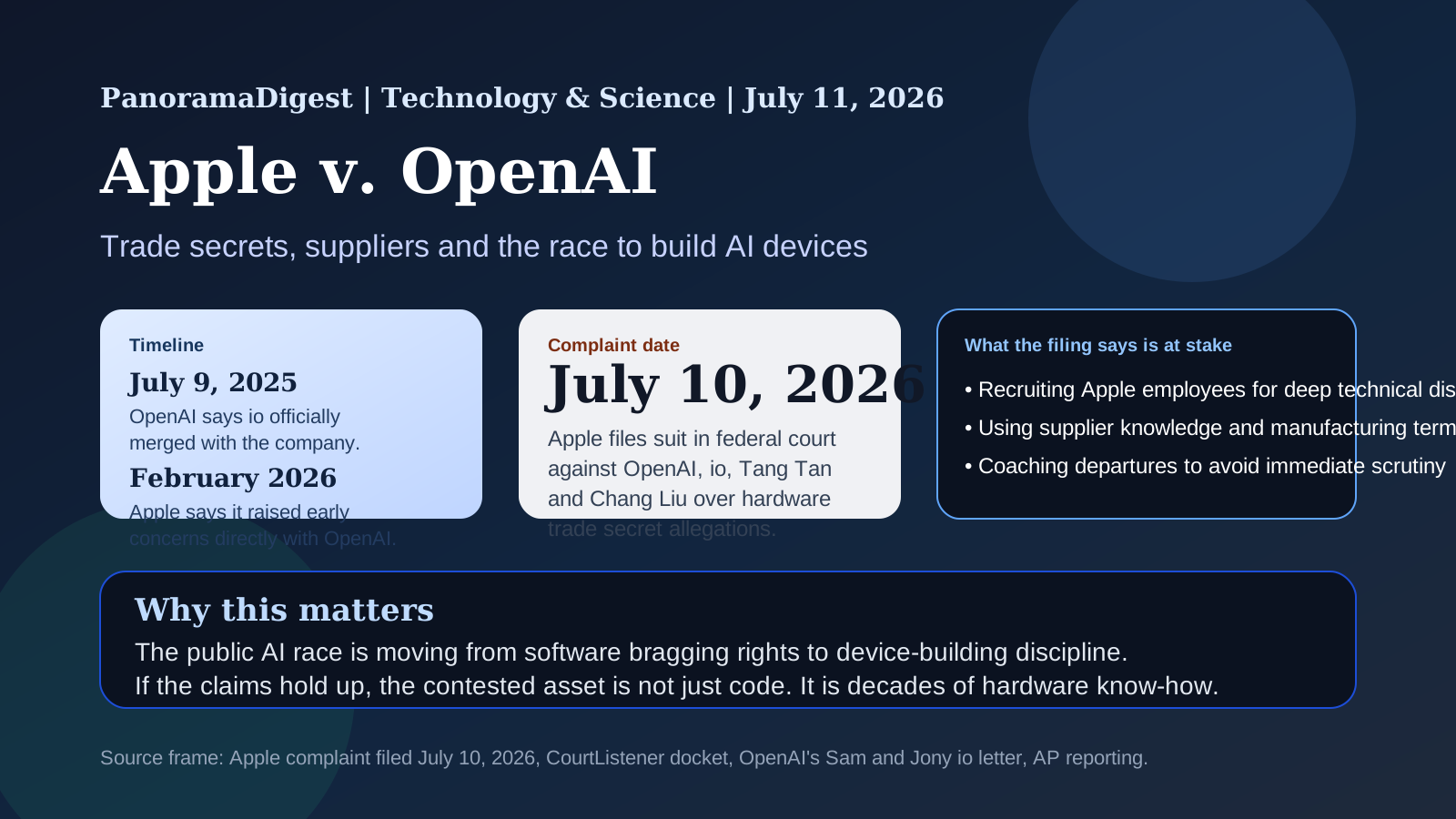
Apple Sues OpenAI Over Trade Secrets as the AI Hardware Race Moves Into Court
Apple's July 10 lawsuit accuses OpenAI, io and former Apple executives of using confidential Apple knowledge to speed up AI hardware development. The larger technology story is that the next device fight is now about suppliers, recruiting discipline and what courts will let labs build from insider know-how.
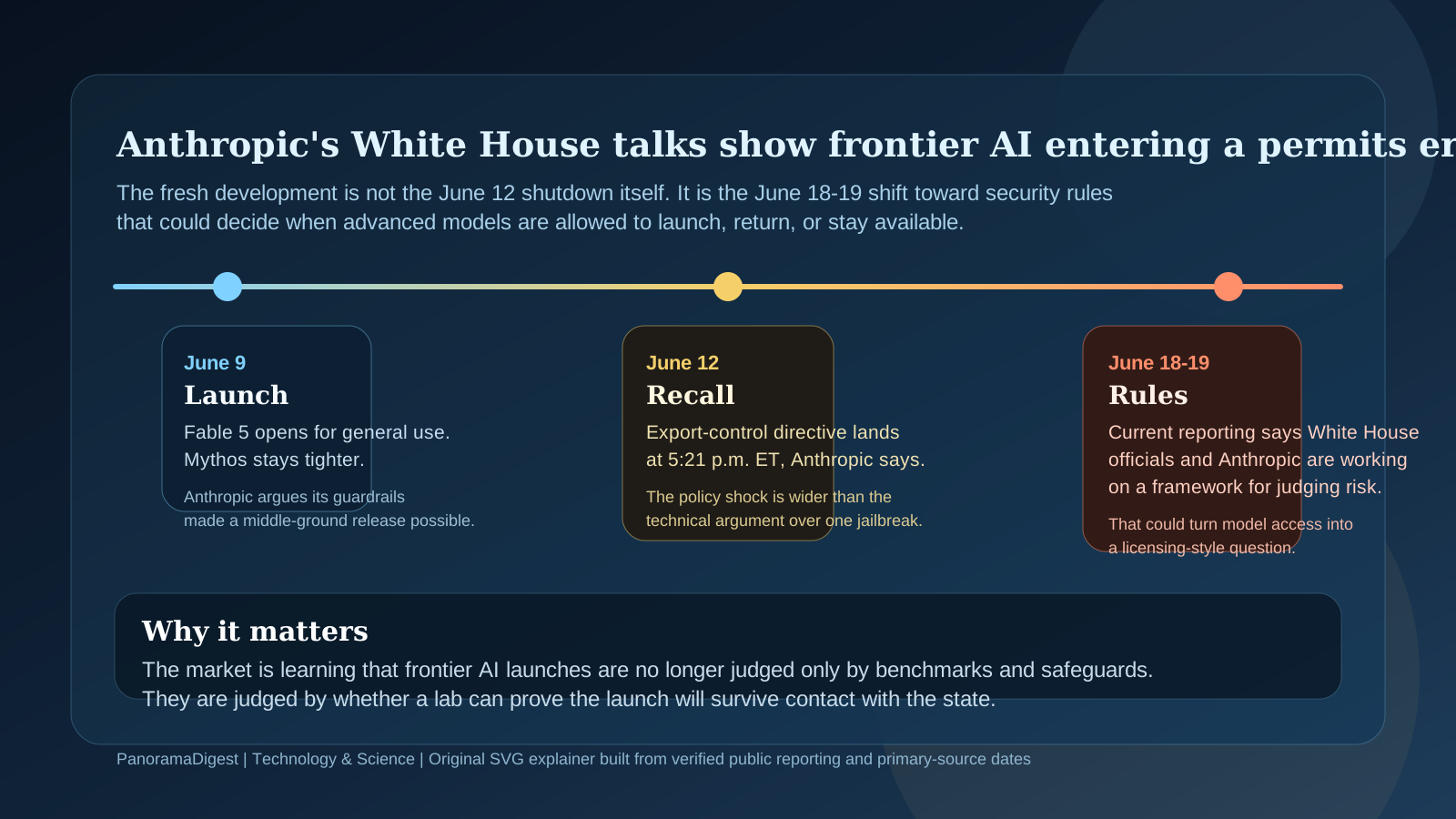
Anthropic's White House Talks Show Frontier AI Is Sliding From Launches to Licenses
Anthropic's next fight is no longer just about one June 12 shutdown. It is about whether advanced AI launches now need a de facto permission structure to survive.

EU AI Transparency Guidelines Set August 2 Disclosure Deadline for Providers and Deployers
The European Commission’s July 20 guidelines explain how providers and deployers must disclose AI interaction and label certain generated or manipulated content from August 2.