Iran Says Hormuz Is Closed Again. The Real Test Is Whether the U.S.-Iran Deal Still Has a Clock.
Iran's June 20 warning that the Strait of Hormuz is closed again turned Lebanon fighting and delayed Switzerland talks into a harder question: whether the U.S.-Iran deal still has a timeline anyone trusts.
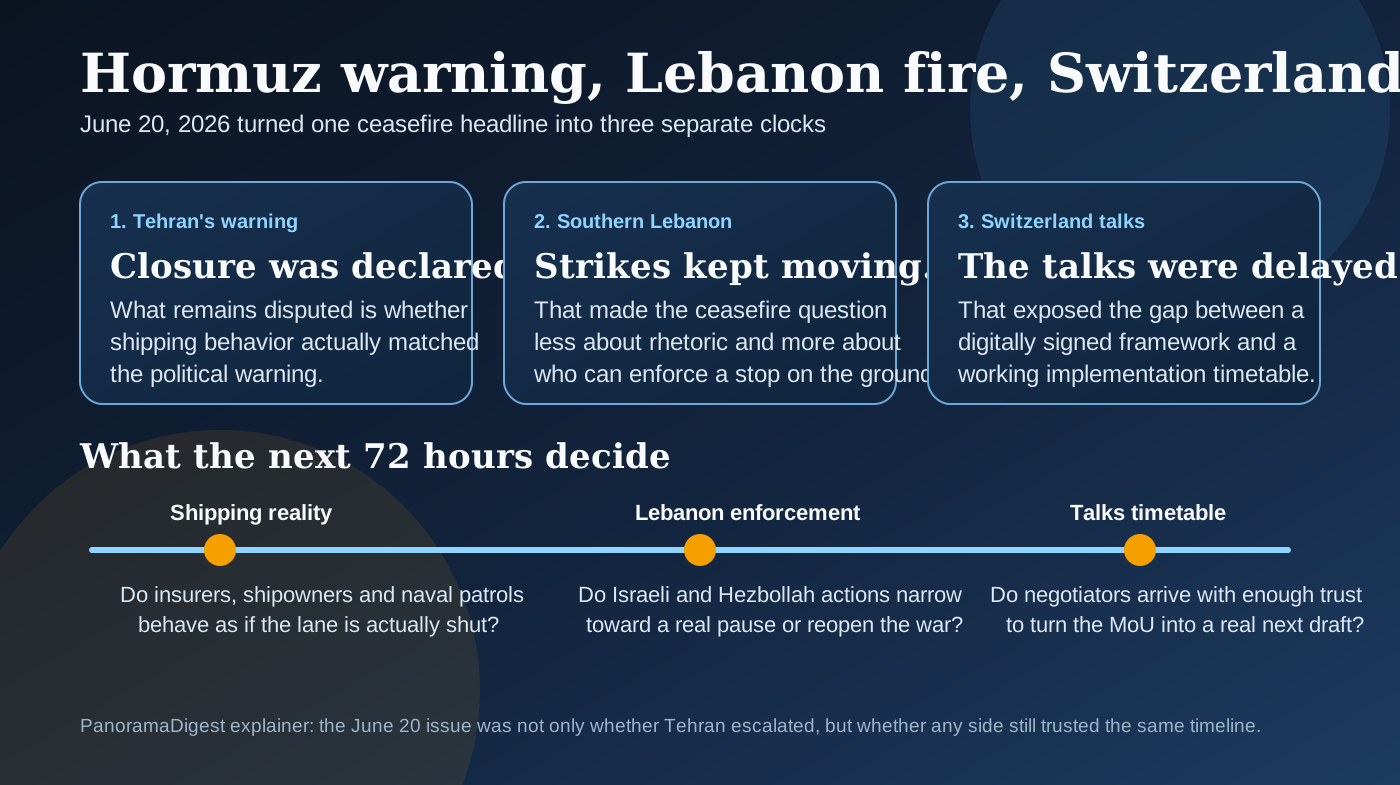
Saturday, June 20, 2026 did not kill the U.S.-Iran deal in one dramatic stroke. It did something more damaging. It made the agreement look as though every party involved might be operating on a different clock. The Associated Press reported that Iran's joint military command said the Strait of Hormuz was closed again, citing Israeli attacks in Lebanon and what Tehran described as American bad faith. Mehr News, relaying the Iranian statement, published the same core claim and tied it directly to Khatam al-Anbiya Central Headquarters. But Axios reported that a senior U.S. defense official saw no Iranian military movements matching a practical closure, while CENTCOM said 55 merchant ships still transited the waterway on Saturday carrying more than 17 million barrels of oil. That gap is now the whole story. Tehran can announce a closure. The market, the shipping lanes and the diplomacy will decide whether it landed as an order, a warning or a bargaining instrument.
CBS Mornings / YouTube — Uncertainty surrounds U.S.-Iran deal as Israel strikes Lebanon
CBS Mornings' June 20 video is the cleanest current summary of the Lebanon strikes, delayed talks and renewed Hormuz warning. If the player does not render, use the direct YouTube link in the story.
The second pressure point was Lebanon, where the ceasefire theory and the battlefield reality broke apart almost immediately. The Guardian reported that Israeli strikes in southern Lebanon killed at least 16 people on Saturday after a renewed ceasefire had been discussed. AP's Dubai dispatch said the same surge of violence threatened the interim U.S.-Iran agreement because the memorandum explicitly tied regional de-escalation to Lebanon as well as Hormuz. That matters because this is no longer a narrow maritime argument. Once Lebanon keeps burning, the Iranian claim that Washington has failed to deliver the first article of the deal becomes easier to sell at home, even if the U.S. position is that the strait itself still functions.
The closure claim is clear. The operating picture is not.
That distinction deserves discipline because the story is sensitive, market-moving and easy to overstate. Mehr's text is explicit: Iran's central military command said the strait is closed to vessel traffic because the United States failed to enforce the agreement's first clause and Israel kept striking southern Lebanon. AP similarly reported that Iranian state television carried the warning and that the statement promised further steps if what Tehran calls aggression continues. Yet Axios added the critical counterweight: U.S. officials said the military was not seeing on-the-ground Iranian movements that matched a real shutdown, and CENTCOM described safe passage as still intact for dozens of ships. Those two things can be true at once. A state can issue a coercive closure notice before it fully enforces it. In fact, that may be the point. The threat gains leverage precisely because traders, insurers and diplomats have to decide how much of it to price in before the navy picture visibly changes.
Why this is a different follow-up from PanoramaDigest's earlier Hormuz pieces
PanoramaDigest has tracked this file from the draft stage through the supposed breakthrough. On June 15, our analysis of the framework deal and the Friday Hormuz test argued that the real issue was implementation, not applause. On June 19, our piece on Lebanon's fragile ceasefire and the U.S.-Iran talks warned that the Lebanon track could still destabilize the larger bargain. June 20 is the first day those two warnings fused into a single visible problem. The pressure is no longer theoretical. Iran is now using Lebanon's violence to challenge the credibility of the wider agreement, and the wider agreement is now being measured by whether it can restrain actors who never signed it.
| Pressure point | What was announced or observed on June 20 | Why it matters now |
|---|---|---|
| Hormuz status | Iran said the strait is closed again; U.S. officials said merchant transit continued. | The gap between political warning and practical traffic determines whether energy markets treat this as a crisis, a bluff or an opening bid. |
| Southern Lebanon | Israeli strikes continued and local authorities reported heavy casualties. | If fighting keeps moving, Tehran can keep arguing that Washington cannot deliver the regional side of its own deal. |
| Switzerland talks | Delegations still headed toward Switzerland, but AP reported little is likely to happen quickly. | A delayed or hollow first round would turn the memorandum into a pause without a trustworthy calendar. |
| Deal credibility | Neither Israel nor Hezbollah signed the agreement, yet both can destabilize it. | The whole arrangement now depends on enforcement power that the signatories only partly control. |
The negotiation problem is no longer just diplomatic drafting
AP reported that Iran's team was still heading to Switzerland even as its officials signaled that meaningful progress depends on the U.S. proving it is honoring the understanding. That is an important nuance. Tehran is not simply walking away. It is trying to negotiate from a position in which military pressure, maritime ambiguity and diplomacy all reinforce one another. For Washington, that is a harder environment than the one created by a clean breakdown. A collapse is visible. A conditional continuation is murkier, and therefore more destabilizing. It keeps the door nominally open while making every side doubt the order in which obligations will be met.
This is why the most useful question for readers is not whether the Switzerland meeting happens at all. It is whether anyone arrives there with a believable enforcement story. If Iran says the first clause has already been violated, if Israel insists it still needs freedom of action in Lebanon, and if U.S. officials insist Hormuz remains operational in practice, then the negotiation table is no longer just about a final nuclear text. It is about rebuilding a shared chronology. Who moves first? What counts as compliance? Which battlefield event voids which promise? Those are not footnotes. They are the architecture.
- Earlier this week: the interim U.S.-Iran agreement reopened Hormuz and pointed negotiators toward a Switzerland track.
- Friday, June 19: Lebanon violence escalated again, forcing a pause and delay around the expected talks timetable.
- Saturday, June 20: Iran publicly declared the strait closed again, tying the move to Lebanon and alleged U.S. non-compliance.
- Next 72 hours: shipping behavior, battlefield discipline and the substance of Switzerland contacts will show whether this was a true rupture or a high-stakes warning.
What matters over the next 72 hours
The next signals should be judged in the coldest possible way. First, does commercial traffic through Hormuz materially slow, reroute or face new interdiction behavior? Second, do Israeli and Hezbollah actions narrow toward an actual pause, or does each side keep using the other's fire as evidence that no real ceasefire exists? Third, when diplomats meet in Switzerland, do they talk about a final text, or do they spend the session arguing over whether the interim deal has already been breached?
That is why June 20 matters as more than another Middle East headline. The deeper issue is not whether the memorandum survived one more ugly day in formal terms. It is whether the people who are supposed to implement it still believe time is moving in the same direction. Right now, Tehran, Washington, Jerusalem and Hezbollah all appear to be reading from different clocks. Deals can survive violence. They rarely survive incompatible timelines for very long.
Source card: The clearest current video summary is CBS Mornings' Uncertainty surrounds U.S.-Iran deal as Israel strikes Lebanon. If the embedded player is blocked in your browser or region, the direct YouTube link carries the same report. For text verification, keep the AP relay, Axios and the Guardian's Lebanon reporting alongside the Iranian statement carried by Mehr.
Reader Sentiment & Impact Pulse
How do you evaluate the primary outcome of this development?
Select an option to cast your perspective. Responses are anonymous and aggregated in real time.
Key Context & Frequently Asked Questions
Iran's June 20 warning that the Strait of Hormuz is closed again turned Lebanon fighting and delayed Switzerland talks into a harder question: whether the U.S.-Iran deal still has a timeline anyone trusts. This analysis from PanoramaDigest examines primary documentation, operational implications, and broader institutional impacts across world.
Read Next
Related Stories

Israeli President Pardons Combat Medic Convicted in High-Profile Shooting
Israeli President Isaac Herzog has granted an executive pardon to a combat medic convicted after shooting an incapacitated Palestinian attacker. The decision reopens deep national debates over military legal accountability and international human rights standards.
Houthi Ballistic Missile Attack Targeting Riyadh Heightens Regional Security Risks
Yemen’s Houthi movement has claimed a ballistic missile attack on the Saudi capital, threatening regional economic stability and signaling a renewed wave of escalation across Middle Eastern energy corridors.

Putin Accuses Ukraine of Interfering in Russian Parliamentary Elections
Russian President Vladimir Putin alleged Ukrainian intelligence services are actively attempting to sabotage Russia's parliamentary elections, signaling potential cyber escalations and tightened domestic security control.