The U.S.-Iran Framework Deal Moved the Headline. The Harder Test Still Sits at Hormuz.
The June 15, 2026 U.S.-Iran framework deal is a real diplomatic advance, but the practical test still sits in the Strait of Hormuz, Lebanon and the planned Friday signing that both sides say must come before implementation.
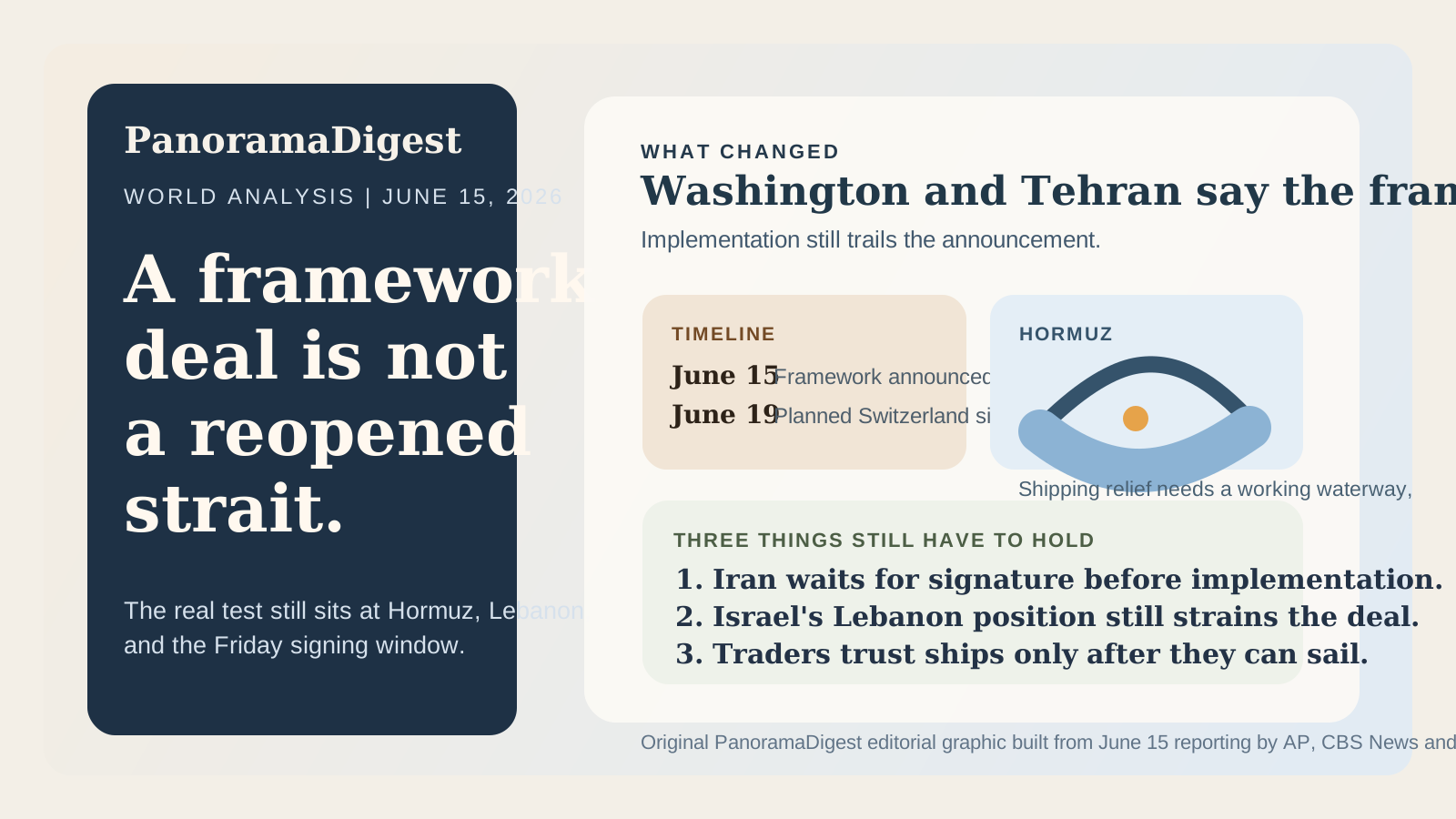
Monday, June 15, 2026, brought a real shift in the U.S.-Iran story. The argument is no longer whether Washington and Tehran are publicly gesturing toward the same diplomatic destination. It is whether the framework they now say they have reached can survive contact with the three places that matter most: the Strait of Hormuz, Lebanon and the days between announcement and signature.
AP News / YouTube — US and Iran reach tentative deal to end the war and reopen Strait of Hormuz
AP's June 15 video summary matches the same framework announcement discussed in the article. If the player does not render, use the direct YouTube link in the story.
The Associated Press reported that the United States and Iran reached an initial agreement on Monday to extend their shaky ceasefire and reopen the Strait of Hormuz, a route that carried roughly a fifth of the world's oil and gas before the war. AP also reported that Iran's deputy foreign minister, Kazem Gharibabadi, confirmed the agreement on state television but said Iran would not begin implementing it until the document is signed on Friday, June 19, in Geneva. That caveat is not diplomatic fine print. It is the entire practical story.
CBS News' live coverage adds the other piece that makes the framework bigger and riskier than a single waterway deal. Pakistani Prime Minister Shehbaz Sharif described the agreement as calling for the immediate and permanent termination of military operations on all fronts, including Lebanon. That is a much larger political claim than reopening a shipping lane. It means a U.S.-Iran understanding is now being sold not only as a maritime de-escalation but as a regional peace architecture. Those are very different levels of difficulty.
Why the word framework matters more than the applause line
This is exactly where PanoramaDigest's June 13 analysis of the text-versus-signing gap now pays off. Two days ago, the most important question was whether the draft language had been stabilized at all. On June 15, the diplomatic situation is stronger than that. AP says the initial agreement exists. CBS says Pakistani mediation is presenting it as a war-ending arrangement. But the same reporting also says the agreement still requires a Friday signing before implementation begins. In other words, the breakthrough has crossed the threshold from rumor to political fact, but not from political fact to operational reality.
That distinction is where readers should keep their attention. Diplomatic history is full of agreements that changed tone before they changed conditions on the ground. A framework can calm markets, lift rhetoric and reorder television coverage before it proves that shipping lanes are safe, commands are aligned and regional partners are willing to absorb the same deal on the same terms.
- Thursday, June 11: Trump said a deal was close, but Iran publicly pushed back on the idea that the process was settled.
- Saturday, June 13: Pakistan said Washington and Tehran had agreed on the wording of a deal, which PanoramaDigest treated as a signing-and-ownership problem rather than a finished peace.
- Monday, June 15: AP reported an initial agreement and CBS reported that Pakistan was presenting it as an end to military operations on all fronts, including Lebanon.
- Friday, June 19: Both AP and CBS point to a planned signing in Switzerland before the agreement is supposed to take practical effect.
Hormuz is still a physical system, not a talking point
The Strait of Hormuz is the cleanest test because it is the least ideological part of the story. Either commercial traffic regains a level of confidence that insurers and ship operators can live with, or it does not. Either the blockade logic ends in practice, or vessels still behave as though a ceasefire headline is not enough. AP's Monday dispatch makes that plain by tying the agreement directly to a shipping route whose closure helped drive a global energy shock. That is also why the official celebratory language out of Pakistan needs to be read as positioning rather than proof. On Monday, the Press Information Department published a statement in which Pakistan's finance minister, Senator Muhammad Aurangzeb, called the U.S.-Iran peace agreement a proud moment for Pakistan and a great moment for the global economy. That may turn out to be right. It is not the same thing as evidence that ships, premiums and loading schedules already agree.
| Claim now circulating | What current reporting supports | What is still unresolved |
|---|---|---|
| The war-ending framework is in place. | AP reports an initial agreement exists, and CBS says Pakistan is framing it as an all-fronts deal. | The agreement still requires Friday's signing before Iran says implementation begins. |
| The Strait of Hormuz is effectively reopening. | AP says reopening the strait is central to the agreement's purpose. | Traffic confidence, insurance behavior and practical operating conditions still have to improve in reality. |
| The regional war can now wind down quickly. | CBS says Pakistan is presenting the arrangement as covering Lebanon as well. | Israel is not party to the U.S.-Iran negotiations and has its own security timetable. |
| The economic shock is already behind us. | Official statements are now speaking in relief-and-recovery terms. | Energy and shipping systems do not reset at the speed of a press release. |
Lebanon is where the settlement can still break
The hardest political problem may no longer be the U.S.-Iran channel itself. It may be whether the rest of the region is prepared to live inside the same peace architecture. AP reports that Israel's defense minister said Monday that Israel would not withdraw from land it has seized in Lebanon, Syria and Gaza, and that a spokesman in Prime Minister Benjamin Netanyahu's office said Israel would continue acting against threats to its security. That means the June 15 framework lands in exactly the terrain PanoramaDigest identified in its June 14 analysis of the Trump-Netanyahu break: an Iran deal can look diplomatically cleaner in Washington than it looks militarily stable in Beirut.
That does not make the framework hollow. It makes it contingent. A deal that promises calm across multiple fronts is only as durable as its least cooperative theater. Lebanon now looks like the obvious candidate for that role. If Israel keeps operating on one clock and Iranian negotiators keep selling restraint on another, the agreement can remain formally alive while strategically fraying.
The public story is ahead of the implementation story again
That is the recurring pattern here. Political leaders announce convergence first because convergence is the part they can own in public. Implementation comes later because implementation involves commanders, inspectors, port operators, commercial shipping, allied governments and the possibility that one actor will interpret the same sentence as permission while another treats it as a pause. Readers do not need cynicism to understand that risk. They only need chronology.
Watch: The Associated Press video summary is here: US and Iran reach tentative deal to end the war and reopen Strait of Hormuz. If the embedded player below is blocked in your browser or region, the direct YouTube link carries the same report.
What to watch before Friday, June 19
The next useful signals are not more triumphant adjectives. They are narrower and tougher. First, does the Friday signing actually happen on schedule? Second, do shipping and insurance conditions around Hormuz start behaving as though the route is materially safer? Third, does the Lebanon front move toward the political language now being attached to the agreement, or away from it?
Those are the questions that will decide whether June 15 was the first day of a durable settlement or simply the day the settlement became easiest to announce. The framework deal matters because it is closer to peace than the region was a week ago. But the harder test still sits at Hormuz, and it still has company.
Read Next
Related Stories

Denmark's 11-Month Military Service Starts With 1,600 Volunteers Across 14 Bases
Denmark's first full 11-month military-service cohort includes about 1,600 volunteers at 14 sites. Equal conscription applies if volunteers fall short.

Lula Wins PT Nomination for Brazil's 2026 Election With Alckmin as Running Mate
Brazil's Workers' Party formally selected Lula and Geraldo Alckmin for the 2026 presidential election. Candidate registration is due August 15.

Ceuta Migrant Crossing Death Toll Reaches 67 as Spain Adds a 500-Meter Barrier
Spain says 67 people died during the mass crossing into Ceuta and is adding a 500-meter sea-border barrier after most entrants returned to Morocco.