Taiwan's New Reporting Portal for Chinese Citizens Turns Intelligence Into a Public Message
Taipei's new reporting portal is not just a spy tip line. It is a public attempt to turn cross-strait frustration, digital tradecraft and political signaling into one carefully staged message.
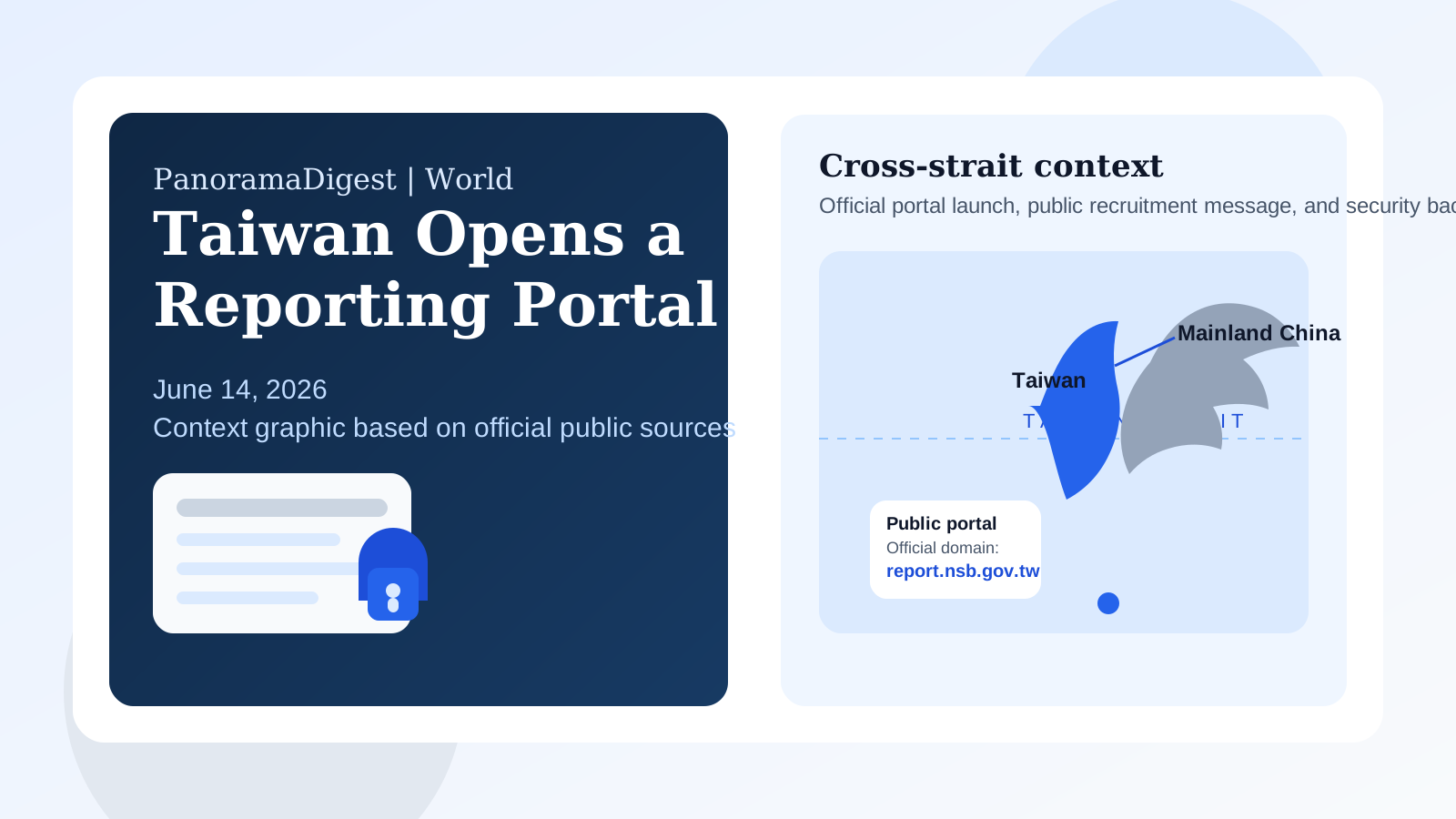
Taiwan's new online reporting portal for Chinese citizens is easy to misread as a simple spy tip line. It is also a political message, and that may be the more important part. By putting the portal in public view on June 14, 2026, Taipei signaled that cross-strait competition is no longer confined to military drills, courtroom indictments or closed-door intelligence work. It now includes a deliberately public invitation to people inside China who feel boxed in by surveillance, political control or institutional fear.
That matters because the launch was not framed as a covert capability. In Reuters reporting on June 14, Taiwan's National Security Bureau said it was opening a secure channel for Chinese nationals who want to provide information. The official portal at report.nsb.gov.tw makes that pitch visible instead of implied. That choice turns the launch into a test of legitimacy as much as a test of collection.
Why Taipei made the launch public
The strategic backdrop did not begin this weekend. In a March 13, 2025 national security address, President Lai Ching-te laid out a broader response to what his government described as Chinese infiltration, espionage and united-front pressure. He cited rising prosecution figures in spying cases and argued that Taiwan had to treat political, military and information pressure as a whole-of-society problem rather than a narrow security file.
The new portal fits that logic. Instead of quietly waiting for defectors, intermediaries or informal channels, Taiwan is publicly telling potential sources that it believes there is usable friction inside China itself. The message is less subtle than traditional tradecraft, but that is the point: Taipei is trying to show both domestic and international audiences that China's tightening control can create its own intelligence openings.
What the portal appears designed to do
The clearest operational detail available in accessible reporting came from Taiwan News, citing CNA on June 14. The report said the site gives different guidance to people connecting from inside China and to people contacting Taiwan from overseas, and it emphasizes device hygiene and anonymity before any outreach is made. That is a strong clue about what Taiwan thinks the real problem is: not just persuading someone to talk, but helping them survive the first digital trace.
| Reported portal guidance | What it suggests |
|---|---|
| Use a non-Chinese-brand phone or tablet | Taipei is assuming hardware and software exposure are part of the risk, not an afterthought. |
| Factory-reset the device before use | The first contact is being treated as a counter-forensics problem. |
| Avoid Wi-Fi tied to real-name registration | Identity linkage is viewed as one of the easiest ways for Chinese authorities to spot a user. |
| Use a VPN, a Western-made browser and private browsing mode | The bureau is trying to reduce traceability before a source even decides what to submit. |
Those instructions do not prove the portal will produce major intelligence. They do show Taiwan understands that a public recruitment push only works if it looks technically aware. A portal that ignored surveillance risk would be performative. A portal that foregrounds digital precautions at least tries to answer the first question a would-be source would ask: will this get me caught?
The propaganda value is part of the story
Reuters also reported that the bureau paired the launch with an AI-generated promotional video in which a Chinese civil servant watches colleagues disappear into investigations and concludes that it is time for change. Taiwan News, again citing CNA, described the video as "Change." Even if the number of actionable submissions remains unknown, the existence of a state-backed recruitment narrative matters on its own. Taipei is not only fishing for information; it is telling a story about brittleness inside the Chinese system.
That narrative cuts two ways. Supporters will say Taiwan is adapting to a sharper era of gray-zone pressure and doing openly what intelligence services have always done quietly. Critics will say a public portal risks producing noise, hoaxes and unverifiable claims while inviting Beijing to portray Taiwan as running an information provocation campaign. Both arguments can be true at once. Public recruitment creates visibility, but visibility is not the same thing as signal.
What to watch next
The immediate question is not whether the portal exists. It clearly does. The harder question is whether Taipei follows this public gesture with disciplined filtering, careful source handling and realistic expectations about what will arrive through an open channel. If the site produces nothing but rumor, Beijing will treat it as a propaganda stunt. If it produces even a modest stream of usable political, economic or military leads, the launch will look like an early sign that Taiwan has become more comfortable turning counterintelligence into an overt instrument of strategy.
Readers should watch three things over the next several weeks: whether Taiwan's officials publicly discuss volume or quality of submissions, whether Beijing issues a formal response rather than leaving the matter to lower-level commentary, and whether other democracies facing Chinese pressure begin to echo Taiwan's blend of public messaging and technical source-protection advice. If that happens, June 14 may be remembered less as the debut of one website and more as the moment Taiwan made espionage part of an openly contested political language.
Read Next
Related Stories

Denmark's 11-Month Military Service Starts With 1,600 Volunteers Across 14 Bases
Denmark's first full 11-month military-service cohort includes about 1,600 volunteers at 14 sites. Equal conscription applies if volunteers fall short.

Lula Wins PT Nomination for Brazil's 2026 Election With Alckmin as Running Mate
Brazil's Workers' Party formally selected Lula and Geraldo Alckmin for the 2026 presidential election. Candidate registration is due August 15.

Ceuta Migrant Crossing Death Toll Reaches 67 as Spain Adds a 500-Meter Barrier
Spain says 67 people died during the mass crossing into Ceuta and is adding a 500-meter sea-border barrier after most entrants returned to Morocco.