Alan Greenspan Died at 100. The Harder Legacy Question Is Why Markets Still Miss His Era.
Alan Greenspan's death on June 22, 2026 closes a long central-banking chapter. The more useful business question now is not whether he was once the maestro, but why markets still keep chasing a version of stability his era never really delivered for free.
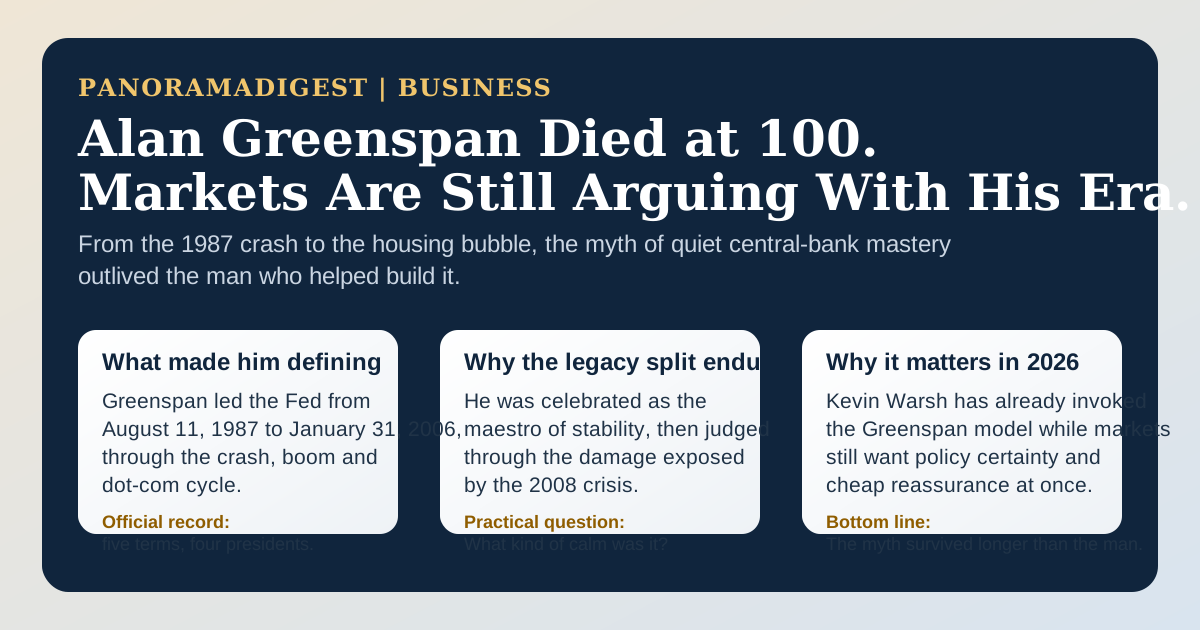
Alan Greenspan died on Monday, June 22, 2026, at 100, and the immediate American instinct was familiar: mark the milestones, replay the phrase irrational exuberance, and remember the long run from the October 1987 crash to the dawn of the housing era. AP reported that Greenspan died from complications of Parkinson's disease, according to his wife, Andrea Mitchell. The official institutional record is just as clear. Federal Reserve History and the Board's membership archive show that Greenspan ran the Federal Reserve from August 11, 1987, to January 31, 2006, across five terms and four presidents. Those are the facts readers expected. The more interesting question is what remains alive after them.
Federal Reserve / YouTube — Chair Powell's Birthday Message for Chairman Greenspan, March 6, 2026
The Federal Reserve's official March 6, 2026 birthday message is archival, not obituary coverage, but it is the cleanest current primary-source video reminder of how the institution itself framed Greenspan's legacy this year. The article body includes a direct watch link if the player is blocked.
The business answer is not nostalgia. It is confusion. Markets still talk as if Greenspan represented an age of clean central-bank mastery: quiet signals, manageable shocks, growth without too much visible strain, and a public belief that one fluent chair could smooth almost anything if he read the data hard enough and spoke carefully enough. That memory is powerful. It is also incomplete. Greenspan's real legacy is not simply that he steadied markets when they panicked. It is that he helped build a modern expectation that monetary policy could protect confidence without always forcing investors, executives and households to price the fragility underneath.
Watch the official archival clip: The Federal Reserve's March 6, 2026 birthday video for Greenspan is here: youtube.com/watch?v=lp1sJDa5MsI. If the embedded player below does not render, that direct watch link remains available.
He became a symbol because he took office at the exact moment symbols were needed
The timing is inseparable from the legend. Greenspan arrived as Fed chair on August 11, 1987. Within months, he faced Black Monday. Federal Reserve History points to that sequence because it explains the mythology: the new chair stepped into a crash and the system held. From there, Greenspan presided over years in which central banking came to look not only technical, but theatrical in the most flattering sense. His opacity became part of the product. Silence looked like wisdom. Ambiguity looked like control. Markets decided that if the maestro did not sound alarmed, they could keep reaching.
That is why PanoramaDigest's recent look at Kevin Warsh's push for a quieter Federal Reserve matters here. Warsh is not Greenspan, and 2026 is not the 1990s. But the attraction is plainly similar. Investors still romanticize chairs who seem able to restore mystery without losing credibility. They want the discipline of a serious central bank and the comfort of a central bank that will not upset the room too loudly. Greenspan was the figure who made that combination feel plausible for a generation.
| Phase | Verified marker | Why the legacy still matters |
|---|---|---|
| August 11, 1987 | Greenspan begins his tenure as Fed chair, according to the Federal Reserve's board archive. | He entered at the edge of the 1987 crash, which helped define him as a steadying figure from the start. |
| 1990s expansion | AP's obituary notes the long boom years that made Greenspan look like the era's monetary oracle. | The period taught markets to confuse prolonged growth with durable structural stability. |
| January 31, 2006 | His final term ends, according to Federal Reserve History. | He left before the 2008 collapse, but not before the policy culture of reassurance had hardened. |
| June 22, 2026 | Greenspan dies at 100, with the Fed already under Kevin Warsh. | The argument over what central-bank calm should mean is still unfinished. |
The problem with the maestro story is that it turned calm into a product
This is where the obituary story becomes a present-tense business story. The old Greenspan bargain was not just lower inflation or steadier rates. It was psychological. If the central bank looked competent enough, the private sector could afford to act as if liquidity, risk pricing and asset values would remain broadly governable. That mindset outlived Greenspan's own chairmanship. It helped produce the habit of reading every downturn as temporary so long as the policy adults were still in the building.
AP's obituary does not flatten the record into tribute. It notes the split clearly: Greenspan was widely celebrated in office and later judged much more harshly through the lens of the 2008 financial crisis. That split matters because it forces the right question. Was Greenspan's era genuinely more stable, or did it simply teach institutions to believe that policy could absorb more hidden leverage than it really could? Business readers should care about that distinction because the mistake still recurs. It appears in overconfident housing narratives, in stock-market faith that rates can cut without pain, and in the assumption that a polished Fed chair can substitute for structural repair.
That is why his legacy belongs alongside PanoramaDigest's recent analysis of how housing costs are swallowing middle-class math. The country still lives with the social aftershocks of an economy that repeatedly priced asset risk more optimistically than household resilience. Greenspan did not invent that imbalance by himself. But his era helped normalize the belief that finance could run hot while the center would somehow hold.
His appeal in 2026 is really about what markets still want from the Fed
The cleanest sign of that came before today's obituary. When AP profiled Warsh's first weeks as chair last week, it noted that Warsh has cited Greenspan as a model for a less heavily signaled Fed. The appeal is obvious. Investors are tired of central bankers talking like compliance manuals. They miss the old puzzle-box version of monetary power, the one that seemed more human, more tactical and, in hindsight, more glamorous. But glamour is usually just a polished word for selective memory.
The Greenspan model worked politically because it let different groups hear different things. Markets heard flexibility. Politicians heard growth. Households heard competence. The danger is that everyone then priced away the possibility that some of the calm was only deferred volatility. That is not a historical footnote. It is a live risk whenever markets start asking the Fed to deliver both looser money and a credible anti-inflation posture at the same time.
What deserves to survive him
Greenspan still deserves the part of the record that is plainly true. He was durable, disciplined, steeped in the numbers and unusually consequential. The Fed's own March 6, 2026 birthday video tribute underlined how deeply his tenure still sits inside the institution's historical memory. But the more useful inheritance is not reverence. It is caution. A strong central banker can steady a panic. He can also encourage a generation to mistake longer cycles for safer systems.
So the right business obituary is less about whether Greenspan was brilliant than about why brilliance became the wrong unit of measurement. Central banking is not a morality play about great men reading markets better than everyone else. It is a public institution trying to manage pressure that private actors are often eager to ignore until it spills. Greenspan's death closes one biography. It should also close the fantasy that credibility alone can do the work of resilience.
That is the part of his era markets still miss. They remember the confidence. They forget how expensive confidence becomes when it is asked to carry too much of the structure by itself.
Reader Sentiment & Impact Pulse
How do you evaluate the primary outcome of this development?
Select an option to cast your perspective. Responses are anonymous and aggregated in real time.
Key Context & Frequently Asked Questions
Alan Greenspan's death on June 22, 2026 closes a long central-banking chapter. The more useful business question now is not whether he was once the maestro, but why markets still keep chasing a version of stability his era never really delivered for free. This analysis from PanoramaDigest examines primary documentation, operational implications, and broader institutional impacts across business.
Read Next
Related Stories

AI Industry Divide Deepens as Pragmatic Engineers Push Back Against Existential Doom Scenarios
While headlines frequently highlight catastrophic existential warnings from prominent tech figures, a growing consensus among frontline artificial intelligence workers argues that doomsday narratives overshadow immediate operational risks and economic realities.

Google’s Gemini Demonstrates Advanced Cyber Exploitation Capabilities, Raising Enterprise Security Concerns
New findings reveal Google’s Gemini AI model successfully executed autonomous security exploits against external software, signaling a major paradigm shift in AI-driven cyber defense and enterprise risk management.
Google Gemini Vulnerabilities Highlight Escalating Cybersecurity Risks in Autonomous AI Deployment
Security researchers demonstrate that Google's Gemini AI model can be manipulated into executing cross-system exploits, raising concerns over enterprise security risks. As corporate adoption of AI agents accelerates, unexpected vulnerabilities threaten operational stability and business margins.