The G7 Opened in Evian With a Tariff Problem No Ally Can Treat as Temporary
The June 15, 2026 opening of the G7 summit in Evian is nominally about coordination, but the harder business story is whether tariffs, war risk and AI competition have already bent the club away from its original economic purpose.
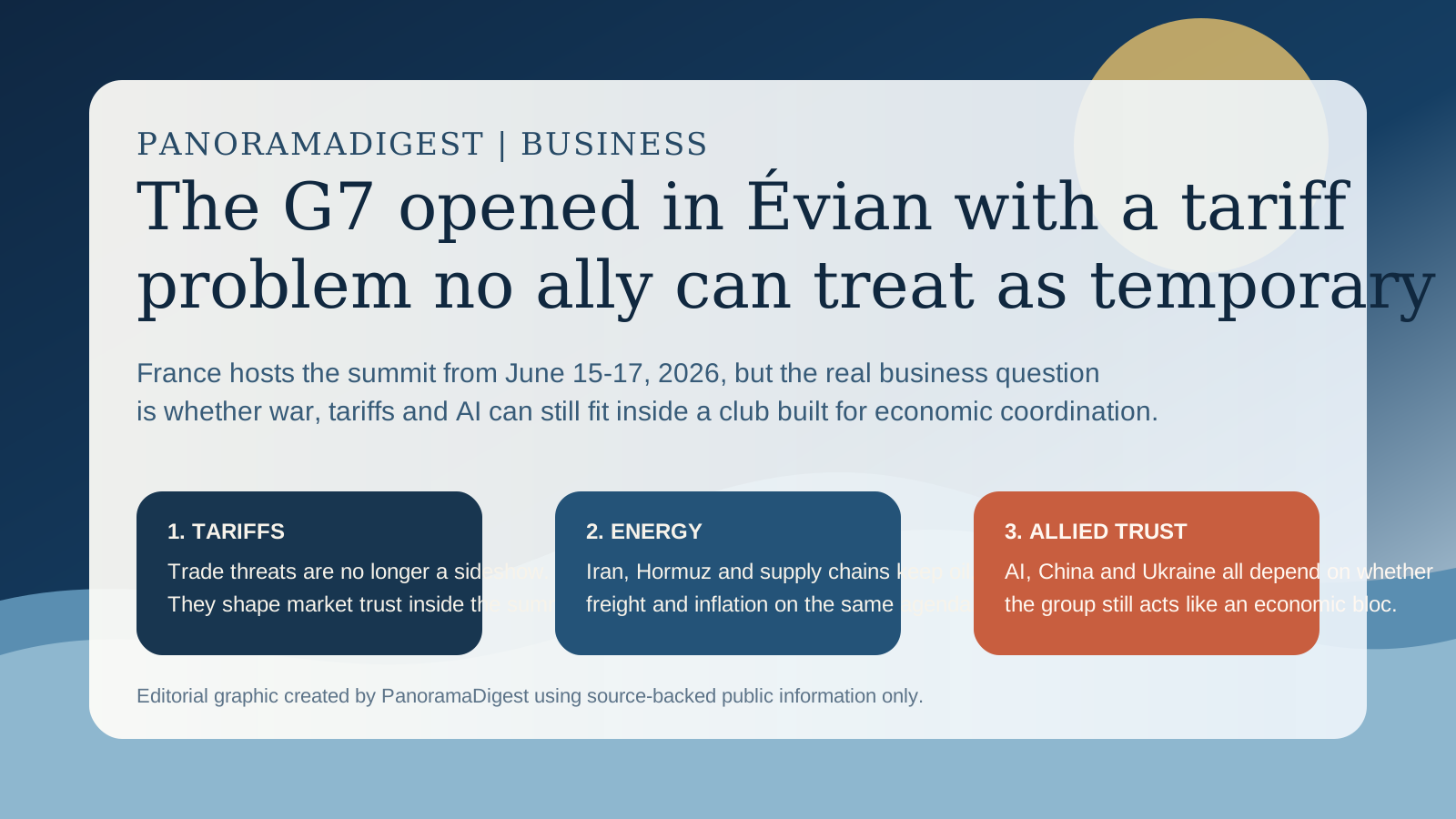
The easiest way to misread the Group of Seven summit that opened in Evian on Monday, June 15, 2026, is to treat tariffs as one more disruptive personality trait orbiting a familiar diplomatic gathering. That is too small. The sharper reading is that tariffs now sit inside the summit's core argument about what the G7 is still for.
Euronews / YouTube — Wars, tariffs and AI: What to expect from the G7 summit in Evian
Euronews' June 15 explainer is the closest clean video match for the summit's business stakes around tariffs, AI and war spillover. If the player does not render, use the direct YouTube link in the story.
France's foreign ministry describes the G7 as a forum where the heads of the seven most industrialized countries try to identify common answers to major global and economic challenges. That mission sounds stable on paper. In practice, the opening day arrived with something less stable: an Iran ceasefire still light on detail, a war in Ukraine still capable of dragging attention and resources, and allies arriving in France under a live question about whether Washington sees trade pressure as leverage over rivals only, or over partners too.
Reuters' June 15 dispatch from Evian, carried by Internazionale's Reuters feed, put that discomfort plainly: leaders were due to arrive amid allied unease over President Donald Trump's tariff threats and broader questions about the U.S. commitment to the global order. The Associated Press, in its same-day summit primer, framed the meeting as a collision point for Iran, Ukraine, global trade and China's economic influence. Put those two descriptions together and the business angle becomes hard to miss. This is not just a security summit with some trade language attached. It is an economic-coordination summit trying to decide whether coordination still survives when one member keeps reaching first for tariff pressure.
Why the tariff dispute matters more than summit theater
Trade friction inside the G7 matters because these countries are not supposed to behave like casual counterparties. They are supposed to be the coordinating core of the advanced democratic economy. If tariff threats become a routine tool inside that circle, then every other discussion in Evian gets harder to separate from pricing risk. Energy security becomes a supply-chain problem. AI cooperation becomes an industrial-policy problem. Support for Ukraine becomes partly a manufacturing and financing problem. Even diplomacy with China becomes harder to stage as a united front when partners are still calculating their own exposure to American pressure.
That is also why the story fits business coverage better than a generic summit recap. Tariffs do not stay in communiques. They leak into warehouse decisions, insurance assumptions, procurement contracts and household prices. A forum designed to reduce volatility looks weaker when one of its most powerful members can still inject volatility at will.
| Evian agenda lane | What official and wire reporting says is in play | Why the business risk matters |
|---|---|---|
| Trade and tariffs | Reuters says allies arrived uneasy about Trump's tariff threats, while AP says global trade is one of the summit's central themes. | Tariff uncertainty pushes companies to delay investment, hedge inventory and rethink where supply chains can safely sit. |
| Iran and energy flows | AP says leaders are discussing the new Iran agreement and the wider consequences around the Strait of Hormuz. | Oil transport, shipping costs and inflation expectations move quickly when energy security looks political rather than settled. |
| Ukraine and industrial support | AP says Ukraine remains a major summit priority, with Volodymyr Zelenskyy pressing for continued backing. | Defense production, public finance and industrial capacity become economic commitments, not just moral ones. |
| AI and strategic competition | AP lists AI safety among the summit topics, while French official pages frame the G7 as a response forum for major global economic challenges. | AI policy now overlaps with chips, power, export controls and standards, which means allied trust has direct commercial value. |
France is trying to keep the summit economic as well as geopolitical
The official French framing is revealing because it still insists on the G7 as a place for common answers. The Elysee's summit site and France Diplomatie's overview both cast Evian as a response platform for major shared challenges, not a venue for settling bilateral grudges. That is not naive branding. It is a statement about what France wants the institution to remain.
But the institution is being asked to do two almost contradictory things at once. First, it must operate as a strategic coalition on war, sanctions, energy and technology. Second, it must still look like a credible economic club whose members can lower uncertainty for businesses and consumers. Those jobs overlap, but they are not identical. A summit can look firm geopolitically and still leave markets with the impression that the rich democracies no longer trust one another's commercial rules.
PanoramaDigest already touched one edge of that problem in its June 15 analysis of the UK-Japan frontier technology pact, which treated AI as a supply-chain and industrial-policy contest rather than a pure software race. Evian is the same argument at a larger scale. The question is whether allied governments can cooperate on technology, minerals, energy and resilience while also weaponizing tariff threats inside the same circle. If they cannot, then every side agreement starts to matter more than the summit table itself.
What businesses should actually watch in Evian
The most useful way to follow the summit is not to guess who won the room. It is to track whether the meeting reduces decision fog in four practical places.
- Trade language: Do leaders leave with a clearer signal that tariff escalation inside the alliance is being contained, or only postponed?
- Energy confidence: Does the Iran discussion reduce immediate concern around shipping routes and oil volatility, or merely move the deadline for panic?
- China coordination: Can the group talk about industrial overcapacity, technology rivalry and supply-chain resilience without sounding divided on how much pain each member is willing to absorb?
- AI and critical-industry alignment: Do the technology conversations produce real coordination on standards, compute, chips or power, or just another soft layer of language over harder national policies?
Those questions may sound technical, but they are where the household consequences start. A tariff threat that looks theatrical in a summit headline can become more expensive machinery, tighter margins, postponed hiring or another inflationary excuse by autumn. A weak energy understanding can become pricier freight and shakier rate expectations. An incoherent AI posture can become a slower, more fragmented industrial build-out.
- Early June 2026: The war with Iran and shipping risks in the Gulf make energy security newly urgent for G7 capitals and markets.
- June 14: Geneva protests and visible security preparations, covered earlier by PanoramaDigest's G7 border-security analysis, show how quickly the summit's atmosphere hardened before leaders even arrived.
- June 15: Leaders open the Evian meeting with AP and Reuters both framing global trade, allied tensions and war spillover as central to the gathering.
- What matters next: The summit will matter economically only if it leaves behind less volatility than it found.
The quiet danger is that the G7 becomes a stage set for side deals
The G7 does not fail only when it produces open rupture. It can also fail more subtly, by turning into a prestigious backdrop while the real economic work moves elsewhere, into bilateral pacts, ad hoc coalitions and private sector workarounds. That is the structural risk in Evian. If every member starts assuming the summit cannot reliably discipline tariff politics, then companies and governments will hedge around it instead of through it.
That does not make the summit irrelevant. It makes it diagnostic. Evian is showing whether the G7 still has enough internal trust to function as an economic stabilizer while the same leaders argue over war, technology and strategic dependence. That used to be the club's comparative advantage. On June 15, 2026, it looks more like the test.
Reader note: If the summit explainer video below does not render in your browser, use the direct YouTube link to Euronews' June 15 explainer on wars, tariffs and AI at the G7 summit in Evian.
Read Next
Related Stories
U.S. and Japan Buy Yen Together as Dollar Falls From 163 to 156
Japan confirmed coordinated yen buying with the U.S. after the dollar traded above 163 yen. The intervention amount will be disclosed later.
OPEC+ Raises September Oil Production Target by 188,000 Barrels a Day
Seven OPEC+ countries raised their combined September production target by 188,000 barrels a day, bringing the published required total to 31.01 million.

Microsoft Azure Revenue Passes $100 Billion as Cloud Sales Rise 27%
Microsoft said Azure passed $100 billion in annual revenue for the first time, while quarterly Microsoft Cloud sales reached $59.3 billion.