DOJ Cleared Paramount’s Warner Bros. Deal. Hollywood’s Harder Fight Starts Now.
The Justice Department’s June 12 approval moved Paramount Skydance’s Warner Bros. Discovery takeover out of the antitrust waiting room, but it did not settle the question Hollywood actually cares about: who gets to control the next decade of studios, streamers and newsroom power once the lawyers outside Washington take their turn.

The federal government gave Paramount Skydance its clearest win yet on Friday, June 12, when the Justice Department said it had closed its antitrust investigation into Paramount’s proposed acquisition of Warner Bros. Discovery and found the deal was not likely to harm competition or American consumers. That sounds like an ending. In entertainment, it is much closer to the end of the first act.
NBC News / Face the Nation — Justice Department signs off on Paramount's Warner Bros. acquisition
NBC News and Face the Nation summarize the DOJ decision. If the player is blocked, use the direct YouTube link in the article body.
The official Justice Department statement is unusually blunt about the markets it says it examined: streaming video on demand, linear television, and studio development, production and theatrical distribution. The agency said an eight-month review, including more than two million documents from over 80 custodians, led it to conclude the combined company would not reduce competition in those arenas. The practical meaning is straightforward. Washington has decided this merger does not look like a Disney-Fox rerun. Hollywood still has to decide what kind of media machine it would actually create.
- February 27, 2026: Paramount announced its agreement to buy Warner Bros. Discovery for $31 a share in cash, with a target close in Q3 2026, according to Paramount’s transaction release.
- June 12, 2026: The Justice Department said it had finished its antitrust review and would not sue to block the deal.
- June 13, 2026: The argument shifted from whether Washington would stop the merger to whether state attorneys general and overseas regulators still might slow or reshape it.
The approval matters because it blesses a bigger streaming answer, not just a bigger studio
There is a reason the DOJ statement spends so much time on streaming. It argues that Paramount+ and Warner’s HBO Max do not sit at the top of the subscription stack today and that combining them could create a sturdier challenger in a market still dominated by larger platforms. That is the government’s legal logic. The cultural and commercial logic is sharper: this deal is an admission that prestige libraries, cable-era news brands and standalone studio identities no longer feel strong enough on their own.
Paramount’s own merger announcement framed the combination as a way to put franchises such as Mission: Impossible, Top Gun, Harry Potter, DC, Game of Thrones and SpongeBob SquarePants under one roof while chasing greater scale in streaming and film. That is not a small bookkeeping exercise. It is a bet that the next durable entertainment company will be built not by one iconic brand but by stacking enough libraries, live rights and advertising muscle to survive the next consumer migration.
The real anxiety is not only about movies. It is about who gets to steer attention.
That is why the story refuses to stay inside the business pages. The Guardian reported that state attorneys general could still try to challenge the transaction and noted that California Attorney General Rob Bonta said the merger remains under investigation by his office. The same report said UK scrutiny is still active. Those details matter because this is no longer just a question about box-office overlap or cable carriage fees. It is a question about what happens when a single company can bargain with advertisers, talent, sports partners, distributors and news audiences using a much larger bundle of assets than either side currently controls alone.
| Question after DOJ approval | What the official record says | What Hollywood still has to answer |
|---|---|---|
| Would federal antitrust regulators sue? | The DOJ said no on June 12 after reviewing streaming, linear TV and theatrical competition. | Whether state or foreign regulators will impose delay, pressure or conditions. |
| Can scale help the combined company compete? | Paramount says the merger creates a broader global media and entertainment platform. | Whether bigger scale produces better strategy or just a larger pile of expensive legacy assets. |
| What becomes more powerful inside the company? | The transaction would combine major studios, streaming brands and news operations. | Who controls editorial identity, budget priorities and the inevitable cuts that accompany synergy promises. |
This is where the merger stops looking like a legal file and starts looking like a cultural power test
Entertainment mergers are often sold as math, then experienced as management philosophy. The math is easy to advertise: bigger catalog, broader ad base, more leverage in negotiations, more places to spread a hit. The philosophy is what audiences and workers end up living with. Does the combined group invest like a long-cycle studio owner, or does it treat beloved brands as inventory that can be squeezed faster? Does it protect different newsroom identities, or does it flatten them into one executive theory of risk? Does streaming scale produce creative patience, or just a more sophisticated justification for cutting mid-budget bets?
The DOJ statement does not answer those questions because antitrust law is narrower than cultural judgment. Its job was to ask whether the merger is likely to reduce competition in specific markets. The entertainment industry’s job is to ask what kind of competition remains once another giant player starts negotiating from a deeper vault of franchises, channels and attention habits. That is why the approval matters, but also why it should not be misread as the whole verdict.
Paramount got the federal answer it wanted on June 12. The harder answer is still coming from state investigators, overseas regulators, creative labor, rival distributors and audiences who have learned that every merger promise eventually reaches the screen as programming, price, cuts or control. If this deal closes on the timetable Paramount outlined back in February, Hollywood will not remember June 12 as the day the story ended. It will remember it as the day the real ownership argument finally became unavoidable.
Watch the source video: If the embedded player below does not load, use the direct YouTube link at youtube.com/watch?v=iJHk8HVDk-c.
Continue reading: Fox's $22 Billion Roku Deal Is Really a Fight to Own the TV Interface.
Read Next
Related Stories
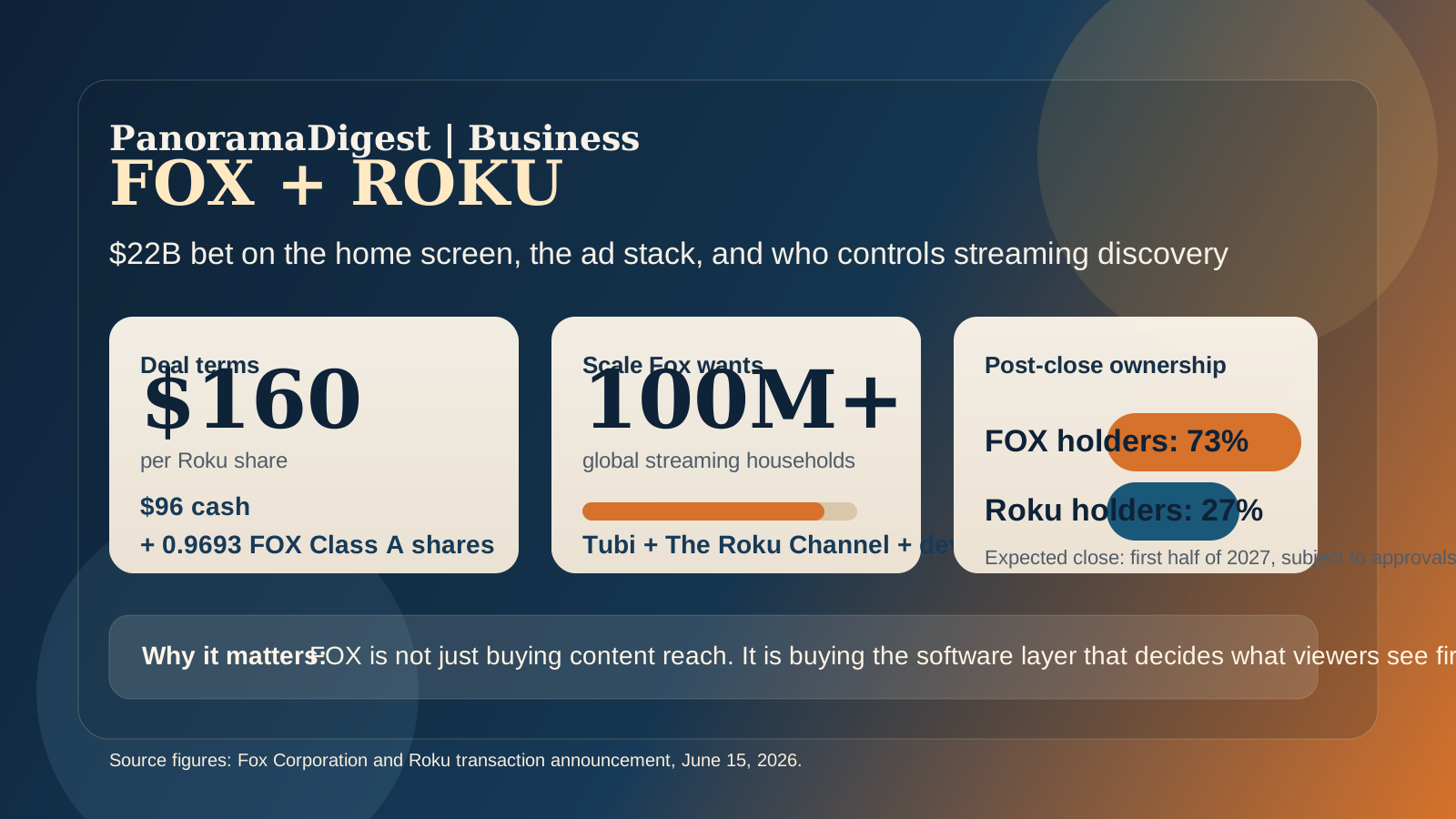
Fox's $22 Billion Roku Deal Is Really a Fight to Own the TV Interface
Fox's proposed Roku takeover is less about adding another streamer and more about controlling the screen, ad data, and distribution layer that still shapes what television means.

Netflix Cuts 2026 Ad Revenue Forecast to $2.7 Billion: The 10% Change Explained
Netflix lowered its annual ad outlook, not last year's sales. A calculation table separates the 10% revision, its revenue share and the company's quarterly results.

Vincent Pastore Dies at 80: The Sopranos Actor's Career Beyond Big Pussy
Vincent Pastore, who made friendship and betrayal inseparable as Big Pussy on The Sopranos, has died at 80. His manager confirmed the death to AP.