The U.S.-Iran Deal Now Has a Text. The Harder Part Is Getting Two Capitals to Own It.
Pakistan says Washington and Tehran have agreed on the wording of a June 13, 2026 peace deal, but the real test has shifted to final approval, Hormuz enforcement and whether the region is being asked to live with a settlement neither side has fully owned in public.
By the time Saturday, June 13, 2026, reached the diplomatic tape, the U.S.-Iran story had changed shape again. On Friday, the argument was whether Washington and Tehran were even describing the same draft. On Saturday, the argument was narrower and more dangerous: whether the text is now close enough that markets, allies and adversaries will start acting as if the ending is already secure.
NBC News — U.S. and Iran appear close to signing agreement after Trump's repeated claims the war is over
NBC News summarizes the June 13 diplomatic shift and the remaining risks. Use the direct YouTube link in the article if the embedded player is blocked.
The Associated Press reported that Pakistan's Prime Minister Shehbaz Sharif said the United States and Iran had agreed on the wording of an agreement aimed at ending the war and that mediators were working with both sides on the next steps. AP also reported that Iranian Foreign Minister Abbas Araghchi said the agreement had never been closer, while still placing the decisive technical fight after the signing rather than before it. That matters because a political text and a durable settlement are not interchangeable things, especially when the unresolved parts still include uranium handling, shipping through the Strait of Hormuz and the wider regional war map.
The White House live page still reflects the Trump administration's preferred public frame: the deal's core value is that Iran would not have a nuclear weapon. CBS News' current live coverage adds the most important implementation detail now circulating from the U.S. side, citing a senior administration official who said the agreement would reopen the Strait of Hormuz, start dismantling Iran's nuclear program and begin a 60-day technical process for destroying or removing enriched uranium. Those are not decorative details. They are the parts that will decide whether this becomes a real peace architecture or just the latest draft that can survive a news cycle but not the region it is supposed to calm.
The freshest claim is stronger than Friday's, but it is still not the finish line
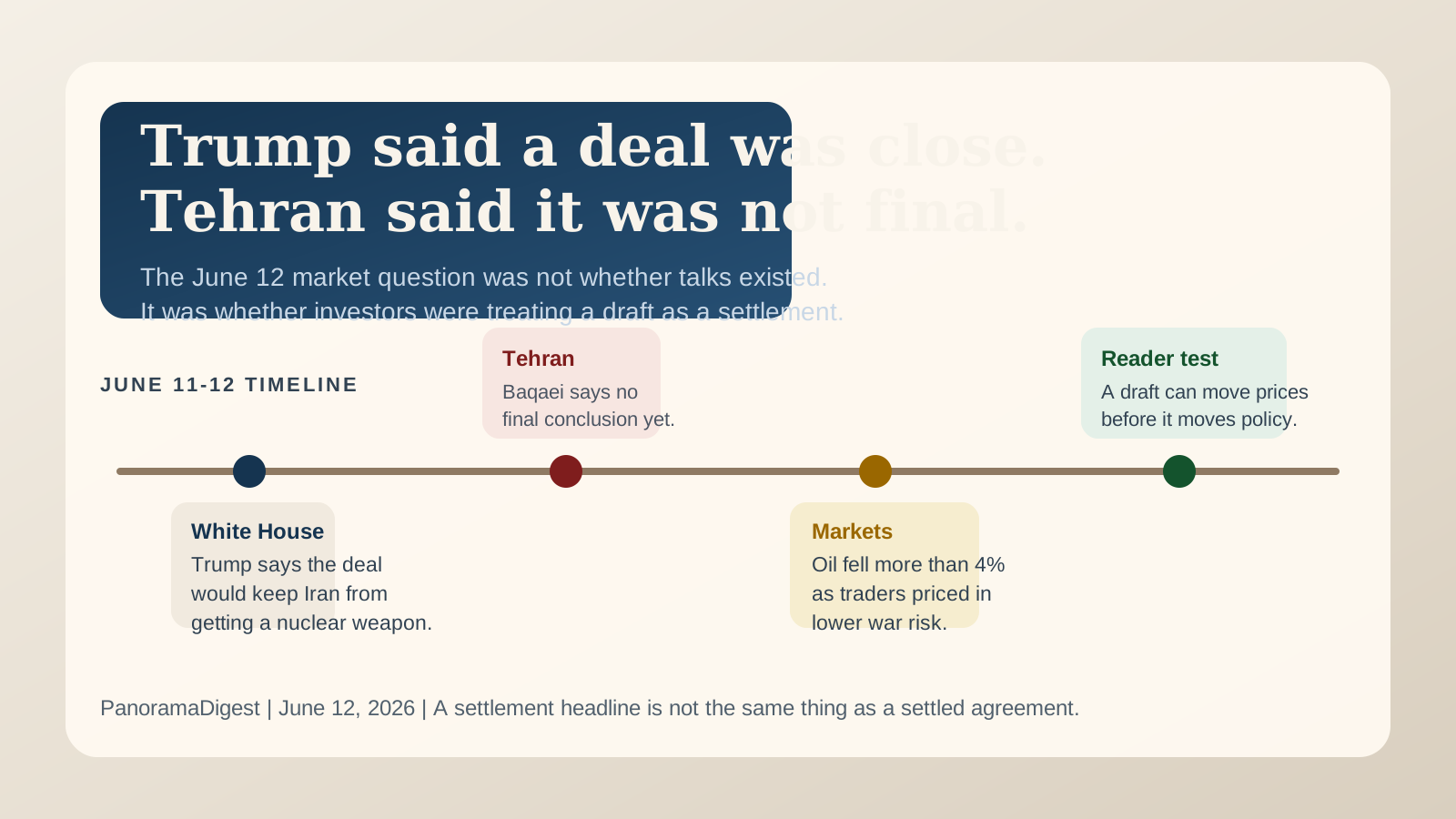
That is the genuine shift from PanoramaDigest's June 12 analysis of the draft-versus-approval gap. Friday's public story was that Washington sounded ready while Tehran still insisted no final decision had been made. Saturday's public story is more advanced: Pakistan is now saying the wording itself is agreed. That is a real development, not a cosmetic refresh. But it still leaves a political gap between having a mediated text and having two governments, plus the region around them, prepared to live with the same interpretation of that text once enforcement starts.
AP's companion explainer sharpens the point. It says Pakistan expects the agreement to be finalized within 24 hours and that technical talks would follow next week. It also says the emerging deal would include reopening the strait, phased sanctions relief and a 60-day period to settle the nuclear terms. That sequence is revealing. The text is being sold as an ending, but many of the most explosive arguments are actually being pushed into the period after the signing. That can work if both sides want a real off-ramp. It can also fail if either side treats the signature as a propaganda checkpoint rather than the start of compliance.
- June 11: Trump said a deal was close and publicly tied success to blocking an Iranian nuclear weapon.
- June 12: Iran said the public optimism had outrun final authorization, keeping the diplomatic gap open.
- June 13: Pakistan said Washington and Tehran had agreed on the wording of the deal and were moving toward finalization.
- What still matters most: approval, enforcement and whether the post-signing technical phase becomes a bridge to peace or a new arena for breakdown.
The Strait of Hormuz remains the clearest reality test
Readers should still treat Hormuz as the cleanest proof point because it is the least rhetorical part of the story. Shipping either becomes safer in a measurable way, or it does not. Insurance costs either keep easing, or they do not. The civilian energy economy either starts trusting the water again, or it does not. AP's Saturday explainer says the emerging agreement would reopen the strait, while CBS reports that the U.S. side sees that reopening as one of the deal's first practical outcomes. That is why the war's diplomatic story keeps circling back to the same narrow waterway. It is the place where a claimed breakthrough has to survive contact with logistics, not just language.
That is also why the market response deserves attention but not worship. If traders believe the near-term war premium has fallen, oil can move before diplomats prove anything. That is rational up to a point. But it also means markets can begin rewarding atmosphere while negotiators are still leaving the hardest work for the technical phase. PanoramaDigest made that broader warning in its June 11 article on Hormuz and the ceasefire test. Saturday's development does not cancel that logic. It intensifies it, because a nearly-final text invites everyone to behave as though implementation is a formality when it rarely is.
| Claim now circulating | What current sourcing supports | What remains unresolved |
|---|---|---|
| The war-ending deal text is agreed. | AP reports Pakistan says the wording is agreed and mediators are working on next steps. | Final political approval in Washington and Tehran still matters more than wording alone. |
| The agreement can reopen the Strait of Hormuz. | CBS cites a senior U.S. administration official saying that reopening the strait is part of the deal's core structure. | Operational enforcement, transit confidence and the cost structure for passage still have to hold in practice. |
| The nuclear dispute is effectively settled. | Current reporting says there would be a 60-day technical process to handle enriched uranium after signing. | The technical phase is exactly where past confidence has often been tested hardest. |
| The region can now move on. | AP says the draft is meant to declare an end to the war on all fronts, including Lebanon. | Israel is not a party to the U.S.-Iran talks, and the Lebanon piece remains politically fragile. |
The most fragile part of the story may be the part sold as most settled
The risk now is not that there is no diplomacy. There plainly is. The risk is that each capital is incentivized to package the same text as a different kind of victory before the compliance burden arrives. Washington wants a story about pressure, deterrence and a nuclear red line enforced. Tehran wants a story about endurance, sanctions relief and a political exit that does not look like capitulation. Pakistan wants a story about mediation that delivered what larger powers could not. None of those stories are inherently false. The problem is that a peace text lasts only if those stories can coexist when costs, inspections, timetables and violations become concrete.
Saturday's AP reporting points to another reason for caution: some of the most sensitive pieces remain in the technical or regional basket, not the celebratory one. Lebanon is still in play. Israel is still outside the negotiations. The handling of enriched uranium still sits in the after-signing phase. That means the public narrative has reached its most optimistic stage before the most combustible implementation stage has even begun. Diplomats know that can be manageable. Readers should also know it can be precisely how an apparent breakthrough becomes a new argument with better branding.
Watch: NBC News' current video summary is here: U.S. and Iran appear close to signing agreement after Trump's repeated claims the war is over. If the embedded player below is blocked in your browser or region, the direct YouTube link carries the same report.
What to watch in the next 24 hours
The next decisive signal is not another optimistic phrase. It is whether both governments actually approve the package on the terms being circulated, whether Hormuz risk declines in ways shippers can trust, and whether the post-signing technical talks start looking like execution rather than delay. If those three things happen together, Saturday may be remembered as the day the region moved from rhetorical truce toward a real settlement framework. If they do not, it may be remembered as the day the agreement became easiest to announce and hardest to own.
That is the sober reading on June 13, 2026. The U.S.-Iran deal is closer than it was a day ago. It may even be closer than either side has previously allowed in public. But the strongest new fact is still not that peace is complete. It is that the final mile is now visible enough for everyone to start mispricing how difficult it will be.
Read Next
Related Stories
Trump Says the Iran Deal Is Close. Tehran Is Warning Markets Not to Confuse Drafting With Peace.
President Donald Trump said a U.S.-Iran deal could be signed within days, but Tehran said it had not made a final decision, leaving markets to price optimism long before diplomats can bank it.
Hormuz Escalation: US-Iran Ceasefire and Shipping-Security Questions
Fresh U.S. strikes after an Apache helicopter incident have turned the Strait of Hormuz from a military flashpoint into the place where diplomacy, shipping security, and escalation control collide.
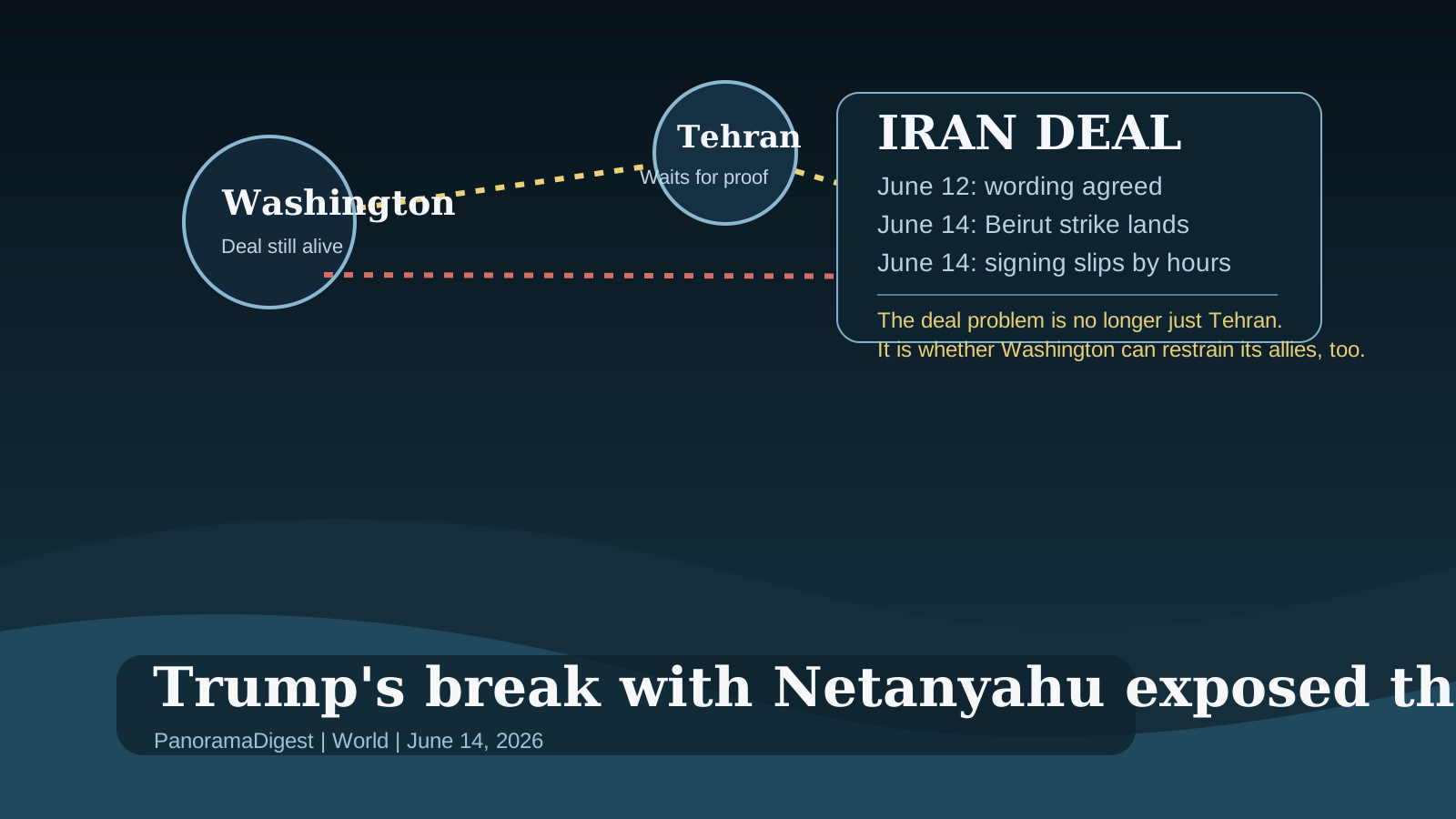
Trump's Public Break With Netanyahu Shows How Fragile the Iran Deal Still Is
Donald Trump's anger over Israel's Beirut strike was not just another personality flare-up. It exposed the central weakness in the emerging U.S.-Iran deal: Washington is asking Tehran to trust a diplomatic landing while its closest regional ally keeps testing the edge of the bargain.