The Supreme Court's Roundup Ruling Did Not Settle the Cancer Debate. It Settled Who Gets to Force a Warning.
On Thursday, June 25, 2026, the U.S. Supreme Court ruled 7-2 for Monsanto in Monsanto v. Durnell, blocking state-law failure-to-warn suits over Roundup's label. The most important consequence is not that the justices declared glyphosate scientifically settled. It is that they said states cannot use tort law to force a cancer warning when the EPA has not required one.
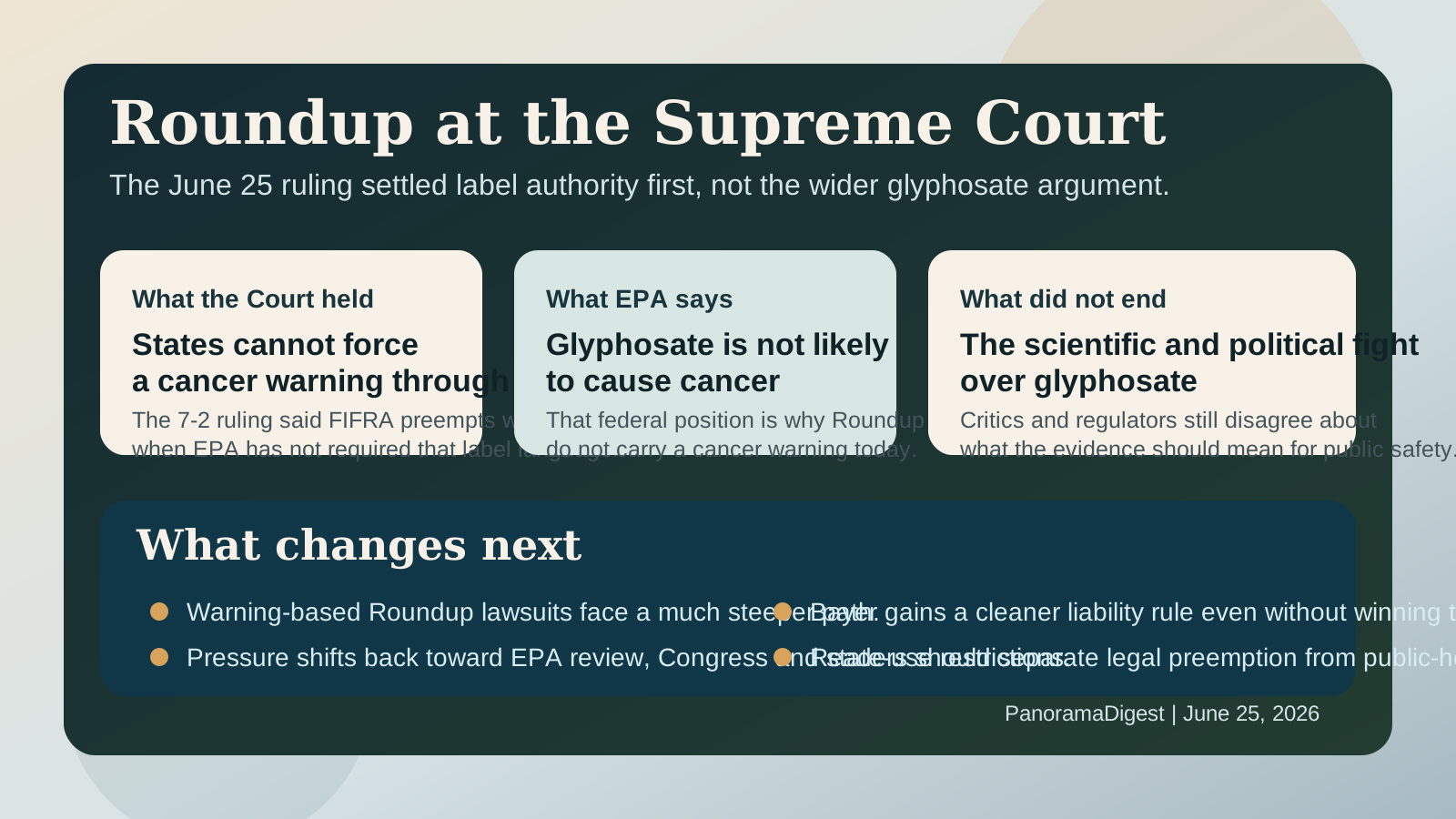
The most important part of the Supreme Court's Roundup decision is what it did not say. In Monsanto v. Durnell, decided on Thursday, June 25, 2026, the justices did not declare the glyphosate debate over. They did something narrower and, for industry, far more valuable: they decided who gets to force the label. In a 7-2 ruling, the Court said state-law failure-to-warn claims are preempted when they would require Monsanto to add a cancer warning that the Environmental Protection Agency has not required under federal pesticide law.
Reuters — US Supreme Court hears Bayer on Roundup lawsuits
Reuters' report from the Supreme Court arguments gives readers the case background; if the player is blocked, use the direct YouTube link in the article body.
That distinction matters because Roundup litigation has always operated on two tracks at once. One track is scientific and political: does glyphosate present a cancer risk, how should regulators weigh the evidence, and why do different institutions keep landing in different places? The other track is operational: if EPA has approved a label without a cancer warning, can juries in state courts effectively rewrite that label through damages verdicts? Thursday's ruling did not close the first argument. It largely answered the second.
The Court's own syllabus makes the holding plain. The justices wrote that FIFRA's preemption clause bars Durnell's claim because it would require Monsanto to add a cancer warning to a label federal law requires the company to keep using unless EPA approves a change. The opinion, written by Justice Brett Kavanaugh, repeatedly returns to the same structural point: the pesticide label is part of a federal scheme meant to stay uniform, not something each state can alter through litigation after the fact.
"Durnell's state law failure-to-warn claim would require a cancer warning on Roundup's label."
U.S. Supreme Court syllabus in Monsanto v. Durnell, June 25, 2026
What the ruling resolved, and what it very much did not
The opinion leans heavily on the fact that EPA has, for decades, maintained that glyphosate is not likely to cause cancer and therefore has not required a cancer warning on Roundup labels. The Court said that once EPA has made that judgment, a state-law damages claim demanding a different warning becomes an additional labeling requirement, which FIFRA forbids. That is the legal hinge.
But legal preemption is not the same as scientific closure. The Court itself noted the long-running dispute inside the public record, including the fact that the International Agency for Research on Cancer classified glyphosate as a probable carcinogen in 2015 while EPA reaffirmed the opposite view in later reviews. That tension never disappears in the opinion. It is simply subordinated to a different question: whether the state warning duty conflicts with the federal label regime. Readers should be careful not to confuse those two debates just because Thursday's winner was the same company on both fronts.
| Question | What the ruling says | Why readers should care |
|---|---|---|
| Did the Court say glyphosate is harmless? | No. The decision turned on federal label preemption, not a new scientific finding by the justices. | The public-health argument over glyphosate does not disappear just because the legal route narrowed. |
| What did Monsanto win? | A ruling that state-law failure-to-warn suits cannot force a cancer warning when EPA has not required one. | That threatens a large share of current and future warning-based Roundup cases. |
| What role did EPA play? | The Court treated EPA's approval of a label without a cancer warning as the controlling federal requirement. | Federal regulators, not state juries, now sit even more squarely at the center of this fight. |
| What still remains contested? | The science, the politics around pesticide safety, and what other claims or settlements may survive outside this narrow warning theory. | The litigation story is not necessarily over, even if the label theory just took a major hit. |
Why Bayer won more than one case today
AP reported that Bayer has already spent years fighting a litigation wave that produced multimillion-dollar verdicts, settlements and roughly 200,000 claims tied to Roundup. The company also stopped selling glyphosate-based Roundup for residential use in the United States, even as it continued insisting the product is safe. Thursday's ruling matters because it offers something settlement money never can: a cleaner rule for future cases.
That is why Bayer's own reaction focused less on one Missouri plaintiff than on containment. In its full post-ruling statement and initial immediate statement, the company framed the outcome as regulatory clarity and part of a broader strategy to shrink the litigation's future footprint. That is corporate language, but the underlying point is real. Bayer did not need the Court to vindicate every part of its public case. It needed the justices to make warning suits harder to sustain. On that front, it succeeded.
The ruling also helps explain why so many major businesses prefer federal uniformity to state-by-state accountability fights, especially in sectors where the label is the battlefield. Once the legal system says compliance with a federal label can block later state warning claims, the strategic value of winning the regulator grows dramatically. In that sense, the Roundup case is not just about weedkiller. It is a wider reminder that administrative decisions can end up doing the work that juries once did.
The harder public question now shifts back to regulators
For critics of glyphosate, that means the center of gravity shifts again. If a state damages verdict can no longer do as much work, then pressure returns to EPA, to Congress, and to state governments acting through sales or use restrictions rather than label-by-label warning theories. The Court itself noted that states still retain some power to regulate pesticide use within their borders. What they have less room to do after Thursday is demand a different warning through tort law when EPA has already spoken.
That is why this case belongs in the same family of stories as PanoramaDigest's recent look at how the Court turned a federal protection program into an immediate countdown. In both disputes, the justices were less interested in broad moral resolution than in deciding which institution gets the last operational word. That institutional choice is often where the real power lies.
- Watch the remaining claim types: Thursday's ruling was devastating for warning-based suits, but it does not automatically erase every legal theory attached to Roundup.
- Watch EPA pressure next: critics who want a cancer warning now have even more reason to target federal regulatory review directly.
- Watch how investors read the ruling: a cleaner ceiling on future warning liability matters to Bayer even more than one day's stock move.
Watch the case background video: if the player below does not load in your browser, use the direct link to Reuters' report from the Supreme Court arguments in the Roundup lawsuits case.
The cleanest way to read Thursday's decision is this: the Court did not resolve a decades-long fight over what glyphosate means for human health. It resolved, at least for now, whether states can use civil verdicts to outrun the EPA on the label. For Bayer, that may be the more valuable victory anyway.
Read Next
Related Stories

Old Trails Fire Damage Estimate Reaches 640 Structures in Spokane
Spokane County's preliminary estimate says the Old Trails fire destroyed 640 structures, while evacuation zones remain active across northwest Spokane.

USCIS Can Now Refer Asylum Cases to Immigration Court Without an Interview
A DHS rule effective July 28 lets USCIS send some affirmative asylum applications directly to immigration court. Referral is not a denial, but the interview is no longer guaranteed.

Seattle Center Shooting Kills Three and Injures Four at Bite of Seattle Festival
Seattle police say a shooting at the Bite of Seattle festival killed three people and injured four others, including a 2-year-old boy. One suspect was arrested and police continued searching for another.