Venezuela Earthquakes: Rescue Operations After Two Powerful Shocks
Two earthquakes measuring 7.2 and 7.5 struck Venezuela 39 seconds apart on Wednesday, June 24, 2026. By Thursday evening, June 25, officials said at least 188 people had died. The deeper story is how quickly violent shaking became a test of rescue reach, airport access, communications and state capacity.
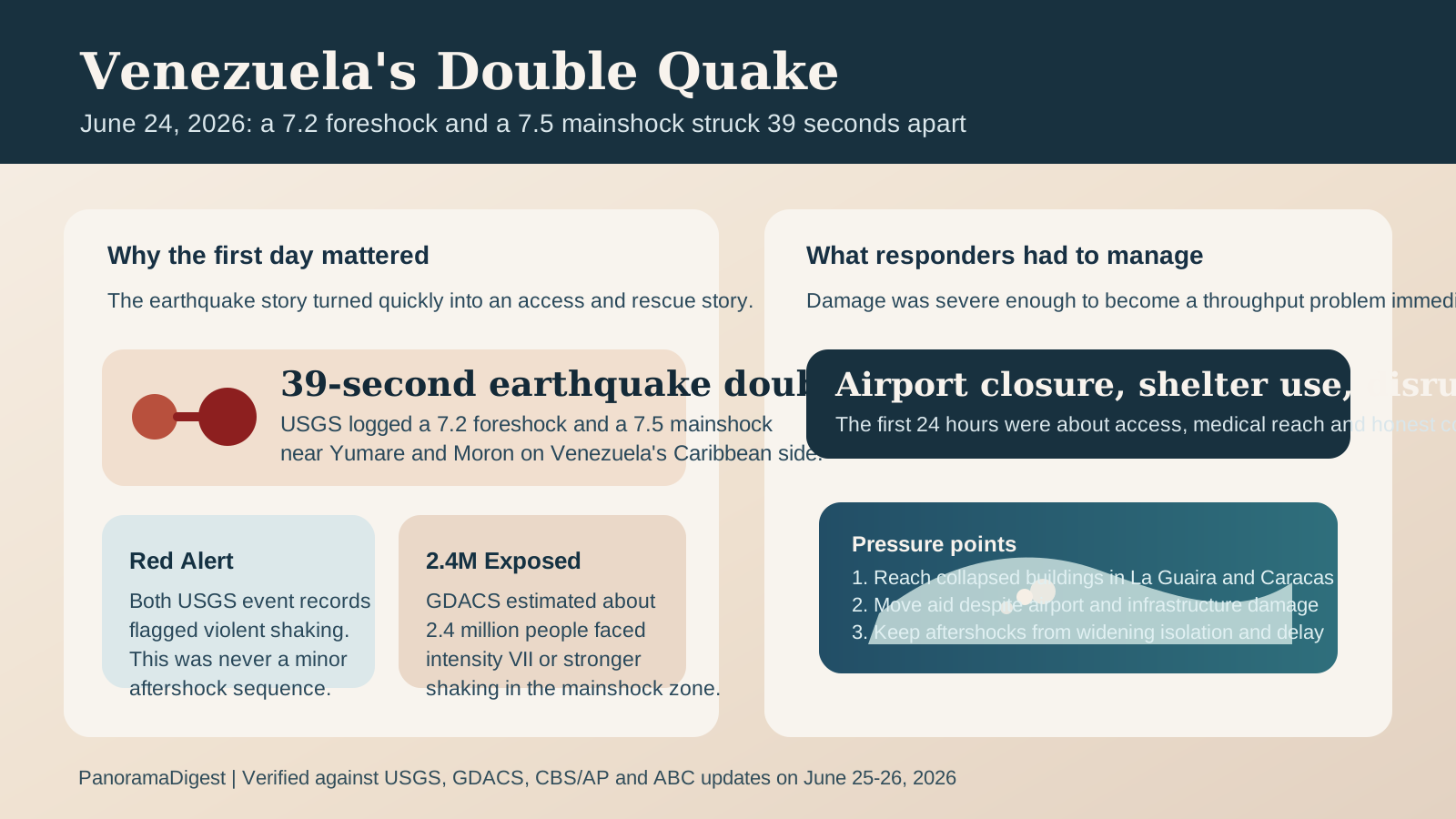
The first fact is brutal enough on its own. Two earthquakes measuring 7.2 and 7.5 struck Venezuela just 39 seconds apart on Wednesday, June 24, 2026, according to the U.S. Geological Survey's foreshock summary and the mainshock event record. By Thursday evening, June 25, officials cited by CBS News and the Associated Press said at least 188 people had been killed and about 1,500 injured. But the hardest part of this story is not only the death toll. It is how fast a seismic doublet turned into a logistics and rescue-capacity emergency in a country where the first 24 hours were always going to depend on more than geology.
Reuters — Severe quakes rock Venezuela, high casualties likely: USGS
Reuters' first report frames the double quake and the rescue challenge; if the player is blocked, use the direct YouTube link in the article body.
The scale of the hazard was visible immediately in the official data. USGS gave both events a red alert level and violent-shaking estimates, while the Global Disaster Alert and Coordination System, a UN-European Commission platform, estimated that the 7.5 mainshock exposed about 2.4 million people to intensity VII or stronger shaking. GDACS also flagged Venezuela's coping-capacity score at 4.3 and noted that analytical support products, including a UNOSAT damaged-buildings activation and an EC/ECHO daily map, were already being generated on June 25. That combination is what separates a major earthquake from a broader state-stress story. The shaking was severe. The population footprint was large. The response system was immediately under pressure.
Why the doublet matters more than a single headline magnitude
Earthquake coverage often compresses events into one dramatic number. In Venezuela, that shortcut hides the operational problem. USGS said the 7.2 foreshock struck at 22:04 UTC on June 24 and the 7.5 mainshock followed at 22:05 UTC, both near Yumare and Moron on the Caribbean side of the country. That sequence matters because a strong first shock can drive people into streets, stairwells and damaged corridors just before a larger second event arrives. It also complicates the first wave of emergency reporting: agencies are sorting not just one rupture and its aftershocks, but a pair of severe shocks that produced overlapping damage patterns in quick succession.
- June 24, 2026, 22:04 UTC: USGS records a magnitude 7.2 foreshock near Yumare, Venezuela.
- 39 seconds later: A magnitude 7.5 mainshock follows, also near Yumare, and both events receive red alert levels.
- June 25, 2026: GDACS estimates 2.4 million people were exposed to intensity VII or stronger shaking from the mainshock and flags high humanitarian impact.
- Thursday, June 25: Venezuelan officials say at least 188 people are dead, Simón Bolívar International Airport is closed, and schools are being used for shelter and relief support.
By Thursday, the visible consequences had spread well beyond collapsed walls. CBS/AP reported that Acting President Delcy Rodriguez declared a state of emergency, closed the country's main airport after severe damage, and said schools would be used as shelters and donation centers. That is the point at which disaster stories stop being about tremors and start being about state throughput. A damaged airport slows incoming aid. Power and cellphone disruptions slow family tracing and casualty verification. Schools used as shelters tell readers that the crisis is already moving from rescue into short-term displacement management.
The hardest hit places are also where counting and access become harder
Official statements and current reporting point to La Guaira and parts of Caracas as the clearest pressure points. CBS/AP said La Guaira appeared to be the hardest-hit state, while rescue crews in Caracas were still working through collapsed residential buildings and blocked streets. ABC's live update coverage tracked the rising casualty count and the international offers of help, while Reuters video coverage documented the early assessment that heavy casualties were likely. That mix of sources matters because disaster understanding depends on combining three layers at once: instrument data, official emergency declarations and on-the-ground reporting from damaged neighborhoods.
| Signal | What is verified | Why it matters now |
|---|---|---|
| Seismic force | USGS recorded a 7.2 foreshock and a 7.5 mainshock 39 seconds apart, both with red alerts and violent-shaking estimates. | The damage pattern came from a double hit, not one isolated jolt. |
| Population exposure | GDACS estimated 2.4 million people exposed to intensity VII or stronger shaking in the mainshock zone. | Large urban exposure raises the stakes for rescue, shelter and medical throughput. |
| Infrastructure stress | Officials said the main airport was closed and parts of the country faced power and cellphone disruptions. | Access and communications failures can push casualty counts upward even after the shaking stops. |
| International response | UNOSAT, EC/ECHO and U.S. aid channels were activated or announced by June 25. | The disaster crossed the threshold where domestic response alone may not be enough. |
The earthquake's second act is therefore about access, not only impact. When the first official count is already 188 dead and roughly 1,500 injured within a day, the next question is whether responders can reach damaged buildings, move the injured, and maintain enough communications to prevent neighborhoods from becoming isolated. Disaster mortality is often a race between structural damage and response speed. Once airports close and telecoms falter, that race gets harder to win.
Why the red-alert models matter, even if they overshoot the final toll
USGS loss models are not death certificates, and readers should not treat them that way. But they do explain why this event drew such immediate global concern. The CBS/AP report noted that USGS predictive modeling showed a meaningful probability of casualties in the thousands, a reminder that the earthquake's physical parameters alone were severe enough to justify worst-case planning. In practice, those models matter less as final forecasts than as a clue to what emergency officials have to assume before all the facts are available. If the model says the humanitarian envelope could be huge, governments and aid networks have to act while the real count is still incomplete.
That is where the Venezuela story becomes larger than the map. Countries with strained infrastructure and uneven service capacity can find that the first day of a major earthquake is really an argument about throughput: ambulances, hospitals, rubble clearance, shelter beds, fuel, family tracing and communications. Seismology explains the force. Capacity determines how much force keeps turning into harm after the rupture is over. PanoramaDigest has seen the same systems lesson in a different geography before, in our June 8 analysis of the Mindanao earthquake and the trust test around tsunami alerts: the first number matters, but the response chain matters more.
What readers should watch next
The next useful signals are practical, not dramatic. Watch whether the airport closure persists. Watch whether casualty figures keep rising sharply in La Guaira and Caracas as more buildings are searched. Watch whether aftershocks alter access to already damaged neighborhoods. And watch whether outside assistance moves from promises into visible logistics on the ground. Those are the indicators that tell readers whether Venezuela is shifting from first-shock chaos toward a more stable rescue and shelter operation, or whether the doublet will keep widening into a longer emergency.
Watch the first verified video briefing: if the player below does not load in your browser, use the direct link to Reuters' report on the severe Venezuela quakes and likely high casualties.
The cleanest way to read this disaster on June 26 is not as a single terrible number, and not as a generic reminder that earthquakes are dangerous. It is as a test of whether rescue systems can move faster than isolation, disrupted infrastructure and the compounding effects of a double shock. Venezuela's geology started the crisis. Its response capacity will now determine how much worse the crisis becomes.
Read Next
Related Stories

French Senate Election 2026: RN's Group Breakthrough and the 10-Member Rule
RN officials announced enough senators for a group after the September 27 election. Here is why 178 seats, a 10-member threshold and a 14-member claim mean different things.
Swiss Neutrality Vote: 70.15% Reject Stricter Rules on Sanctions and Military Cooperation
Switzerland remains neutral after voters rejected a stricter constitutional definition. The official result and the sanctions exceptions explain what stays unchanged.
Denmark's 11-Month Military Service Starts With 1,600 Volunteers Across 14 Bases
Denmark's first full 11-month military-service cohort includes about 1,600 volunteers at 14 sites. Equal conscription applies if volunteers fall short.