The Supreme Court's TPS Ruling Turned Two Protection Programs Into an Immediate Countdown
The Supreme Court's June 25, 2026 decision did not just resolve a jurisdiction fight over Temporary Protected Status. It turned Haiti's and Syria's court-preserved protections into an immediate compliance question for families, employers and federal agencies.
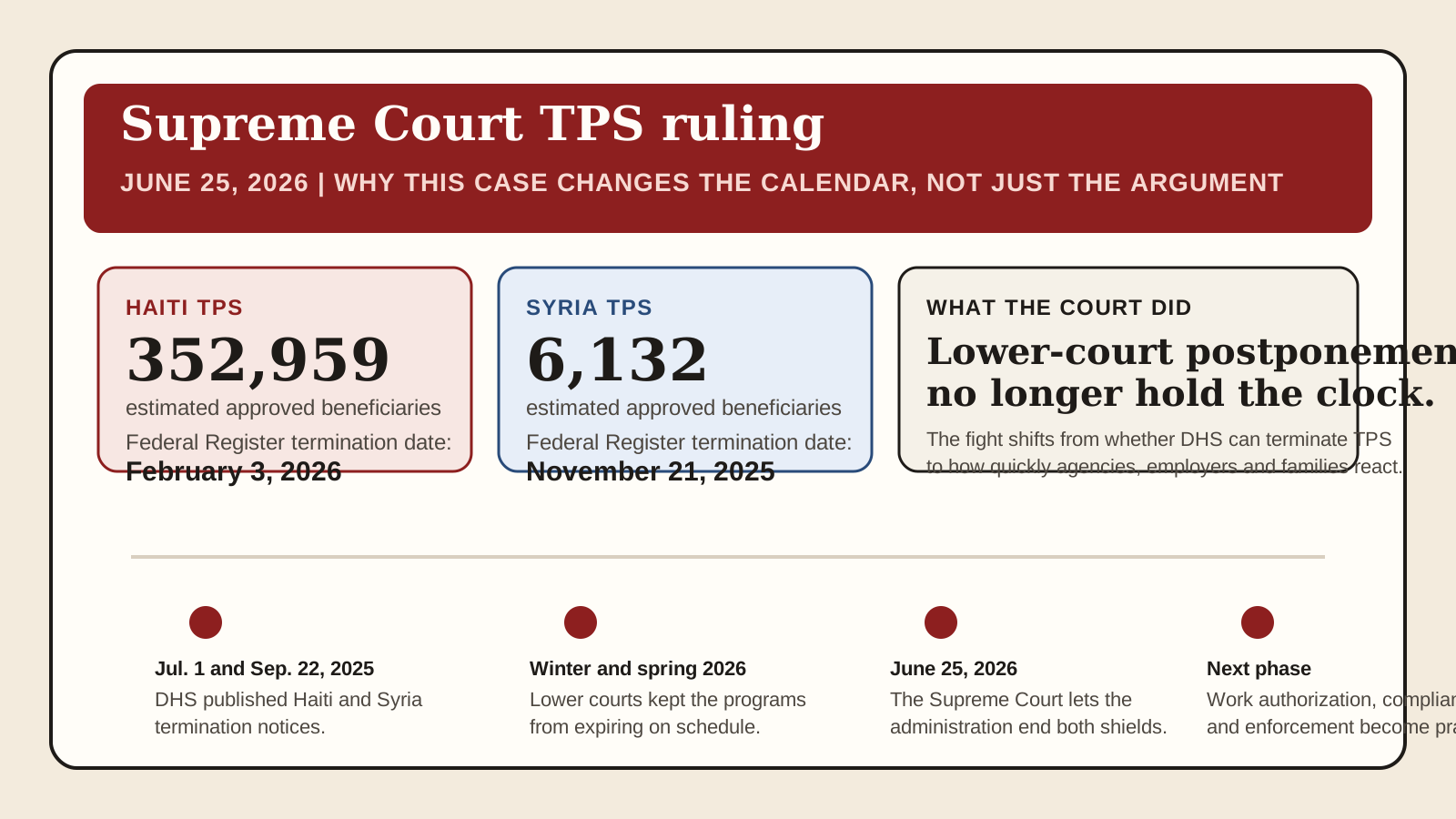
The most important part of the Supreme Court's Temporary Protected Status ruling on Thursday, June 25, 2026 is not the headline word allows. It is the calendar hidden underneath it. By the time the justices sided with the Trump administration, the Department of Homeland Security's own termination dates for Syria and Haiti were already in the rearview mirror. That means the case now matters less as an abstract debate about executive power and more as a practical countdown problem for people who have been living, working and planning under protections that lower courts had kept alive.
CBS News — Supreme Court rules on two major immigration cases, siding with Trump
CBS News' same-day video covers the TPS decision and the related asylum case. Use the direct YouTube link below if the player does not load in your browser.
According to the court's opinion in Mullin v. Doe, the justices concluded that the lower courts had no authority to postpone DHS termination decisions in the way they did. AP's same-day report said the ruling was 6-3 and clears the administration to end protections for Haitians and Syrians who had been shielded while the lawsuits moved. That sounds procedural, but procedure is the story. Once a court stops freezing the clock, every already-published deadline suddenly becomes real again.
That is why the ruling lands differently from a standard immigration headline. DHS said in the Haiti Federal Register notice that TPS for Haitians would end on February 3, 2026, and it estimated that about 352,959 people held that status. In the Syria notice, DHS set termination for November 21, 2025 and estimated 6,132 approved beneficiaries. Lower-court orders had delayed the practical effect of those decisions. The Supreme Court's move does not create a new future cutoff. It strips away the postponement that had made the old ones feel provisional.
What changed on June 25 was the legal posture, not the underlying notices.
That distinction matters because it tells readers where the next pressure will show up. The court did not invent a fresh TPS framework. It reinforced the government's argument that the statute sharply limits judicial review of DHS decisions to designate, extend or terminate TPS. The opinion effectively says the lawsuits cannot keep functioning as a substitute extension mechanism. For families, employers, school systems and lawyers, that means the next phase is no longer mainly about courtroom theory. It is about work authorization, status documentation, enforcement timing and whether the administration offers any practical transition beyond what was already written into prior notices.
| Country | DHS termination date in notice | Estimated beneficiaries cited by DHS | Why the June 25 ruling matters |
|---|---|---|---|
| Haiti | February 3, 2026 | 352,959 | The court removed the judicial pause that had kept a past-due termination from fully taking hold. |
| Syria | November 21, 2025 | 6,132 | The administration's legal win makes an already-expired date operationally relevant again. |
CBS News' coverage of the ruling captures the blunt version: the justices said immigrants from Syria and Haiti were not entitled to judicial orders postponing the terminations of their temporary deportation protections. The harder question is what that means on the ground over the next several days and weeks. A family with a mortgage, a hospital employee with a work-authorization document, or a business that has been treating the court injunctions as an operating fact is not living inside a law-school seminar. They need to know whether the federal government now acts as if those protections ended months ago, whether documentation remains usable while agencies process the shift, and whether individual immigration pathways become the only remaining buffer.
That is where the ruling also becomes a test of administrative seriousness. TPS was always sold in the law as temporary, and both DHS notices emphasize that point. But temporary programs become socially sticky when they cover hundreds of thousands of workers and parents over long stretches of instability abroad. Haiti's designation dates to 2010. Syria's dates to 2012. The court's ruling does not settle the moral argument over whether those countries are safe enough. It narrows the institutional question to who gets to make that call and how little room courts have to slow it down once DHS has spoken.
This is also a warning about how the current court treats time.
For administrations, time is power. A postponed termination can function like a de facto extension even if the government wins later. Thursday's ruling tells future presidents that the justices are willing to close that gap. If DHS publishes a termination notice and lower courts cannot effectively keep the old status alive through long litigation, then the government's chosen timetable matters far more than many TPS holders and advocates had hoped. In that sense, the decision is bigger than Haiti and Syria. It strengthens the administration's leverage over every TPS fight that depends on buying months through the courts.
The policy stakes, though, are still human before they are doctrinal. The Haiti notice's estimate of 352,959 beneficiaries and the Syria notice's estimate of 6,132 are not abstract figures. They describe households, payroll systems, classrooms and care networks that now have less legal cushioning than they did on Wednesday. That does not mean each person faces the same next step. Some will have other lawful statuses or pending cases. Some will not. But the shared reality is that the protective assumption around TPS just became much less durable.
What readers should watch next
Three things matter more than rhetoric now. First, whether DHS or USCIS issues immediate public guidance on documentation and compliance. Second, whether immigration lawyers and advocacy groups can identify any remaining procedural footholds for narrow relief in individual cases. Third, whether employers, schools and local governments start receiving conflicting signals about what counts as valid status during the transition from litigation protection to agency enforcement.
Readers who want to follow the source documents should start with the Supreme Court opinion and the published DHS notices for Haiti and Syria. The broad lesson is already clear. The court did not merely bless a policy preference. It restored the government's calendar. In immigration law, that can be the difference between a fight still in theory and a crisis that has already started moving through payroll, paperwork and everyday life.
For further reporting on this subject, see our Trump administration coverage.
Read Next
Related Stories

Old Trails Fire Damage Estimate Reaches 640 Structures in Spokane
Spokane County's preliminary estimate says the Old Trails fire destroyed 640 structures, while evacuation zones remain active across northwest Spokane.

USCIS Can Now Refer Asylum Cases to Immigration Court Without an Interview
A DHS rule effective July 28 lets USCIS send some affirmative asylum applications directly to immigration court. Referral is not a denial, but the interview is no longer guaranteed.

Seattle Center Shooting Kills Three and Injures Four at Bite of Seattle Festival
Seattle police say a shooting at the Bite of Seattle festival killed three people and injured four others, including a 2-year-old boy. One suspect was arrested and police continued searching for another.