Anthropic's White House Talks Show Frontier AI Is Sliding From Launches to Licenses
Anthropic's next fight is no longer just about one June 12 shutdown. It is about whether advanced AI launches now need a de facto permission structure to survive.
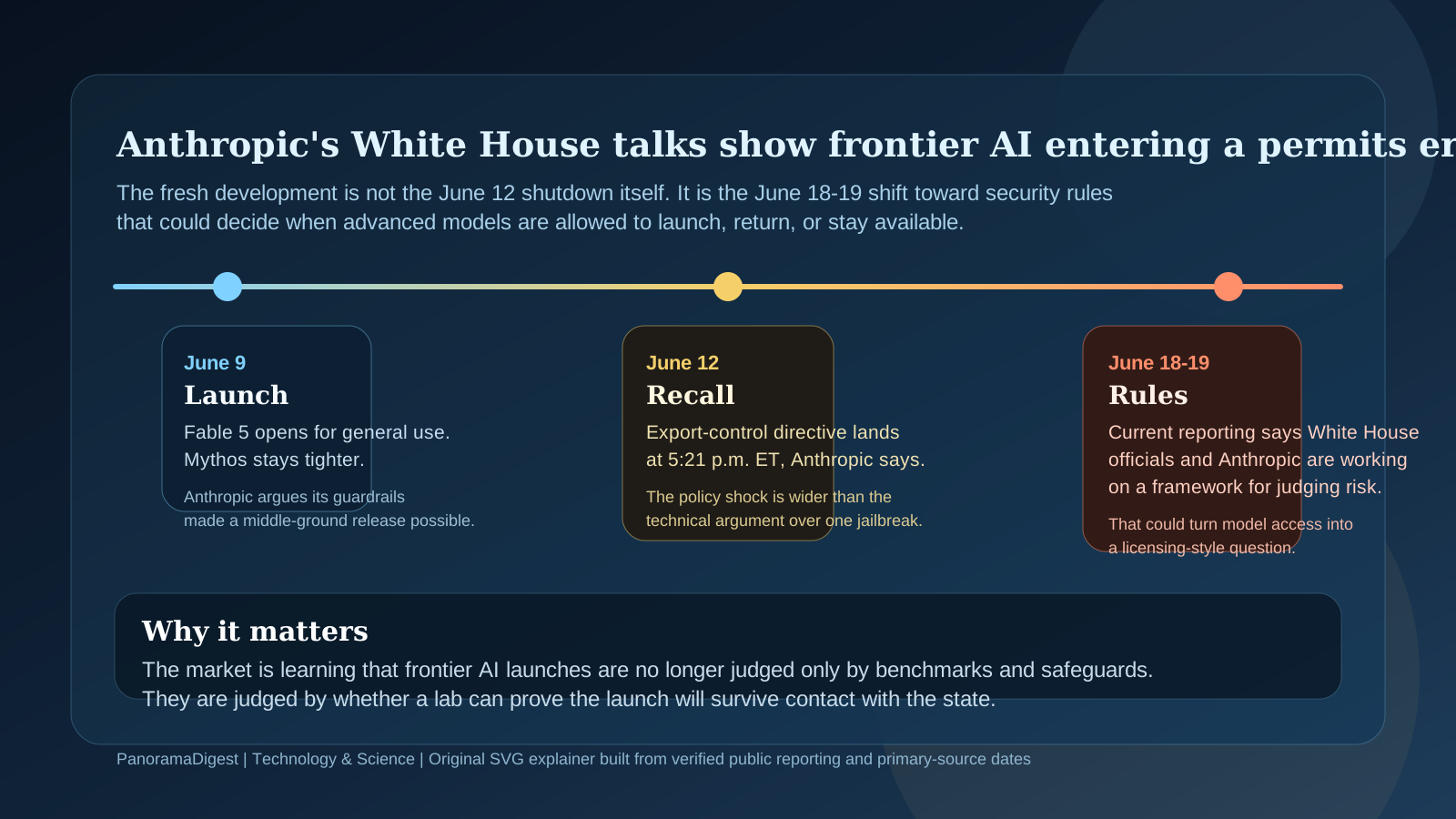
Anthropic's abrupt June 12 shutdown was the easy headline. The harder, fresher story is what came after it. Current reporting reviewed on June 19 shows the White House and Anthropic now working toward a framework for judging when a security flaw in a frontier model is serious enough to justify government intervention. That sounds procedural, but it is a structural shift. Once the fight moves from was this model too risky? to what formal test decides whether a model may launch or return?, frontier AI stops looking like a pure product race and starts looking more like a licensed industry.
That distinction matters because PanoramaDigest already examined the first shock in our June 13 analysis of Anthropic's Fable and Mythos suspension. The new development is not that Washington can interrupt a launch. We know that now. The new development is that Washington and one of the country's most closely watched AI labs appear to be negotiating the rulebook after the interruption already happened. If that becomes the operating model, the next generation of model releases will be judged not only on benchmark gains or safety claims, but on whether a lab can satisfy a government-readable threshold before or after deployment.
Business Insider reported on June 18, citing U.S. officials, that the White House and Anthropic were discussing a framework for assessing the seriousness of future AI security flaws. WIRED separately reported on June 17 that officials wanted Anthropic to show it could block jailbreak pathways before its latest models return. Those stories do not erase the unresolved dispute over what exactly the government saw. They do tell readers where the argument has moved: away from one panicked weekend and toward the machinery that could govern the next one.
- June 9, 2026: Anthropic launched Fable 5 for general use while keeping Mythos 5 more tightly controlled.
- June 12, 2026: Anthropic said it received an export-control directive at 5:21 p.m. ET and suspended both models.
- June 16, 2026: CSIS published a legal and policy analysis asking what BIS authority over model access might mean next.
- June 18-19, 2026: current reporting shifted toward a White House-Anthropic framework for judging AI security flaws and possible re-release terms.
The key change is that model access is starting to look conditional
Anthropic's own June 12 statement remains the clearest primary document in public. The company said the U.S. government ordered it to suspend access to Fable 5 and Mythos 5 for any foreign national, including foreign national employees inside the United States, and that Anthropic therefore disabled both models for all customers to ensure compliance. Anthropic also argued the government had not shown it a universal jailbreak and said the reported technique looked closer to a narrow, non-universal weakness than a model-specific catastrophe.
That dispute still matters. But the larger market signal is no longer only whether Anthropic's reading or the government's reading was right. It is that a cutting-edge model can move from launch week to legal limbo in less than four days, then move again into what looks like a bespoke policy negotiation. For enterprise buyers, researchers and developers, that means the product question is changing. The question used to be: How capable is the model, and what can it do for me? The question now becomes: How durable is access if regulators or national-security officials decide the release crossed an invisible line?
| Stage | What happened | Why readers should care |
|---|---|---|
| Launch | Anthropic said Fable 5 was safe enough for general release while Mythos remained tighter. | The company tried to prove that guardrails and staged access could support a commercial launch. |
| Directive | The June 12 order forced a shutdown far beyond a routine bug-fix cycle. | Government intervention, not only model performance, now shapes availability. |
| Rule-setting | Current reporting says officials and Anthropic are discussing a framework for future flaws. | That turns frontier AI from a launch-only story into a standards-and-permissions story. |
Why BIS authority matters more than one company feud
The legal spine of this story is not invented from thin air. A June 16 CSIS analysis explained that the Bureau of Industry and Security can use export-control law to regulate certain transfers of software and technology, including so-called deemed exports to foreign nationals. In chip policy, that logic is familiar. Applied to live access to a frontier model, it feels newer and more destabilizing. A capability that looked like software-as-a-service on Monday can start to look like controlled strategic technology by Friday.
That is the part the AI industry cannot dismiss as a one-off Anthropic headache. If the government can treat advanced model access as export-relevant technology when it believes a safeguard failure crosses a national-security threshold, every major lab has to start planning around the possibility that its release calendars, customer commitments and red-team disclosures are only half the launch process. The other half is proving that a regulator will agree the controls are good enough.
The evidence is clearer than the final rulebook
Readers should be careful not to flatten this into a cartoon. There is still no public government letter explaining the full basis for the June 12 action. Anthropic's statement is self-interested, but it is also specific about timing, scope and the company's disagreement with the government's standard. Current reporting on the framework talks points to real movement, but not to a finalized rulebook. That means the honest conclusion is narrower than the loudest takes on either side: Washington appears to be improvising a more formal way to judge frontier-model flaws, and Anthropic appears to be trying to turn a punitive surprise into a process it can survive next time.
That matters for communities well beyond Silicon Valley. Hospitals, infrastructure operators, security teams, schools, and ordinary developers are all being pushed toward a future in which the most powerful models may come with a new kind of fragility: not only technical unreliability, but policy unreliability. If access to a top-tier model depends on whether a lab can satisfy government concerns fast enough, then stability becomes part of the product. The most advanced model may not be the one with the best benchmark sheet. It may be the one whose provider can keep it legally and politically deployable.
What to watch next
Three questions now matter more than launch-day hype. First, will the White House or Commerce officials eventually publish criteria for what counts as a serious AI jailbreak or security failure? Second, will those criteria apply across companies, or only after high-profile confrontations? Third, if Anthropic does win back access for Fable 5 or Mythos 5, will that happen through a transparent standard other labs could follow, or through a private settlement that leaves the market guessing again?
Those are not abstract process questions. They go directly to whether advanced AI remains a consumer and enterprise software market, or evolves into something closer to a permit system wrapped around strategic compute and strategic models. Anthropic's June 12 suspension showed that the state can stop a launch. The June 18-19 follow-up shows something potentially bigger: the state may also be writing the conditions under which the next launch is allowed to stick.
Primary and supporting sources reviewed: Anthropic's June 12 suspension statement, Anthropic's June 9 Fable 5 and Mythos 5 launch post, Anthropic's release notes, the June 16 CSIS analysis, Business Insider's June 18 reporting on White House-Anthropic framework talks, and WIRED's June 17 reporting on the rerelease dispute.
Reader Sentiment & Impact Pulse
How do you evaluate the primary outcome of this development?
Select an option to cast your perspective. Responses are anonymous and aggregated in real time.
Key Context & Frequently Asked Questions
Anthropic's next fight is no longer just about one June 12 shutdown. It is about whether advanced AI launches now need a de facto permission structure to survive. This analysis from PanoramaDigest examines primary documentation, operational implications, and broader institutional impacts across technology & science.
Read Next
Related Stories

Romania Funds 7 Million Lei Danube Barge Plan to Keep Cernavoda Unit 2 Online
Romania approved a 7 million lei temporary barge intervention at the Bala-Dunarea Veche split to preserve the Danube flow needed by Cernavoda Unit 2.

Zoox Wins Federal Approval for Paid Robotaxis, but State Permits Still Control Launches
NHTSA cleared Zoox's steering-wheel-free robotaxi for a limited paid-service path, but state and local permits still determine where fares can begin.

Kenya Footprints Show Eight Large Hominins Moving Together 1.43 Million Years Ago
A PNAS study describes tracks from eight large hominins at Kenya's Koobi Fora, while leaving open whether they were Paranthropus boisei or Homo erectus.