Yoon's 30-Year Drone Sentence Recasts South Korea's Martial-Law Crisis as a Border-Security Failure
A Seoul court's June 12, 2026 sentence of former president Yoon Suk Yeol over drone flights into North Korea matters less as one more punishment than as an official finding that state security tools were bent toward domestic political theater.
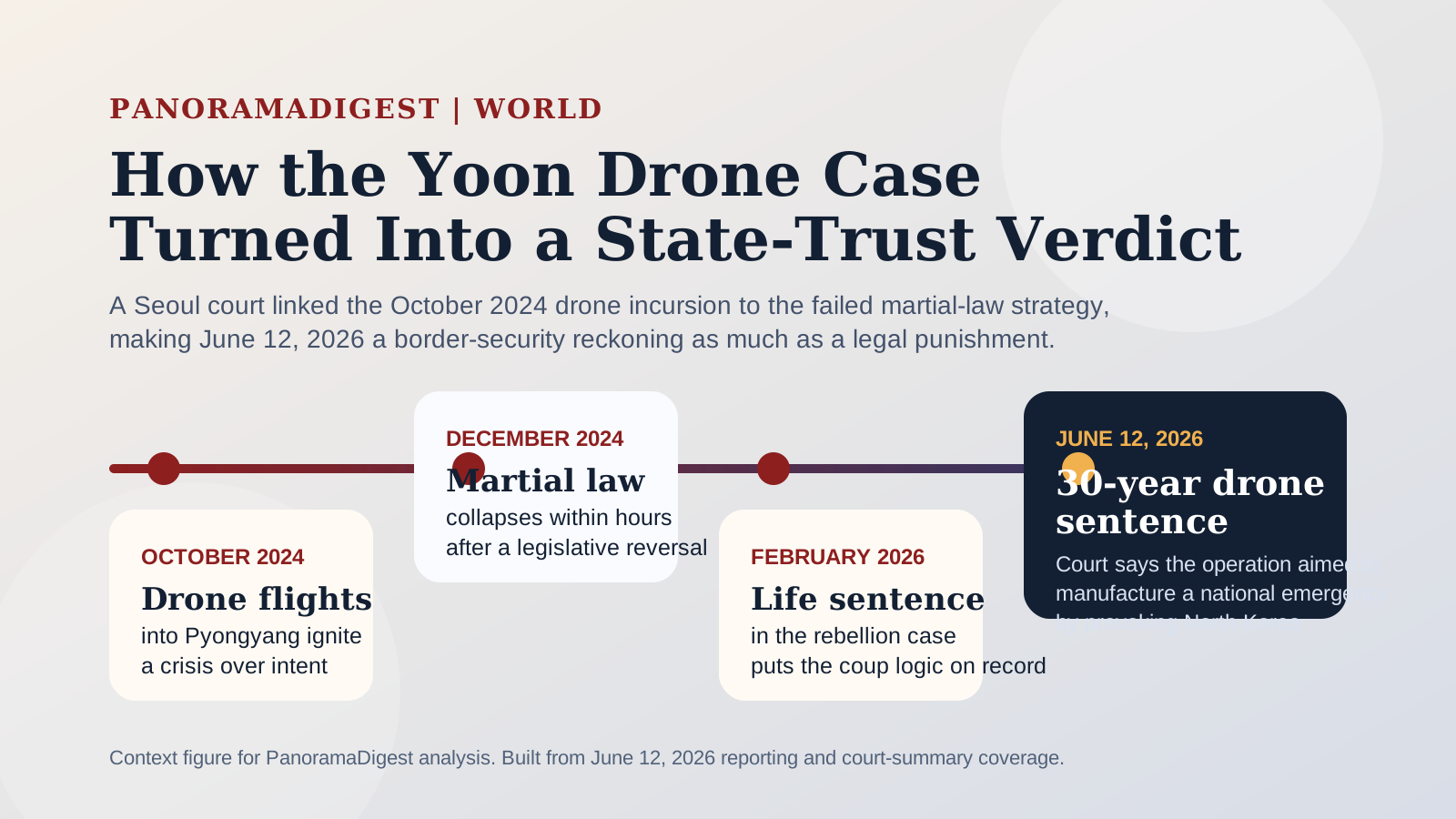
Former South Korean president Yoon Suk Yeol received another 30-year prison sentence on June 12, 2026, but the number is not the most important part of Friday's ruling. The real signal is that the Seoul Central District Court, as summarized by the Associated Press, treated the drone flights over Pyongyang not as a rogue tactical gambit but as a deliberate effort to manufacture a national emergency ahead of Yoon's failed martial-law declaration in December 2024. That changes the story from one more scandal in a disgraced presidency into something heavier: a judgment that border security itself was repurposed for domestic power politics.
Yonhap's local reporting put the sentence into South Korea's own political sequence. Yoon was already serving a life term in the rebellion case tied to the December 2024 martial-law attempt. Friday's ruling added a separate conviction for the October 2024 drone infiltrations, with the court saying the operation was designed to provoke North Korea and help create conditions for extraordinary rule at home. NK News, which follows North Korea and inter-Korean security closely, reported that the judges described the plan as a private scheme that endangered both civilians and the military by exposing operational capabilities and increasing the chance of retaliation.
Why the drone case is more consequential than the prison term alone
South Korea has jailed former presidents before. That history, by itself, can make any new sentence look like another chapter in an already familiar cycle of elite accountability. This case is sharper than that. The court's finding, reflected across AP, Yonhap and follow-up international coverage, is that a commander in chief may have tried to script a foreign-policy crisis in order to widen his freedom of action at home. Al Jazeera's dispatch, citing AFP and Reuters, underscored the same tension: prosecutors said the drone operation was meant to create a pretext for Yoon's disastrous martial-law move, while Yoon's lawyers argued the missions were a defensible answer to North Korean balloon provocations. The distinction matters because one version describes deterrence. The other describes political stagecraft with military tools.
That is why this ruling lands beyond court reporting. If the state can no longer assume that escalatory tools were used for state purposes, every future government inherits a trust problem. The military has to reassure the public that command decisions are operational, not theatrical. Civilian leaders have to prove that emergency claims are real, not manufactured. And South Korea's allies have to recalibrate what they think they know about the decision chain inside one of Asia's most important security partnerships.
A timeline that clarifies what changed
| Date | Verified development | Why it matters now |
|---|---|---|
| October 2024 | Military drones crossed into North Korea, triggering accusations from Pyongyang and a public dispute over responsibility. | The court now treats that episode as part of an intentional political plan, not just a border incident. |
| December 2024 | Yoon briefly imposed martial law before lawmakers reversed it within hours. | The failed power grab became the lens through which earlier security decisions are now being reinterpreted. |
| February 2026 | Yoon received a life sentence in the rebellion case. | That punishment established the domestic constitutional stakes but did not yet settle the drone operation's separate legal meaning. |
| June 12, 2026 | The Seoul Central District Court sentenced Yoon and former defense minister Kim Yong Hyun to 30 years in the drone case. | The ruling formally connects the border operation to the failed martial-law strategy and widens the institutional damage. |
What the court appears to have settled, and what still is not settled
One thing is clearer after Friday. The court accepted the prosecution's basic theory that the flights were meant to provoke North Korea into a response severe enough to help justify emergency rule. AP's account said judges concluded the plan harmed South Korea's military interests by revealing capabilities, reducing future room for maneuver and prompting the North to strengthen its own posture. That finding is more consequential than another headline about prison years because it turns the damage assessment outward as well as inward.
What remains unsettled is the political afterlife. Yoon is appealing. His lawyers are still arguing that a guilty finding punishes legitimate deterrence and weakens national security. The government that replaced him now faces the opposite challenge: proving that accountability will make crisis decision-making stronger, not slower. Yonhap's later report on the unification ministry response suggested Seoul wants to frame the verdict as part of a broader recommitment to stability and peace on the peninsula. That is the right instinct, but it will not be enough on its own. Institutions lose credibility faster than they regain it.
What readers should watch next
The next important measure is not whether another sentence is added to Yoon's legal ledger. It is whether South Korea can restore confidence in the chain between intelligence, military action and civilian authorization. Watch for three things: how appellate courts treat the drone-case reasoning, whether the current administration rewrites oversight around covert or deniable cross-border operations, and whether North Korea's propaganda or military signaling changes now that a South Korean court has publicly characterized the 2024 flights as manufactured escalation.
Friday's verdict does not just close one legal file. It warns that the line between deterrence and political theater can break at the exact place a democracy most needs discipline. That is why the drone sentence matters. It tells South Korea, and its allies, that the martial-law crisis was not only a constitutional shock in Seoul. It may also have begun as a border-security failure one step earlier.
Reader Sentiment & Impact Pulse
How do you evaluate the primary outcome of this development?
Select an option to cast your perspective. Responses are anonymous and aggregated in real time.
Key Context & Frequently Asked Questions
A Seoul court's June 12, 2026 sentence of former president Yoon Suk Yeol over drone flights into North Korea matters less as one more punishment than as an official finding that state security tools were bent toward domestic political theater. This analysis from PanoramaDigest examines primary documentation, operational implications, and broader institutional impacts across world.
Read Next
Related Stories

Saudi Arabia Alleges Houthi Drone Attack Targeting Mecca, Escalating Regional Tensions
Riyadh has accused the Iran-backed Houthi movement of launching an aerial drone targeting the holy city of Mecca, a charge the militant group has vehemently denied. The incident threatens to derail fragile diplomatic efforts across the Middle East.
U.S. Energy Chief Signals Rapid Restart for Key Saudi Arabian Oil Pipeline
U.S. energy officials indicate that a major Saudi Arabian oil transport pipeline will resume full operations within days, calming global crude markets after brief infrastructure concerns.

Denmark's 11-Month Military Service Starts With 1,600 Volunteers Across 14 Bases
Denmark's first full 11-month military-service cohort includes about 1,600 volunteers at 14 sites. Equal conscription applies if volunteers fall short.