Ebola Reached a Congo Displacement Camp. That Is When Disease Control Starts Looking Like Shelter Policy.
Two Ebola-related deaths reported at Kpangba's displacement site in eastern Congo changed the outbreak's center of gravity. Once the virus reaches a crowded camp, containment stops being only a clinical question and becomes a test of shelter space, trust, and movement control.
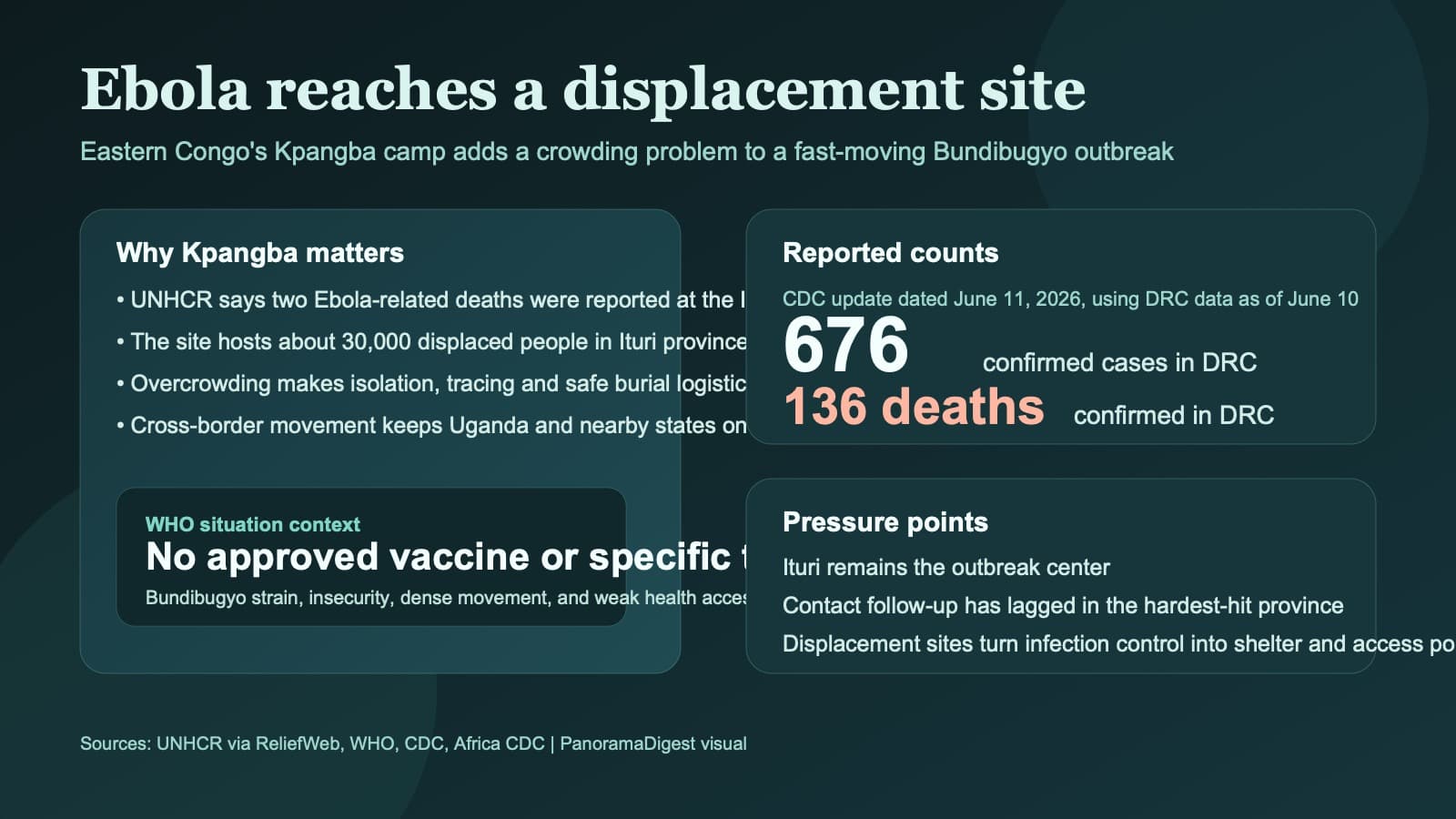
Two Ebola-related deaths reported at the Kpangba displacement site in eastern Democratic Republic of the Congo have changed the story's pressure point. The newest official humanitarian signal is not simply that the Bundibugyo outbreak is still spreading. It is that the virus has now reached a place built around crowding, interrupted healthcare and constant movement. According to UNHCR's preparedness and response appeal published via ReliefWeb, two Ebola-related deaths have been reported at Kpangba in Ituri Province, and transmission risk remains high across eastern Congo.
Africa CDC — Live:Special Briefing on Ebola Outbreak Response || June 11, 2026
Africa CDC's official June 11 briefing gives regional context for the DRC and Uganda outbreak response. If the player does not load, use the direct YouTube link.
That matters because camps do not absorb outbreaks the way ordinary neighborhoods do. Isolation space is thinner. Water, sanitation and routine care are already under strain. People move in and out for food, safety and family reasons. By the time a humanitarian report is naming deaths inside a site that UNHCR says hosts roughly 30,000 internally displaced people, the challenge is no longer only whether clinicians can identify cases fast enough. It is whether the wider system can create enough physical and social room for containment to work.
The broader outbreak is already large. CDC's June 11 update, using Democratic Republic of the Congo data as of June 10, lists 676 confirmed cases and 136 confirmed deaths in the DRC, alongside 19 confirmed cases and two confirmed deaths in Uganda. WHO's outbreak page says the Bundibugyo strain has no approved vaccine or specific treatment and is unfolding in a setting shaped by humanitarian crisis, insecurity and heavy population movement. Those are exactly the conditions that make a displacement site more than a tragic footnote. They make it a multiplier.
| Pressure point | What changes in a displacement site | Why readers should care |
|---|---|---|
| Isolation | Families often share tight shelter space, making home separation unrealistic. | Even a small number of infections can produce more close contacts than a better-housed community would. |
| Tracing | Residents and recent arrivals move for aid, safety and reunification. | Contact lists go stale faster, which slows the response exactly when speed matters most. |
| Trust | Conflict, rumor and institutional fatigue already weaken public-health messaging. | People who fear the system tend to present later, when they are sicker and have exposed more others. |
| Regional spillover | Eastern Congo's routes connect camps, towns and cross-border corridors. | Uganda and neighboring states are not watching a local problem. They are watching a mobility problem. |
The camp is not the whole outbreak. It is the clearest warning about what kind of outbreak this has become.
WHO's June 8 disease-outbreak notice already showed how fast the emergency was moving before Kpangba entered the picture. As of June 6, WHO reported 515 confirmed cases and 91 confirmed deaths in the DRC, with Ituri accounting for the overwhelming majority of confirmed cases. It also said more than 5,000 contacts had been identified, but follow-up in Ituri lagged badly behind the rates reported in North Kivu and South Kivu. That dated count is lower than CDC's more recent totals, but the operational lesson is the same: this outbreak has been outrunning smooth surveillance for days.
Once you add a displacement site, the arithmetic gets harsher. Kpangba is not just another dot on a map. It stands inside a region where, as the UNHCR appeal notes, more than 2 million forcibly displaced people live in areas at risk and local infrastructure has already been weakened by conflict. That means Ebola control is now entangled with shelter density, clinic access, sanitation capacity, burial logistics and whether families believe reporting symptoms will help them rather than isolate them from food or movement.
This is also why the official reassurance has to be read carefully.
For U.S. readers, CDC says the overall risk to the American public remains low, and that is a real and useful distinction. Low domestic risk is not the same thing as a contained outbreak in central Africa. It means the danger is being managed at distance through travel measures, screening and public-health coordination. Inside eastern Congo, the relevant question is different: whether authorities and aid groups can keep the outbreak from embedding itself more deeply in places where people are already living one disruption away from another.
Africa CDC's latest public briefing, published on June 11, made that regional framing explicit. The agency has been discussing the Congo and Uganda outbreaks together because the problem is not bounded by one clinic or one province. PanoramaDigest's earlier analysis of the continental response plan argued that the central issue was logistics rather than alarmism. Kpangba sharpens that point. Logistics now includes whether an overstretched site can support infection control without collapsing the routines displaced people depend on to survive.
What to watch next
Three things matter from here. First, whether health authorities report additional cases linked to Kpangba or nearby sites. Second, whether aid groups can expand water, sanitation, screening and isolation capacity fast enough to keep camp transmission from compounding. Third, whether public communication stays credible in a region where rumor and violence have already made the outbreak harder to measure cleanly.
This is why the Kpangba development deserves more attention than a standard outbreak update. A virus reaching a displacement site is not just another data point on the upward curve. It is the moment when public health has to borrow its success from housing, humanitarian access and social trust. If those supports fail, case counts become the aftermath rather than the warning.
Watch the briefing: If the embedded Africa CDC player below does not load, use the direct link at youtube.com/watch?v=f7_MV__2HxI.
Read Next
Related Stories
Africa CDC-WHO Ebola Response Plan: Funding and Delivery Priorities
The new Africa CDC-WHO response plan matters not because it makes the outbreak sound bigger, but because it admits the fight has become a race over staffing, trust, border controls and clinical capacity.
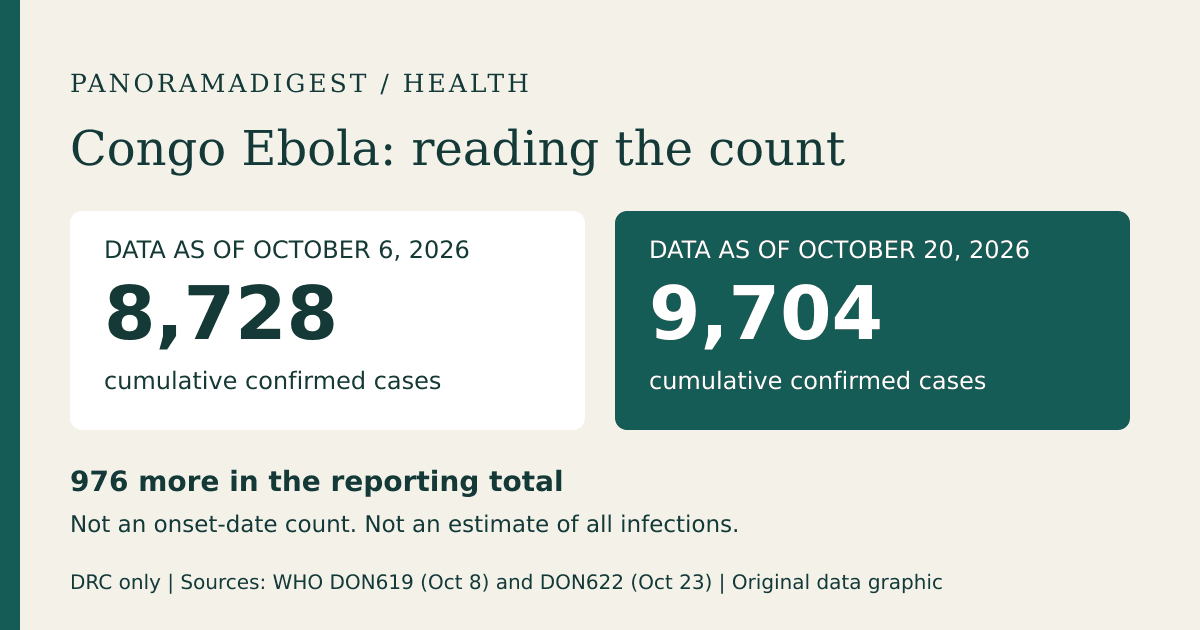
Congo Ebola Case Counts: Confirmed Totals and Hidden Infections
Compare WHO's dated Congo Ebola totals, understand reporting delays and see why July's two-to-four-times estimate cannot be applied to October counts.
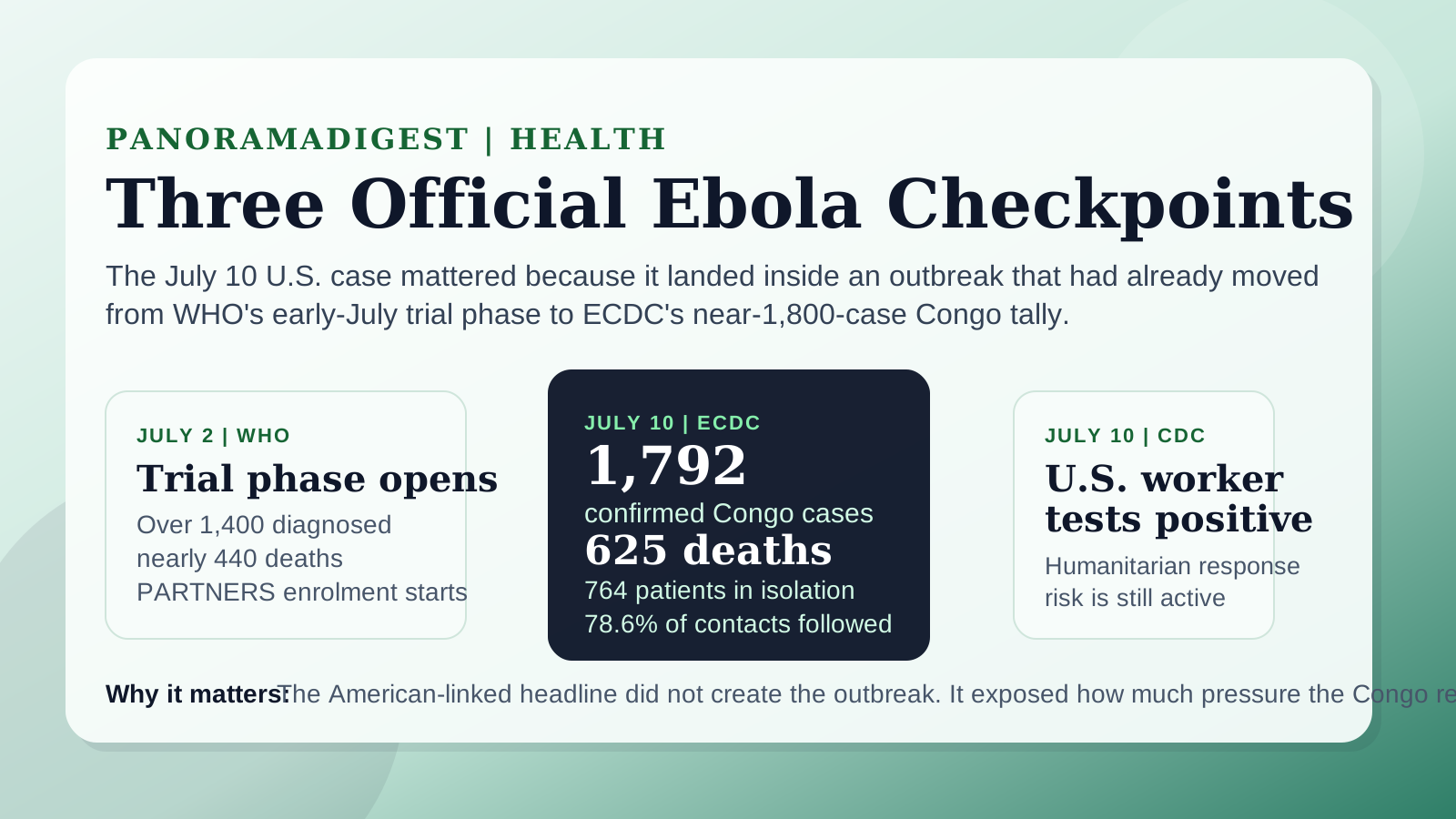
U.S. Citizen Tests Positive for Ebola in Congo as the Outbreak Nears 1,800 Confirmed Cases
CDC said on July 10 that a U.S. humanitarian worker in Congo tested positive for Bundibugyo Ebola. The more important signal is that official European and WHO updates show an outbreak still widening across eastern Congo even as Uganda's case line stays flat.