U.S. Citizen Tests Positive for Ebola in Congo as the Outbreak Nears 1,800 Confirmed Cases
CDC said on July 10 that a U.S. humanitarian worker in Congo tested positive for Bundibugyo Ebola. The more important signal is that official European and WHO updates show an outbreak still widening across eastern Congo even as Uganda's case line stays flat.
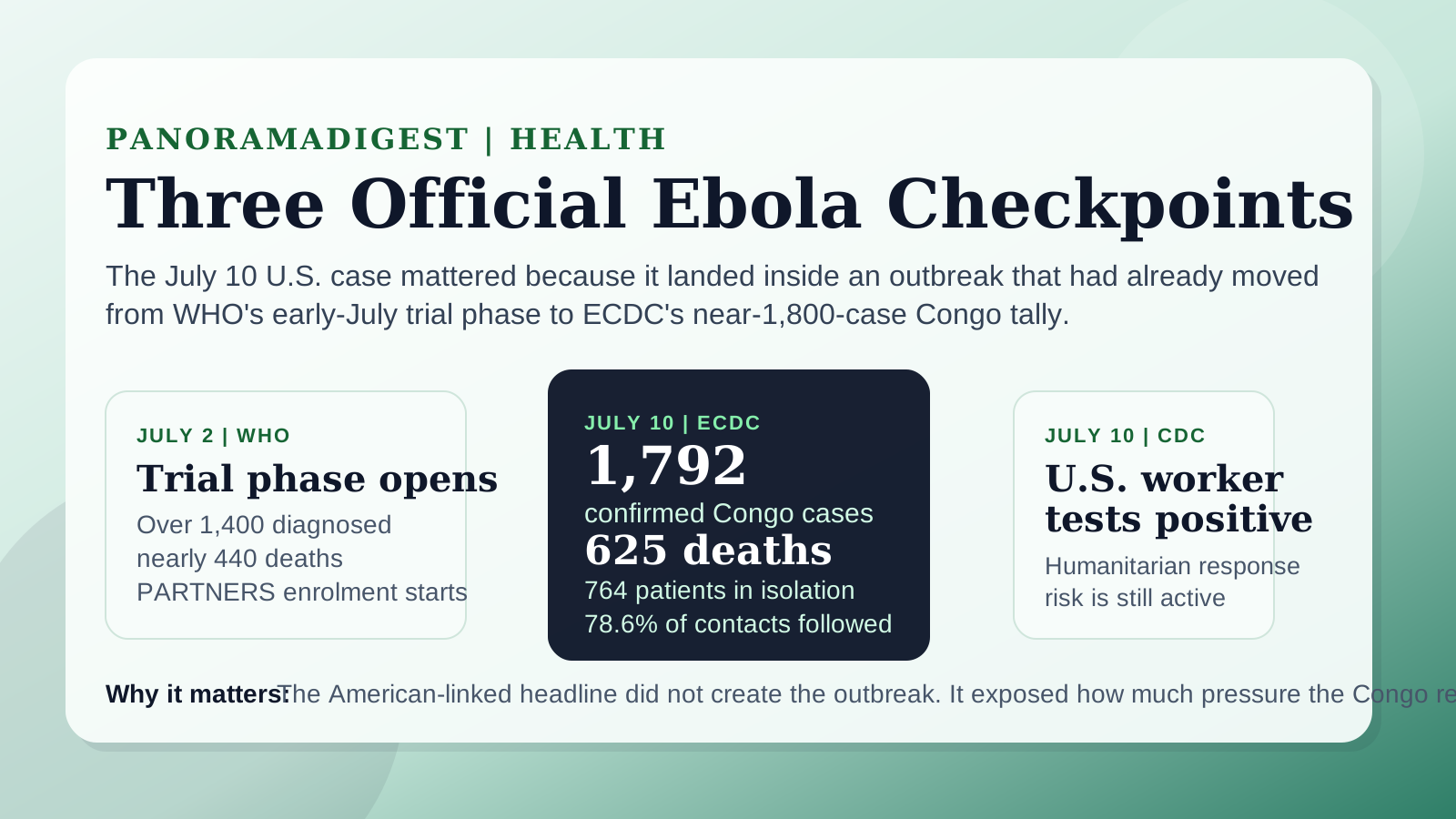
CDC said on Friday, July 10, 2026, that a U.S. citizen working for a humanitarian organization in the Democratic Republic of the Congo had tested positive for Bundibugyo virus, a type of Ebola. The agency said it was supporting contact tracing and risk assessments with the employer, other U.S. agencies, Congolese authorities and partners on the ground. That is the headline readers will search. The harder read is that the American case arrived inside an outbreak that ECDC said on July 10 had already reached 1,792 confirmed cases and 625 related deaths in Congo, based on data reported through July 8, with 764 patients hospitalized in isolation.
Africa CDC — Special Briefing on Ebola Outbreak Response | July 9, 2026
Africa CDC's July 9 briefing is the clearest current official video summary of the Bundibugyo Ebola response. If the player does not load, use the direct YouTube link in the story.
The useful distinction is between an American-linked headline and an American public-health turning point. This new case is important because it shows how exposed the response workforce still is in eastern Congo. It is not, by itself, evidence of community spread in the United States. ECDC's July 10 update said Uganda still had no new confirmed case after June 21, and the same update described the outbreak's center of gravity as eastern Congo, especially Ituri province. The story is still local containment under stress, not foreign panic dressed up as epidemiology.
What officials have confirmed, and when they confirmed it
The date trail matters because the official numbers are moving fast enough to create confusion if readers blend them together. WHO said on July 2 that more than 1,400 people had already been diagnosed with Bundibugyo virus disease in Congo, with nearly 440 deaths and nearly 210 recoveries, as patient enrolment began in the PARTNERS treatment trial. By July 10, ECDC's public update had pushed Congo's official total to 1,792 confirmed cases and 625 related deaths, while noting that 78.6% of identified contacts in Ituri and North Kivu were under follow-up. On the same day, CDC added the new U.S.-citizen case to the public record. Those are not contradictory snapshots. They are three dated checkpoints in an outbreak that is still expanding.
| Date and source | What was confirmed | Why it matters |
|---|---|---|
| July 2, WHO | More than 1,400 diagnosed in Congo, nearly 440 deaths, nearly 210 recoveries; the PARTNERS treatment trial opened enrolment. | The outbreak was already large enough that supportive care alone was no longer the whole plan. |
| July 10, ECDC citing DRC data through July 8 | 1,792 confirmed cases, 625 related deaths, 764 patients hospitalized in isolation, and 78.6% of identified contacts under follow-up. | The official Congo total kept rising sharply even before the new U.S.-citizen case became public. |
| July 10, CDC | A U.S. humanitarian worker in Congo tested positive for Bundibugyo Ebola. | The infection risk is still reaching people embedded in the response, not only patients in the surrounding communities. |
Why this case strengthens, rather than replaces, the existing Ebola lane
PanoramaDigest has already tracked this outbreak as a systems story, not just a daily body-count story. Our June 19 analysis of WHO's new Ebola count and the response clock argued that speed, backlog and local trust were starting to matter as much as the raw totals. Our June 17 piece on the G7's Ebola speed test framed the outbreak as a broader international readiness problem, not a remote-only emergency. And our earlier reporting on why trust acts like clinical infrastructure in Congo's Ebola fight remains relevant because official response capacity still depends on whether communities cooperate before contacts disappear from view. The new U.S.-citizen case does not supersede that lane. It sharpens it.
That is also why the July 10 story is stronger as a health-systems update than as a nationality hook. A foreign passport does not make the biology more dangerous. What it changes is visibility. Readers who ignored a July 2 WHO treatment-trial notice may pay attention when CDC confirms that an American humanitarian worker is infected. The editorial job is to use that visibility well: bring readers back to the outbreak's actual mechanics instead of letting the story collapse into one imported-case frame.
The limiting factor is still the Bundibugyo toolkit
WHO's outbreak overview says the Bundibugyo species involved in this event still has no vaccine or specific treatment approved for use, even as promising candidates are being tested. A CDC risk assessment published in June put the point even more bluntly: no approved vaccines or medications are currently available for BVD, and supportive care remains the core intervention. That is why the WHO-backed PARTNERS trial matters. It is evaluating MBP134 and remdesivir, alone and in combination, during the outbreak rather than after it. But until that research delivers a clear answer, outbreak control still depends on the old fundamentals: early detection, isolation, contact tracing, safe care, and enough community trust for people to present before they are at their sickest.
WHO's overview also says the outbreak is unfolding in a challenging humanitarian and security setting, with high population movement and insecurity complicating the response. ECDC's July 10 page shows how that pressure looks in operational terms: cases remain concentrated in Ituri, but North Kivu is still adding infections and investigations are still active around Kisangani in neighboring Tshopo province. In other words, this is not a closed map with one tragic hotspot. It is a shifting response zone whose boundaries keep needing to be redrawn.
- May 15: Congo and Uganda declared Bundibugyo Ebola outbreaks, formally naming a crisis that had already been transmitting for weeks.
- July 2: WHO announced the start of the PARTNERS treatment trial because the case load had already passed 1,400 in Congo.
- July 10: ECDC's public update put Congo at 1,792 confirmed cases and 625 related deaths based on data through July 8.
- July 10: CDC confirmed that a U.S. humanitarian worker in Congo had tested positive, making the workforce-exposure risk newly visible to American readers.
What to watch next
The next meaningful signals are practical, not theatrical. First, do Congo's official totals keep climbing at the same pace once the next dated update arrives? Second, does Uganda continue to hold its line after June 21 without a new confirmed case? Third, does the contact-follow-up rate improve beyond the 78.6% that ECDC reported, or does the response keep losing too many people between exposure and monitoring? Fourth, do the first treatment-trial results show enough promise to change care on the ground before the outbreak spreads into more densely connected areas?
That is why the July 10 CDC statement should be read carefully rather than loudly. A U.S. citizen's infection is real news. It is also a reminder that the outbreak's core problem is still in Congo, where the virus keeps testing whether local systems, international support and community cooperation can outrun it. Readers who want the broadest official context can also explore PanoramaDigest's Ebola topic hub, which now reads less like an archive and more like a continuing accountability file.
Watch the current official briefing: Africa CDC's Special Briefing on Ebola Outbreak Response | July 9, 2026 is the cleanest current public video source for the regional response picture. If the embedded player below does not load in your browser or region, use that direct YouTube link instead.
Read Next
Related Stories
2026-27 Flu Vaccine Match: Why Lab Results Are Not an Effectiveness Rate
Early CDC testing finds encouraging recognition of sampled flu viruses. The denominators explain why those results cannot tell you a vaccine's real-world protection rate.
WHO Pregnancy-Hypertension Roadmap: Priorities Through 2035
WHO’s October 8 roadmap connects pregnancy-hypertension research, clinical standards and access to care. Here is what its figures and five priorities actually measure.

UK Sugar Rationing Study Links the First 1,000 Days to Lower Dementia Risk
A UK Biobank natural experiment linked sugar rationing during the first 1,000 days to lower later-life risks of dementia, Alzheimer's disease, depression and anxiety, but it does not prove causation.