The Nara Formula Recall Turned a Boutique Safety Pitch Into a Federal Trust Test
Nara Organics' nationwide recall after three infant botulism cases did not threaten U.S. formula supply, but it did show how quickly a premium trust story can collapse once CDC and FDA warnings replace marketing language.
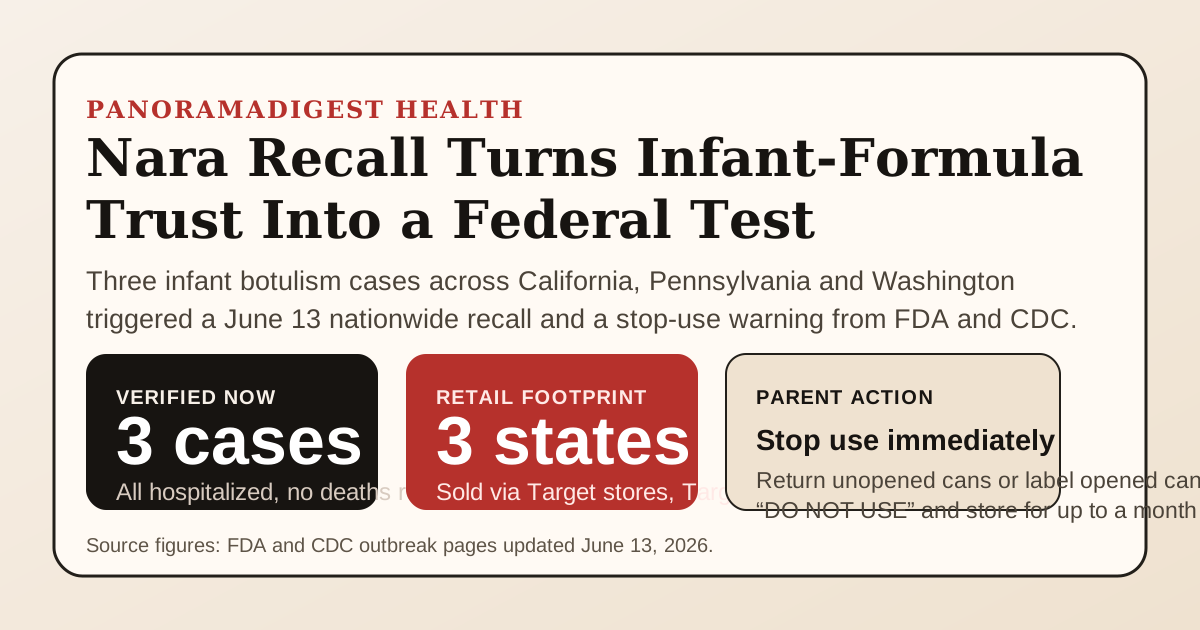
The Nara Organics recall is not a shortage story. It is a trust story, and that distinction matters for parents trying to decide what to do tonight. Federal officials say three infants in California, Pennsylvania and Washington became ill between April and May 2026 after consuming Nara Organics Whole Milk Organic Infant Formula, prompting an ongoing FDA outbreak investigation and a matching CDC food safety alert. All three infants were hospitalized. No deaths have been reported. That is the verified core.
WAVY TV 10 — CDC issues warning after infant Botulism linked to powdered formula
WAVY TV 10 recaps the CDC and FDA warning tied to the Nara Organics recall. If the player fails, use the direct YouTube link.
What changed the story from a niche premium-brand problem into a broader public-health test is how quickly the institutional chain moved once the epidemiological signal became clear. FDA says it contacted the company on June 12, 2026, and recommended a recall because of the severity of illness and the pattern in the cases. On June 13, 2026, Nara agreed to recall all of its infant formula currently in the U.S. market. On its own recall page, the company says no Nara formula has yet tested positive for C. botulinum and frames the move as a precautionary response. That is exactly why this episode deserves careful reading. A recall based on epidemiological evidence is not softer than a recall based on a contaminated lab sample. In infant feeding, it is often the more urgent category, because waiting for cleaner proof can mean waiting through preventable harm.
| Question | What officials say now | What remains open |
|---|---|---|
| How many illnesses are in the outbreak? | FDA and CDC say three infants across three states were identified and all were hospitalized. | Testing of leftover formula collected in two states is still underway. |
| What product is affected? | CDC says all Nara Organics Whole Milk Organic Infant Formula currently in the U.S. market is recalled. | The company says no product sample has yet tested positive, so the precise contamination pathway is not established. |
| Does this create a formula shortage? | CDC and FDA both say no. The brand accounts for less than 1% of U.S. infant formula availability. | Parents may still face short-term disruption if they relied on the product and need a clinician-guided substitute quickly. |
| What should families do with opened cans? | CDC says to label them "DO NOT USE," store them safely away from other feeding items, and keep them for up to a month in case testing is needed. | Symptoms can take weeks to appear, so families may need to monitor longer than they expect. |
The bigger damage lands where premium infant brands make their promises
Nara did not become noteworthy by selling volume. It sold reassurance: European manufacturing, cleaner labeling, direct-to-parent trust and the implied promise that a premium formula can feel more controlled than the mainstream aisle. That pitch is not unique to Nara, but the recall shows how fragile it becomes once public-health agencies intervene. Parents do not hear "precautionary recall" the way companies write it. They hear that the confidence premium they paid for may not protect them from the oldest problem in food safety: uncertainty arriving after a product is already in the home.
That is why the most useful federal line in this story may be the least dramatic one. CDC says the recall should not create shortages because Nara makes up less than 1% of infant formula available in the United States. In other words, the system-level supply risk is limited even if the family-level confidence shock is real. That helps parents separate two questions that tend to blur in recall coverage: "Is this dangerous enough to stop using immediately?" yes, according to federal guidance; and "Does this mean the formula market is about to seize up again?" no, according to the same agencies.
The hard part is that "precautionary" can sound optional when it is not
Families are used to recalls that read like legal cleanup. This one should be read as operational instruction. Botulism in infants is rare, but that rarity is exactly why a soft response is a mistake. The Associated Press reported that the affected infants were between 2 and 5 months old and were treated with BabyBIG, the approved therapy for infant botulism. That is not a profile that leaves much room for wait-and-see behavior.
The broader lesson is not that boutique formula brands are uniquely unsafe. It is that infant-feeding trust is only as strong as the surveillance and recall culture surrounding it. When a company says no sample has yet tested positive, parents should hear that as one part of the record, not the all-clear. When FDA and CDC say stop use now, families should treat that as the controlling instruction while testing catches up. That is the practical hierarchy that matters in a nursery: regulators first, marketing second, wishful interpretation last.
Watch the local-news recap: If the video player below does not load, use the direct link at youtube.com/watch?v=1vzzYnZ6SCU.
Read Next
Related Stories

UK Sugar Rationing Study Links the First 1,000 Days to Lower Dementia Risk
A UK Biobank natural experiment linked sugar rationing during the first 1,000 days to lower later-life risks of dementia, Alzheimer's disease, depression and anxiety, but it does not prove causation.

CDC Atlanta Study Finds 45% 90-Day Mortality in Invasive Mold Disease
CDC surveillance identified 449 invasive mold disease cases at four Atlanta hospitals, with 45% 90-day all-cause mortality in the evaluable group.

Uganda Declares Itself Ebola-Free Before WHO's 42-Day Countdown Ends
Uganda says its 2026 Ebola outbreak is over, but WHO's public timeline starts the formal 42-day countdown later and runs into late August.