Trump's Name Came Off the Kennedy Center. The Harder Problem Is What the Venue Looks Like Next.
Workers removed Donald Trump's name from the Kennedy Center on June 13, 2026 after courts refused to pause the order. That settles the lettering question, but not the larger credibility crisis hanging over one of Washington's signature cultural venues.

By Saturday morning, June 13, 2026, the argument over whether Donald Trump's name would remain on the Kennedy Center facade had collapsed into scaffolding, tarps and a crew taking letters down one by one. CBS News reported that a court filing said the removal work was underway after the administration failed to win an immediate stay. AP's on-the-ground follow-up showed the same scene: the old branding coming off, the facade partly hidden, and the symbolic fight finally becoming physical labor.
CBS News / YouTube — Kennedy Center board tries to stop Trump's name removal
CBS News' report captures the final legal push before workers began removing Trump's name from the Kennedy Center. A direct-watch fallback link is included in the article body.
That is the fresh development. It is also the limit of the easy story. A name can come down in a night. A cultural institution does not recover its public authority that quickly. The Kennedy Center now has a harder task than legal compliance: it has to persuade artists, donors, ticket buyers and ordinary Washington audiences that it still behaves like a national arts venue rather than a stage for a chairman's personal imprint. PanoramaDigest covered the center's late appeal on June 12 in an earlier follow-up on the compliance fight. Saturday's removal moves the story forward because the court order is no longer abstract.
What is confirmed: Judge Christopher Cooper's May 29 ruling held that the board could not lawfully add Trump's name to the institution, and Friday's emergency effort to pause that order failed. CBS reported that the D.C. Circuit declined to grant an immediate stay, leaving the deadline in place even after the government argued that changing signage now could create confusion if it later prevailed on appeal. AP separately reported that the center sought a brief weather-related extension overnight, while assuring the court that removal work was already in progress.
- May 29, 2026: Judge Christopher Cooper rules that only Congress can change the center's name and orders Trump's name removed.
- June 11, 2026: The Kennedy Center board tries a late appeal to slow or pause compliance.
- June 12, 2026: The administration loses its emergency bid for an immediate stay.
- Early June 13, 2026: Workers begin taking Trump's name off the facade under tarps after storms briefly delayed the work.
The legal question is simpler than the cultural one
The statutory baseline is not especially mysterious. Federal law names the institution the John F. Kennedy Center for the Performing Arts. That was the spine of the court's reasoning, and it remains the cleanest explanation for why the signage fight ended the way it did. Once the naming authority is anchored in Congress, the board's branding argument becomes much weaker than its public rhetoric suggested.
But a court can settle naming power without settling trust. That is why the most interesting part of Saturday's development is not the exposed wall under the tarp. It is the institutional aftertaste. For months, the Kennedy Center has looked less like a stable memorial and more like a venue whose public identity could be rewritten by whoever controlled the boardroom. Culture institutions do not live on legal theory alone. They live on repeat attendance, artist confidence, donor patience and the sense that the building stands for something larger than the latest ideological contest.
What the removal resolves and what it leaves hanging
| Question | What Saturday answered | What still looks unsettled |
|---|---|---|
| Can the board keep Trump's name on the facade for now? | No. The immediate stay effort failed and the removal began. | The broader appeal is still alive, even if the physical sign is no longer the administration's strongest leverage point. |
| Does legal compliance restore institutional credibility? | Only partly. Compliance removes the most visible contradiction. | Artists, donors and audiences still need evidence that governance is no longer improvisational. |
| Is the Kennedy Center back to normal programming logic? | Not yet. AP noted that near-term events remain on the calendar. | The longer-range schedule and staffing picture still raise questions about how quickly the venue can look culturally confident again. |
Why the tarp matters more than it seems
There is a small but revealing detail in the current coverage: much of the work happened behind a tarp. That does not change the legal outcome, but it does sharpen the symbolism. A high-profile rebranding campaign was public when it went up and partially obscured when it came down. The contrast fits the broader Kennedy Center story under Trump-era control. The institution has looked bold when claiming authority and procedural when forced to retreat.
AP's earlier Friday report also captured something more important than the litigation choreography: the center had already been taking practical steps to comply, including reverting internal language and dropping Trump's name from official materials. Saturday's removal therefore does not read as a sudden conversion. It reads as the moment the public facade finally caught up to a compliance process that had already begun backstage.
That distinction matters because audiences usually forgive messy transitions faster than they forgive institutions that seem to resent their own rules. If the Kennedy Center wants to stabilize, it would be smart to treat the sign removal not as a humiliation to be outwaited, but as a chance to narrow the gap between what the place says it is and how it actually governs itself.
The next test is not the wall. It is the repertoire.
The entertainment story from here is less about whether one more filing lands on the docket and more about whether the Kennedy Center can behave like a credible programmer again. AP noted that performances such as Moulin Rouge! The Musical and Bluey's Big Play remain scheduled, while the deeper calendar still looks thinner than a healthy flagship venue would prefer. That is the point at which cultural politics turns back into cultural management. Audiences eventually judge a venue by what it stages, how reliably it stages it, and whether artists still want to be associated with it.
Trump's name coming off the building therefore closes one chapter but not the one that most affects the center's future. The bigger question is whether the Kennedy Center can recover the old advantage that made it unusual in Washington: the ability to feel nationally significant without feeling permanently enlisted. On June 13, 2026, the letters came down. The harder work is making the place look bigger than the fight that put them there.
Read Next
Related Stories
Vincent Pastore Dies at 80: The Sopranos Actor's Career Beyond Big Pussy
Vincent Pastore, who made friendship and betrayal inseparable as Big Pussy on The Sopranos, has died at 80. His manager confirmed the death to AP.

Ryan Gosling Will Play Ghost Rider in Marvel's 2028 Film Directed by Shawn Levy
Marvel confirmed Ryan Gosling as its new Ghost Rider at San Diego Comic-Con. Shawn Levy will direct the 2028 film, giving the MCU character his first standalone movie since the rights returned to Marvel.
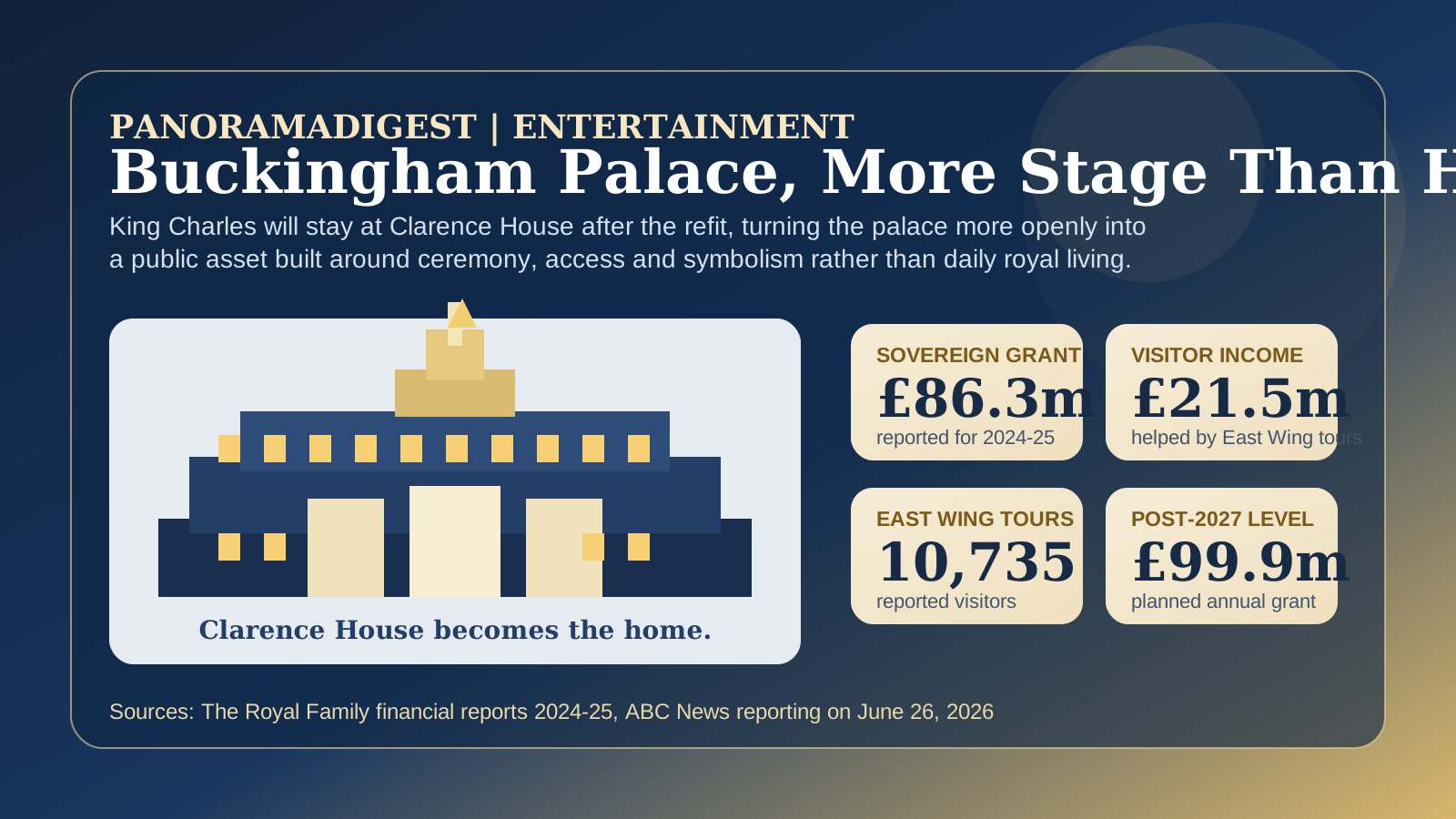
King Charles Won't Live at Buckingham Palace. That Makes the Monarchy's Biggest Symbol More Stage Than Home.
King Charles III and Queen Camilla will stay at Clarence House after Buckingham Palace's renovation. The larger cultural shift is that Britain's most famous royal address is being treated less as a private home and more as a public-facing stage set whose value must now be justified in visits, events and visible utility.